
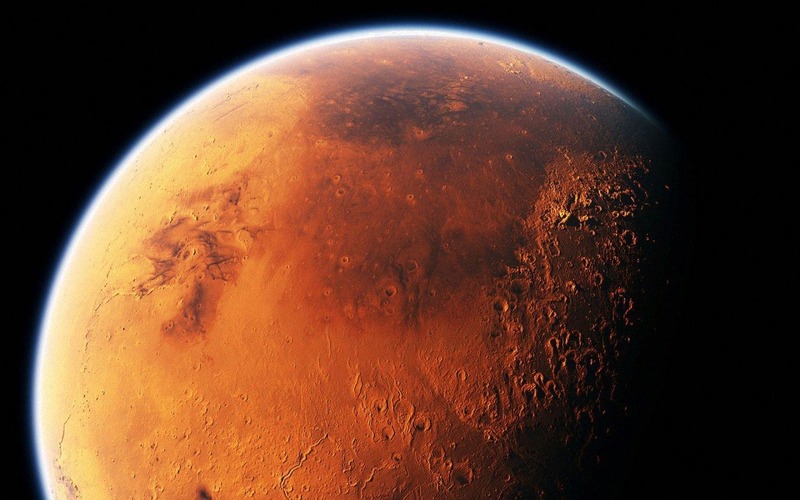
The findings suggest that Mars may have certain regions that could support living organisms, reported NDTV.
The evidence of liquid water was found by the rover on sand dunes located in low latitudes, specifically in areas closer to the equator and further away from the poles.
A report detailing these findings was published in the journal Science Advances.
The study conducted by Chinese researchers highlighted the long-standing belief among scientists that Mars once had a climate similar to Earth's and had an ocean flowing on its surface roughly three billion years ago.
However, due to significant climate changes, most of the water on the planet is thought to have frozen and become trapped in the outer layer or crust of Mars.
Until now, there had been no evidence found to support the presence of liquid water in low latitude areas on Mars.
The latest research is considered a significant breakthrough in the understanding of Mars' evolutionary history, as it provides new evidence of liquid water on the Red Planet in areas where it was previously thought to be absent.
According to the analysis of data gathered by China's Zhurong rover, scientists have noted that the rover did not detect water in the form of frost or ice directly.
Instead, the rover's observations were focused on dunes that were rich in salt, and contained cracks and crusts.
For the first time, the rover identified layers of cracks on small Martian dunes, indicating that the Red Planet was once a world with a significant amount of water and salt as recently as 400,000 years ago, as stated in the study.
"This is important for understanding the evolutionary history of the Martian climate, looking for a habitable environment, and providing key clues for the future search for life," stated lead researcher Professor Qin Xiaoguang, Chinese Academy of Sciences (CAS).
"According to the measured meteorological data by Zhurong and other Mars rovers, we inferred that these dunes surface characteristics were related to the involvement of liquid saline water formed by the subsequent melting of frost/snow falling on the salt-containing dune surfaces when cooling occurs," Mr Qin stated further.
As per the Chinese scientists, the temperature on Mars is highly variable, and it significantly rises in the mornings which causes the saltwater to evaporate, leaving behind newly formed minerals and salt.
These then seeped into the spaces between the sand grains of the dunes and cemented them together to create a crust.