
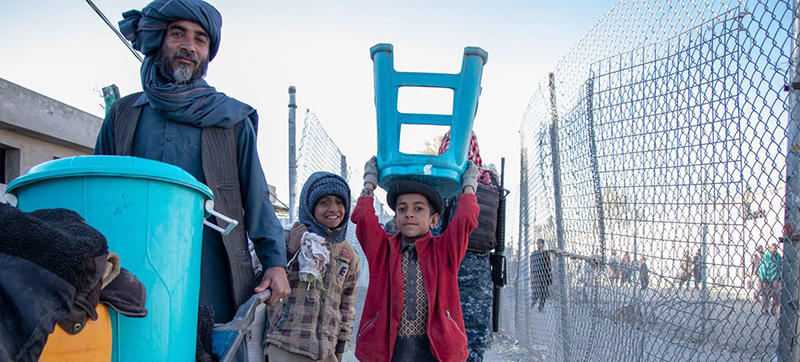
On the pretext of terrorism, the Pakistan Army is driving millions out of their homes, schools, businesses, and neighbourhoods to a country that they may never have considered home.
Millions are forced to live in tent colonies set up hastily along the borders. Living conditions are pathetic. Scores of children are separated from their parents. Women and children are forced to travel by buses, without any male relatives.
These millions had escaped to Pakistan for succour when their homes were taken over by terrorists and their masterminds. They believed in Pakistan’s forefathers who had pledged to protect and offer sanctuary for Muslims. The Afghans shared more than history and tradition with people in Pakistan. Today, Pakistan has left them orphans.
When the Afghans came to Pakistan, they were attracted by the promise of hope and shelter. They had come in waves. The first group arrived in the 1970s after the communist revolution in Afghanistan. The second group arrived during the Afghan civil war in the 1990s, driven by the conflicts among mujahideen factions. The civil war was then followed by the Taliban's brutal emirate, which led to many more refugees fleeing to Pakistan. The third and most recent group arrived in 2021 after the Taliban returned to power. This group consists of teachers, civil servants, government employees, and ethnic and religious minorities who feared the Taliban's rule.
Despite living in Pakistan for decades, these millions of refugee seekers lack proper residency permits, national identity cards, or citizenship. Their children and grandchildren, who have been born and raised in Pakistan, consider Pakistan and not Afghanistan their true home.
 Image: Pixabay
These millions have nothing to do with terrorism. It is true that terrorists attacking Pakistan are mostly Pashtuns. The only thing they share is common ethnicity. But for their crime, millions of innocents are being put through fire by a failed Pakistan Army. These men and women are equal victims of terrorism. In fact, they have suffered terrorism more than the people of Pakistan.
By forcing millions to leave their homes, Pakistan is violating its own and international laws and conventions. Pakistan is a signatory to the Universal Declaration of Human Rights, which obligates the government to protect the basic human rights of all individuals within its borders.
Pakistan’s action is inhumane. Many Afghan refugees have lived in Pakistan for decades and have built lives there. They are well-integrated into Pakistani society and would face persecution and violence if deported to Afghanistan.
Such large-scale displacement of people is economically disruptive. Afghan refugees have established businesses across Pakistan and contribute to the local economy. Mass deportations would disrupt economic stability.
This forced mass migration would further destabilise the region. Forced deportations would play into the narratives of the Afghan Taliban and TTP, which would benefit from increased instability in Pakistan.
In addition to these general concerns, there are several specific reasons why forced deportation would be particularly harmful for different groups of Afghan refugees.
Education for girls is banned in Taliban-controlled Afghanistan. Deporting refugee families to Afghanistan would deny girls access to education and put them at risk of other forms of discrimination and violence.
Ethnic and religious minorities, such as the Hazaras, would be at risk of persecution and violence in Taliban-controlled Afghanistan. Former government employees and their families would be at risk of revenge killings and collective punishment in Taliban-controlled Afghanistan.
For all of these reasons, the forced deportation of Afghan refugees would be tantamount to the destruction of an ethnic community, an act of genocide.