
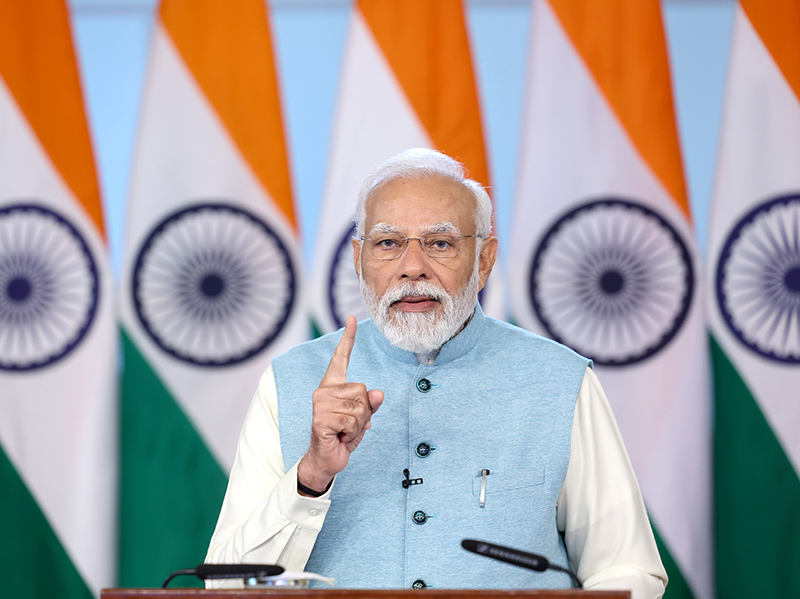
Modi's remarks came after the apex court's five-judge Constitution Bench, presided by the Chief Justice of India (CJI) DY Chandrachud, unanimously held as valid the Constitutional order that abrogated Article 370 of the Indian constitution, thereby ending Jammu and Kashmir's special status.
"The verdict today is not just a legal judgment; it is a beacon of hope, a promise of a brighter future and a testament to our collective resolve to build a stronger, more united India" Modi said on X.
Calling the verdict " historic", the Prime Minister said it constitutionally upholds the decision taken by Parliament on August 5, 2019. "it is a resounding declaration of hope, progress and unity for our sisters and brothers in Jammu, Kashmir and Ladakh".
"Court, in its profound wisdom, has fortified the very essence of unity that we, as Indians, hold dear and cherish above all else"," he said.
The Prime Minister assured the "resilient" people of Jammu, Kashmir and Ladakh that "our commitment to fulfilling your dreams remains unwavering".
"We are determined to ensure the fruits of progress not only reach you but also extend their benefits to the most vulnerable and marginalised sections of our society who suffered due to Article 370" he added.
Article 370 Explained:
Oct 26, 1947: On this day the Instrument of Accession,1947 was signed between Maharaja Hari Singh of Jammu and Kashmir and the Government of India paving the way for Jammu and Kashmir to merge with independent India. Singh signed the instrument amid a tribal invasion by Pakistani forces, who were genociding the non-Muslims of the region.
Oct 17 1949: Article 370 that granted special status to the former state of Jammu and Kashmir was incorporated into the Constitution of India which itself came into effect on January 26, 1950.
Jammu and Kashmir was administered by India as a state from 17 November 1952 to 31 October 2019. Article 370 conferred on the state the power to have a separate constitution, a state flag, and autonomy of internal administration. It also barred Indians from outside the state from purchasing property or settling there.
Article 370 stipulated that the other articles of the Constitution that gave powers to the Central Government would be applied to Jammu and Kashmir only with the concurrence of the former State's constituent assembly.
Article 370 of the Indian Constitution said it was a temporary status of Jammu and Kashmir. It was titled "Temporary, Transitional and Special Provisions", stating that the Constituent Assembly of Jammu and Kashmir would be empowered to recommend the extent to which the Indian constitution would apply to the state.
On May 14th, 1954, then President Rajendra Prasad issued the Presidential order guaranteeing territorial integrity to Jammu and Kashmir and introduced Article 35A which conferred special rights and privileges to permanent citizens of Jammu and Kashmir which its non-permanent residents, even if they were Indian citizens, were not entitled to. This order was passed with the concurrence of the Constituent Assembly of Jammu and Kashmir. Since the state constituent assembly dissolved itself without recommending the abrogation of Article 370, the article was deemed to have become a permanent feature of the Indian Constitution.
On 5 August 2019, the Indian government issued a Presidential Order superseding the 1954 order, and making all the provisions of the Indian constitution applicable to Jammu and Kashmir. The order was based on the resolution passed in both houses of India's parliament with two-thirds majority. A further order on 6 August made all the clauses of Article 370 except clause 1 to be inoperative.