
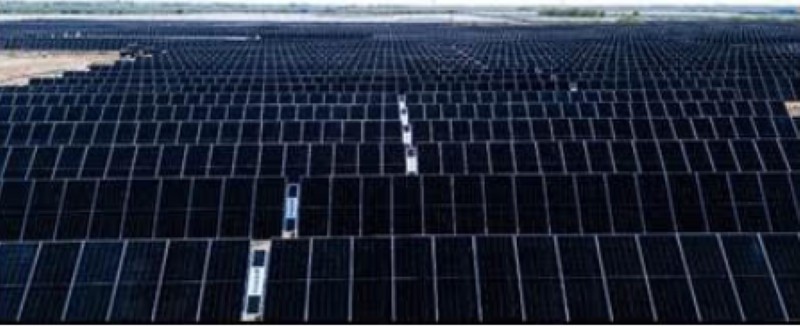
With the commissioning of the project, TPREL’s utility-scale renewable energy portfolio has increased to 12.3 GW, while its operational capacity has crossed the 7 GW milestone, reinforcing its position in India’s clean energy transition.
The project will supply renewable power to three Tata Group companies — TP Solar Limited (40.625 MW), Tata Power’s solar manufacturing arm producing high-efficiency solar cells and modules; Tata Electronics Private Limited (53.125 MW), which focuses on semiconductors, precision engineering and advanced electronics; and Tata Realty and Infrastructure Limited (6.25 MW), a real estate and infrastructure development company.
The project is expected to generate 240.63 million units (MUs) of clean electricity annually and offset approximately 1.5 lakh tonnes of CO₂ emissions each year.
A key feature of the project is the deployment of Flexible Terrain Compatible (FTC) Single Axis Tracker technology, described by the company as a first-of-its-kind deployment for a Tata project in India.
The project is equipped with 2,61,660 Mono PERC bifacial solar modules and has been designed to maximise energy generation while improving operational efficiency across varying terrain conditions.
The power generated will be transmitted through the Kayathar 400 kV Grid Substation (GSS), enabling reliable evacuation and efficient delivery of renewable power to the beneficiary companies.
TPREL said the project demonstrates its capabilities in executing large-scale solar projects through engineering expertise, construction practices and a focus on quality.
The company’s 7 GW operational renewable energy capacity comprises more than 5.7 GW of solar and 1.3 GW of wind assets.
TPREL also has an additional 5.3 GW of renewable energy projects under various stages of development. This includes 2.2 GW of solar and 3.1 GW of wind projects, which are scheduled for phased commissioning over the next six to 24 months.
The project further strengthens TPREL’s position in India’s renewable energy sector and supports the country’s target of achieving 500 GW of non-fossil fuel capacity by 2030.