
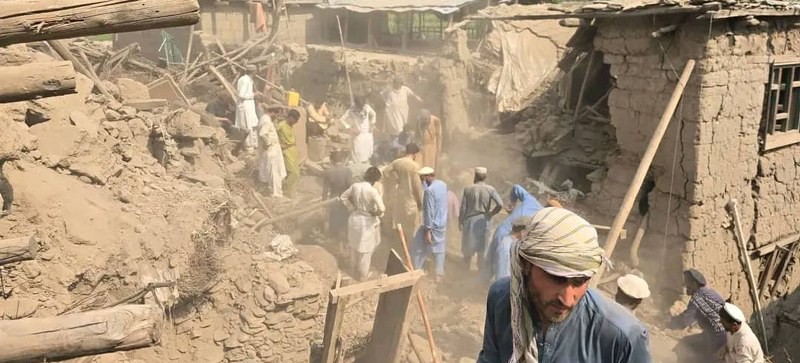
Latest updates from UN assessment teams who reached affected communities in mountainous Ghazi Abad district on foot on Tuesday underscored the urgent need to press on with the humanitarian response.
“The issue of getting people out from under the rubble is urgent,” said Salam Al-Jabani from the UN Children’s Fund, UNICEF, in Kabul. “People are saying what is urgently needed is people to help us bury the dead and get them out.”
Preliminary reports from Afghanistan’s de facto authorities now indicate that at least 1,400 people were killed and more than 3,100 injured when a magnitude six earthquake struck northeastern regions late on Sunday.
Casualty figures are expected to rise further as search and rescue teams reach affected areas, but some remote communities have yet to be reached. Access problems are the result of rockfalls and landslides triggered by the earthquake and heavy rains in the days before the disaster.
“Our teams had to leave their cars and walk two hours to get to Ghazi Abad,” explained Mr. Al-Jabani. “Other villages are six to seven hours’ walk away and still not reached…not even by the local authorities’ helicopters.
Communications are also patchy or non-existent: "There is one cell tower near a health centre, otherwise it is dark," Al-Jabani continued.
International response
As part of the international response, the UN has dispatched at least 25 assessment teams to the affected region and boosted humanitarian air service flights from Kabul.
For its part, the UN refugee agency, UNHCR, is deploying prepositioned essential relief items from stockpiles in Kabul, including tents, blankets and solar lamps.
Immediate priority needs include emergency shelter, medical supplies, drinking water and emergency food assistance.
But “getting medicines in is very hard…They are bringing essentials only on foot” from the nearest UNICEF-supported hospital, Mr. Al-Jabani noted.
Health care provision remains fragile, with medical staff at one damaged centre in Ghazi Abad with clearly visible cracks in the walls now treating people “outside, under trees”, as they are too afraid to stay inside, he added.
It is understood that thousands of local community members are now surging into the area to help the search and rescue effort, bringing with them water and food. “People in their thousands are moving in and out of the area,” the UNICEF official noted.