
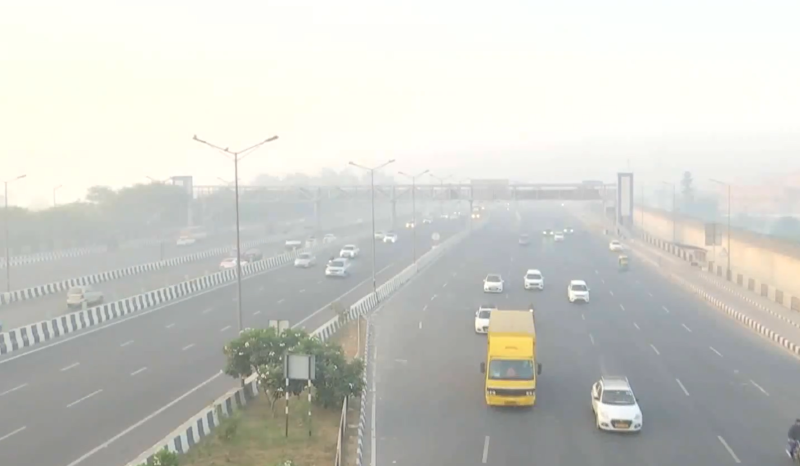
According to data from the Central Pollution Control Board (CPCB), Mundka remained the most polluted locality with an AQI of 436, followed by Rohini (432). Jahangirpuri (420) and Anand Vihar (408) were also among the severely affected pockets, prompting residents to consider temporary relocation.
The situation was no better across the National Capital Region. Noida recorded an AQI of 404, while Greater Noida and Ghaziabad registered 377 and 350, respectively, continuing to remain in the “very poor” zone.
Air pollution during Delhi’s winter months is a recurring crisis, with a thick blanket of smog engulfing the city each year. The capital—home to the residences of the President, Vice President, and Prime Minister—struggles annually with this toxic haze.
#WATCH | Delhi | Visuals from the Akshardham area as a layer of toxic smog blankets the city. AQI (Air Quality Index) around the area is 408, categorised as 'Severe', as claimed by CPCB (Central Pollution Control Board). pic.twitter.com/PAwW2ZGeqF
— ANI (@ANI) November 28, 2025
Reports have highlighted rising health complaints, especially among children, bringing both state and central authorities under scrutiny. Many residents have returned to wearing masks, echoing pandemic-era practices, while fitness enthusiasts have abandoned morning walks as conditions worsen.
During a Supreme Court hearing, Chief Justice of India Surya Kant also expressed his personal struggle with Delhi’s pollution. “I walked for 55 minutes. When I came back, I had difficulty… and till morning, I had problems,” the CJI said, as quoted by The Indian Express.
Social media remains flooded with distress posts. One user wrote that she “came to meet someone at the airport and gifted him a pair of masks,” while another described the city as “gas chambers.”
Welcome to gas chambers #DelhiPollution pic.twitter.com/O4Es13Oh3v
— Divu Ahir (@Divuahirr) November 27, 2025
Even as physical classes resumed on Thursday following a brief improvement that allowed authorities to revoke Stage-3 restrictions of the Graded Action Response Plan (GARP), concerns remain high.
Former Puducherry Lt. Governor Kiran Bedi urged top central leadership and the CJI to intervene, arguing that recurring pollution is a result of temporary fixes, weak enforcement, fragmented governance, and lack of long-term planning. She called for a unified air-quality authority, stronger monitoring, clean energy investments, and improved inter-state coordination.
Let’s understand please.
— Kiran Bedi (@thekiranbedi) November 28, 2025
1.India’s air pollution crisis recurs annually because governments lean on quick, temporary fixes like smog towers and odd–even rules instead of addressing root causes.
2.Fragmented governance — with multiple agencies sharing responsibility but none…