
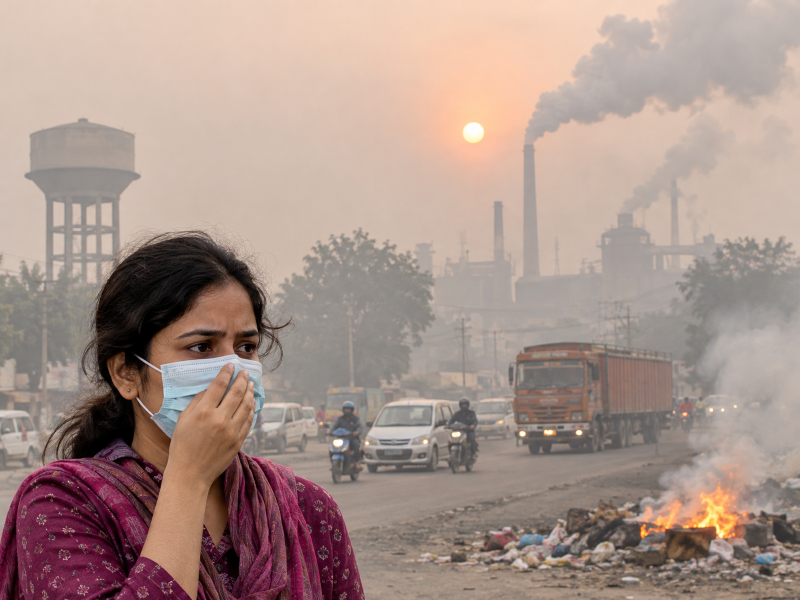
Located around an hour's drive from Delhi, Loni emerged as one of the most polluted locations in the National Capital Region (NCR) after the festival.
The town's pollution problem, however, extends well beyond the annual Diwali celebrations. According to data reported by AFP, Loni recorded an average PM2.5 concentration of 112.5 micrograms per cubic metre over the past 12 months.
This is more than 22 times the World Health Organisation's (WHO) recommended annual limit of 5 micrograms per cubic metre.
The alarming figures also placed Loni among the world's 20 most polluted locations in an annual ranking published by Swiss air-quality monitoring organisation IQAir.
Prolonged exposure to high concentrations of PM2.5, or fine particulate matter, can penetrate deep into the lungs and enter the bloodstream, increasing the risk of serious health conditions, including respiratory illnesses, cardiovascular diseases and lung cancer.
Why is Loni's air so toxic? 10 major factors behind the pollution
While firecrackers contribute to the immediate post-Diwali pollution spike, a combination of industrial, geographical, infrastructural and human activities keeps Loni's air polluted throughout the year.
1. Industrial emissions and unregulated factories
Loni is surrounded by several industrial zones, making factory emissions a major contributor to its deteriorating air quality. Numerous small-scale manufacturing units also operate from residential neighbourhoods. Some use furnaces for metal smelting, releasing hazardous chemical fumes and pollutants into the atmosphere.
2. Dust from damaged roads
Poor road infrastructure and broken, unpaved stretches add to the pollution burden. Dust gets suspended in the air as vehicles move along these roads. During winter, when atmospheric conditions make it difficult for pollutants to disperse, the problem becomes particularly severe.
3. Construction and rapid urban expansion
Situated between Delhi, Ghaziabad and Baghpat, Loni has become an affordable residential destination for people looking to settle in the Delhi-NCR region. Its connectivity and relatively inexpensive land have encouraged continuous construction activity.
Several infrastructure projects also involve excavation and large-scale earthwork, releasing substantial quantities of dust into the surrounding air.
4. Heavy traffic and transport corridors
Loni serves as an important connecting point between Delhi and several parts of western Uttar Pradesh. Major transport routes, including the Eastern Peripheral Expressway and the Delhi-Dehradun Highway, pass through or near the region.
The constant movement of heavy commercial vehicles, along with increasing local traffic, releases exhaust emissions and road dust. Its proximity to major highways further exposes the town to pollution generated by regional transport activity.
5. Open garbage burning and poor waste management
Inadequate waste collection and disposal infrastructure has made garbage management another major challenge in Loni.
With facilities struggling to handle the volume of waste generated by its densely populated neighbourhoods, residents often resort to dumping rubbish in open spaces or burning it.
The burning of household and industrial waste releases toxic smoke and harmful particulate matter, worsening local air quality.
6. Smoke from brick kilns
The neighbouring Baghpat region has numerous traditional brick kilns, several of which are located within a few kilometres of Loni. Their emissions contribute to the area's pollution load.
Additionally, dust generated by the excavation of soil for brick manufacturing adds another layer of particulate pollution to the atmosphere.
7. Stubble burning in nearby agricultural areas
Crop-residue burning remains a significant seasonal contributor to air pollution across northern India.
As winter approaches, farmers in rural areas surrounding Loni also set fire to agricultural stubble to clear their fields.
Consequently, Loni is affected not only by smoke drifting from Punjab and Haryana but also by agricultural fires within Uttar Pradesh.
8. Geographical location and winter weather conditions
Loni's location near the Yamuna and adjoining rural areas influences local atmospheric conditions. During winter, falling temperatures and increased moisture can contribute to atmospheric inversions and a lower mixing height.
This prevents pollutants from dispersing vertically, trapping harmful particles closer to the ground and exposing residents to higher concentrations of pollution.
9. Chemical reactions that create secondary pollutants
Industrial and vehicular emissions release substances such as sulphur dioxide, nitrogen oxides and ammonia into the atmosphere. These chemicals can react with other atmospheric compounds and particulate matter, contributing to the formation of secondary particles.
The resulting fine pollutants, including secondary PM2.5, further deteriorate air quality and increase health risks.
10. The wider Delhi-NCR pollution crisis
Loni's pollution cannot be viewed in isolation. Being part of the Delhi-NCR airshed, it is exposed to many of the same pollution sources affecting the national capital and neighbouring cities.
Rising vehicle numbers in Ghaziabad and northeast Delhi, along with industrial emissions and other regional sources, add to the pollution load.
Airborne pollutants also travel across administrative boundaries, making the problem particularly difficult to tackle locally.
Delhi's AQI nears 500 after Diwali
The pollution crisis was not limited to Loni. Delhi also witnessed a dramatic deterioration in air quality following Diwali celebrations.
Official monitoring data showed the national capital's Air Quality Index (AQI) climbing to 483 at 8:10 am on Monday, placing it in the severe category.
Meanwhile, private monitoring platforms, including Swiss-based IQAir, reported even more alarming readings, with AQI levels crossing 1,000 in Shahdara and Defence Colony in south Delhi.
The contrasting readings highlight the severity of the post-Diwali pollution episode, as the national capital and surrounding NCR areas continue to grapple with hazardous air quality.