
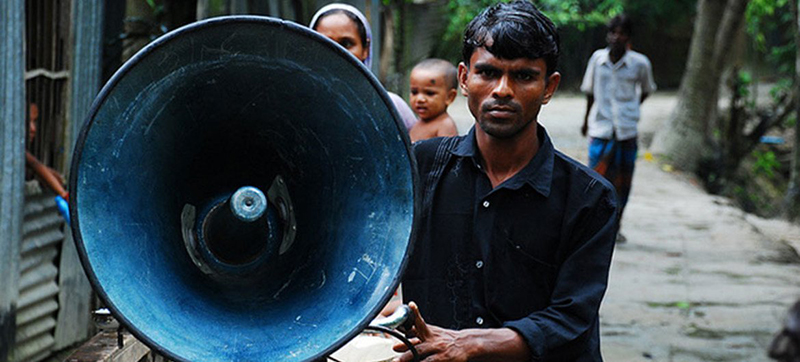
UN chief António Guterres convened an Advisory Panel of top UN agency officials which met for the first time to inject more “political, technical and financial clout to ensure that Early Warnings for All becomes a reality for everyone, everywhere”, said WMO in a press release.
Tuesday’s panel included development banks, humanitarian organisations, civil society representatives, insurance and information technology companies.
The record-breaking Tropical Cyclone Freddy, which has caused severe disruption to critical services in southeast Africa, and fuelled a dangerous cholera outbreak, once again shows the importance of early warning systems that can save lives and livelihoods from increasingly extreme weather, the agency said.
Stepping it up
The months ahead will see stepped up coordinated action, initially in 30 particularly at-risk countries, including Small Island Developing States and Least Developed Countries. Additional countries are expected to be added, as this vital work with partners gathers pace.
At the same time, the UN’s existing life-saving actions and initiatives will continue and be reinforced, “ensuring the Early Warnings for All campaign turns its pledges into life-saving reality on the ground for millions of the most vulnerable people”, said WMO, harnessing the power of modern mass communications.
Results time: Guterres
“Now it is time for us to deliver results. Millions of lives are hanging in the balance”, said Mr. Guterres.
“It is unacceptable that the countries and peoples that have contributed the least to creating the crisis are paying the heaviest prices,” he added.
Need for improvement
“People in Africa, South Asia, South and Central America, and small island states are 15 times more likely to die from climate disasters. These deaths are preventable. The evidence is clear: early warning systems are one of the most effective risk reduction and climate adaptation measures to reduce disaster mortality and economic losses,” said Mr Guterres.
In the past 50 years, the number of recorded disasters has increased by a factor of five, driven in part by human-induced climate change which is super-charging our weather.
If no action is taken, the number of medium or large-scale disaster events is projected to reach 560 a year – or 1.5 each day – by 2030.
The occurrence of severe weather and the effects of climate change will increase the difficulty, uncertainty, and complexity of emergency response efforts worldwide.
Preventable deaths
Half of all the world’s countries currently do not have adequate early warning systems and even fewer have regulatory frameworks where warning systems are linked to emergency plans.
“The unprecedented flooding in Mozambique, Malawi and Madagascar from Tropical Cyclone Freddy highlights once again that our weather and precipitation is becoming more extreme and that water-related hazards are on the rise,” said WMO Secretary-General Prof. Petteri Taalas.
“The worst affected areas have received months’ worth of rainfall in a matter of days and the socio-economic impacts are catastrophic.”
“Accurate early warnings combined with coordinated disaster management on the ground prevented the casualty toll from rising even higher. But we can do even better and that is why the Early Warnings for All initiative is the top priority for WMO”, he said.
Beneficial all round
He added that improved hydrological and weather services will also be “economically beneficial for agriculture, air, marine and ground transportation, energy, health, tourism”.
WMO and the UN Office for Disaster Risk Reduction (UNDRR) are spearheading the Early Warnings for All initiative, along with the International Telecommunication Union (ITU) and the International Federation of Red Cross and Red Crescent Societies (IFRC).
“The operationalization of this initiative is a clear example of how the UN System and partners can work together to save lives and protect livelihoods from disasters”, said Mami Mizutori, Special Representative of the Secretary-General for Disaster Risk Reduction and Head of UNDRR.
'Moral imperative'
“Inclusive and multi-hazard early warning systems that close the ‘last mile’, are among the best risk reduction methods in the face of climate-related hazards and geophysical hazards such as tsunamis.
“Achieving this is not only a clear target in the Sendai Framework for Disaster Risk Reduction but a moral imperative as well”.