
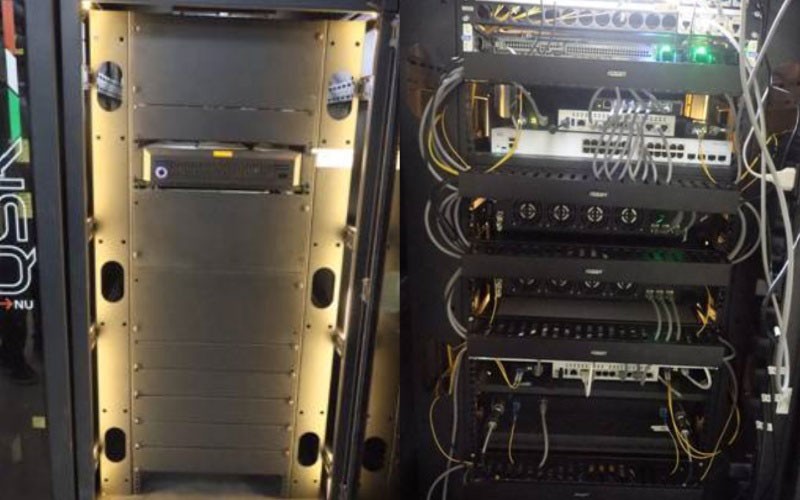
The field trial, conducted on the night of September 27–28, established a secure quantum communication channel between BISAG-N and IIT Gandhinagar. Using QNu Labs’ Pointing, Acquisition and Tracking (PAT) system, the trial achieved a stable Quantum Bit Error Rate (QBER) of below 5% and generated secure keys at a rate of 230–260 bits per second (bps).
According to a government statement, the generated keys were integrated with BISAG-N’s post-quantum cryptography-enabled Vedic Kavach platform, enabling successful end-to-end encryption and decryption of test messages.
The demonstration combined two complementary layers of quantum security: QNu Labs’ hardware-based QKD system, Armos, operating over free-space optical channels, and BISAG-N’s software-based Vedic Kavach platform, which uses post-quantum cryptography and quantum random number generation.
Startup supported by DST under NQM demonstrates 500 km Quantum-Safe Network
— PIB India (@PIB_India) November 5, 2025
One of the 8 startups supported under the National Quantum Mission (NQM) of the Department of Science and Technology (DST) has successfully demonstrated India's first extensive Quantum Key Distribution… pic.twitter.com/9ZxUutO0VA
The integrated architecture is designed to maintain secure communications even if the physical quantum channel becomes temporarily unavailable.
Dr Vinay Thakur, Director General of BISAG-N, said the integration of Vedic Kavach with QNu Labs’ QKD technology marks a significant step towards developing practical quantum-resilient communication systems.
Sunil Gupta, Co-founder and CEO of QNu Labs, said the successful 5.56-km demonstration could pave the way for longer-distance quantum-secure networks and satellite-based quantum communication.
Cmde Manish Tripathi (Retd.), In-charge of the Indian Space Technology and Future (ISTF) programme at IIT Gandhinagar, said the demonstration provides a valuable field environment for advancing practical quantum communication technologies. He added that it showcases how academia, indigenous technology and real-world experimentation can be brought together to address emerging secure communication requirements.
The trial provides a foundation for further development of India’s secure communication infrastructure and could contribute to strengthening resilience against emerging security threats in the quantum era.