
According to the agency’s first report on global water resources, areas that were unusually dry included South America’s Rio de la Plata area, where a persistent drought has affected the region since 2019.
In Africa, major rivers such as the Niger, Volta, Nile and Congo had below-average water flow in 2021. The same trend was observed in rivers in parts of Russia, West Siberia and in Central Asia.
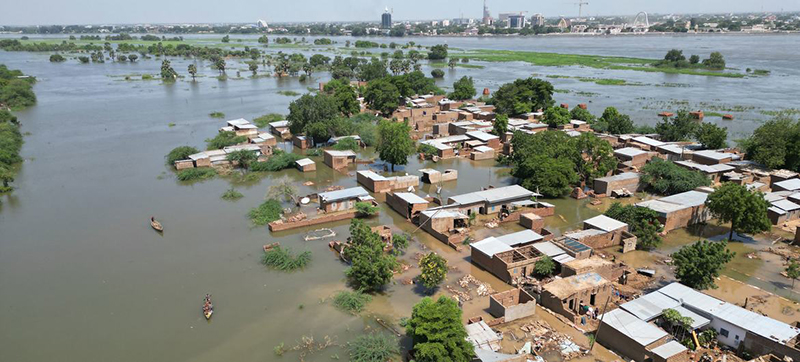
On the other hand, there were above-normal river volumes in some North American basins, the North Amazon and South Africa, as well as in China’s Amur river basin, and northern India.
In Africa, rivers such as the Niger, Volta, Nile and Congo had below-normal discharge in 2021, along with parts of Russia, West Siberia and in Central Asia.
WMO said that 3.6 billion people have inadequate access to water at least one month per year and that this is expected to increase to more than five billion by 2050.
Climate crisis
“The impacts of climate change are often felt through water – more intense and frequent droughts, more extreme flooding, more erratic seasonal rainfall and accelerated melting of glaciers – with cascading effects on economies, ecosystems and all aspects of our daily lives”, said WMO Secretary-General Prof. Petteri Taalas.
“And yet, there is insufficient understanding of changes in the distribution, quantity, and quality of freshwater resources”.
The State of Global Water Resources report “aims to fill that knowledge gap and provide a concise overview of water availability in different parts of the world”, he added.
“This will inform climate adaptation and mitigation investments as well as the United Nations campaign to provide universal access in the next five years to early warnings of hazards such as floods and droughts”.
Water, water everywhere
Between 2001 and 2018, UN-Water reported that a staggering 74 per cent of all natural disasters were water-related.
The recent UN climate change conference, COP27, in Egypt, urged governments to further integrate water into adaptation efforts, the first-time water has been referenced in a COP outcome document in recognition of its critical importance, noted WMO.
The first edition of the report looks at streamflow – the volume of water flowing through a river channel at any given time – and also assesses terrestrial water storage – in other words, all water on the land surface and sub-surface and the cryosphere (frozen water).
The report highlights a basic problem: a lack of accessible verified hydrological data.
WMO’s Unified Data Policy seeks to accelerate the availability and sharing of hydrological data, including river discharge and transboundary river basins information.
Terrestrial cover
Aside from river flow variations, overall terrestrial water storage was classified as below normal on the west coast of the United States, in central South America and Patagonia, North Africa and Madagascar, Central Asia and the Middle East, Pakistan and North India.
It was above normal in Central Africa, northern South America – specifically the Amazon Basin – and northern China.
“Overall the negative trends are stronger than the positive ones”, warned WMO, with several hotspots emerging including Patagonia, the Ganges and Indus headwaters, as well as the southwestern US.
Cryosphere
The cryosphere – namely glaciers, snow cover, ice caps and, where present, permafrost - is the world’s biggest natural reservoir of freshwater.
“Changes to cryosphere water resources affect food security, human health, ecosystem integrity and maintenance, and lead to significant impacts on economic and social development”, said WMO, sometimes causing river flooding and flash floods due to glacier lake outbursts.
With rising temperatures, the annual glacier run-off typically increases at first, until a turning point, often called ”peak water”, is reached, upon which run-off declines.
The long-term projections of glacier run-off and the timing of peak water, are key inputs to long-term adaptation decisions, WMO added.