
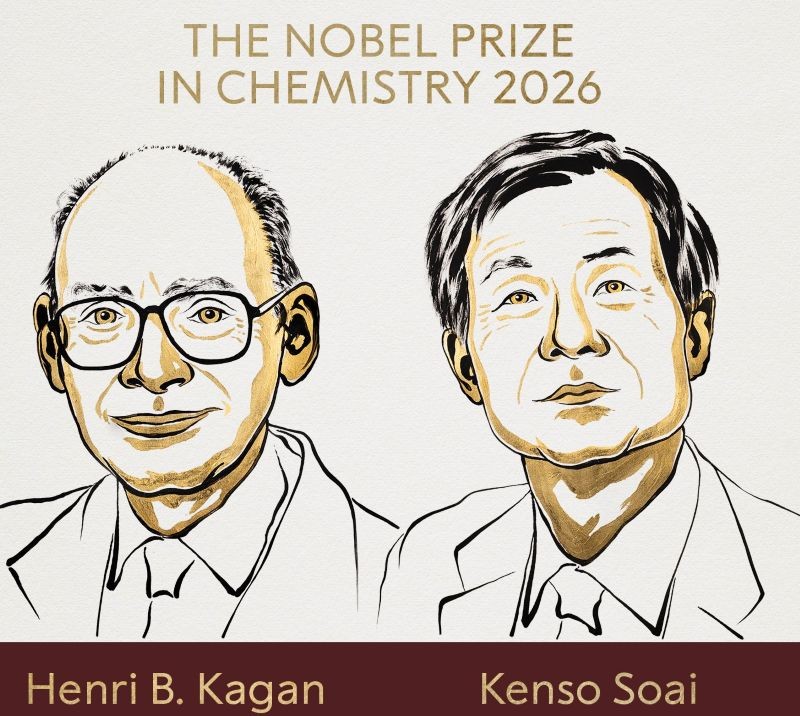
The announcement marks the third Nobel Prize to be declared during Nobel Week, following the awards in Medicine and Physics.
Explaining their contributions, the Nobel Committee said some molecules, including amino acids, exist in two variants that are mirror images of each other. However, living organisms contain only one of these mirror-image forms.
“How chemical asymmetry such as this could have emerged was long a mystery to chemists,” the Nobel Committee said in its statement.
Kagan and Soai are being recognised for their discoveries that helped provide an answer to this long-standing chemical puzzle.
Life’s chemistry is described as homochiral, a term derived from the Greek words for “same” and “hand”. Like human hands, amino acids exist in two mirrored variants, but only one form is found in the proteins within living cells. The other form is rarely found in nature.
For decades, chemists sought to understand how homochirality could emerge. When they experimented with chemical reactions capable of producing two mirror-image molecules, they generally obtained equal amounts of both forms.
Chemists have also sought ways to produce predominantly one mirror image because, in the development of molecules that interact with living organisms — including pharmaceuticals — only one of the two forms may produce the desired effect.
Thanks to the discoveries that are being recognised by the #NobelPrize in Chemistry 2026, chemists have gained fundamental new tools for use in their daily work but, above all, these discoveries have contributed to solving one of chemistry’s greatest mysteries: how homochirality – like that found in all living beings – can be created. The Soai reaction – developed by 2026 laureate Kenso Soai – has awakened new enthusiasm in chemists who want to understand the life’s origins. Around the world, researchers are now trying to repeat Soai’s achievement, but with the aim of producing homochiral amino acids and sugars. The non-linear effects that fellow laureate Henri B. Kagan discovered have become an important tool for chemists when they design new reactions. The fact that a reaction is non-linear provides chemists with information about how it occurs. This information can be used to optimise the reaction, so they can obtain the purest possible enantiomers of the product. This is vital for every company that manufactures substances that are intended to interact with living beings, such as pharmaceuticals, flavours, scents and agricultural chemicals. In some cases, it is also important in the production of new materials.
— The Nobel Prize (@NobelPrize) October 7, 2026
The 2026 Nobel Prize in Chemistry recognises discoveries that have enabled scientists to drive chemical reactions towards homochirality.
“Henri Kagan and Kenso Soai have provided a solution to a chemical mystery that is over a century old: how homochirality can emerge spontaneously. The chemical reactions they have developed are spectacular,” said Heiner Linke, chair of the Nobel Committee for Chemistry.
Kagan took the first decisive step in 1986 when he discovered a new way of manipulating chemical reactions. His work enabled him to produce a greater excess of one mirror-image form than had previously been considered possible.
Soai subsequently took the research further. In 1995, a landmark publication described how he had designed the first chemical reaction with the potential to become homochiral.
In 2003, Soai finally achieved the breakthrough. He demonstrated a chemical reaction in which only one of the two possible mirror-image forms was produced.
Apart from life itself, no one had previously achieved this feat.