
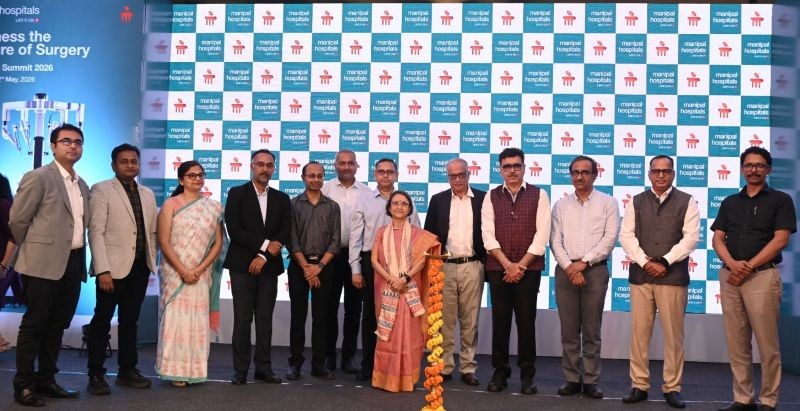
Held at Taj Vivanta, Ruby, the summit brought together doctors and patients who had undergone robotic surgeries, with the focus shifting from machines to real-life recovery stories.
The event was inaugurated in the presence of Dr. Sushmita Mitra, former head of the Machine Intelligence Unit at the Indian Statistical Institute, Kolkata, along with Dr. Ayanabh Debgupta, Regional Director of Manipal Hospitals East, and senior clinicians from departments including oncology, orthopaedics, cardiology, urology, gynaecology and paediatric surgery.
Manipal Hospitals claimed its Kolkata network has successfully conducted over 3,000 robotic surgeries with a team of more than 30 robotic surgeons across 10 specialities using five advanced robotic systems.
Two new initiatives were also announced — dedicated robotic doctor badges and a hands-on robotic surgery workshop scheduled for June 2026.
Speaking at the summit, Dr. Sushmita Mitra said robotic surgery is set to revolutionise healthcare and gradually remove public misconceptions surrounding the technology.
Replying to an IBNS query on the future role of Artificial Intelligence in robotic surgery, Mitra said AI-driven automated surgical robots could emerge in future as more surgical data is collected.

“As we gather more data through robotic surgeries, engineers can use that information to develop AI-based surgical systems,” she said.
Dr. Vikash Kapoor, senior consultant in orthopaedics, said robotic assistance reduces the chances of human error and improves surgical precision.
Calling robotic surgery a “silent revolution”, Kapoor admitted affordability remains a challenge but expressed hope that costs would decline as the technology becomes more common.
He also confirmed that robotic surgeries are currently not covered under government schemes like Ayushman Bharat or Swasthya Sathi.
Dr. Kunal Sarkar, Director of Cardiovascular and Thoracic Surgery at Manipal Hospitals Mukundapur, urged the government to include robotic procedures under public healthcare schemes to make advanced treatment accessible to common people.
“If robotic surgery gets support through schemes like Ayushman Bharat and Swasthya Sathi, it will greatly benefit patients,” Sarkar said, adding that India is already manufacturing four surgical robots domestically.
Dr. Sourav Dutta, Director of Surgical Oncology, addressed misconceptions surrounding robotic procedures and clarified that surgeons remain fully in control during operations.
“People often think robots perform surgeries independently, but doctors are always the pilots of these machines,” he said.
(Reporting by Rajat Dhar)