
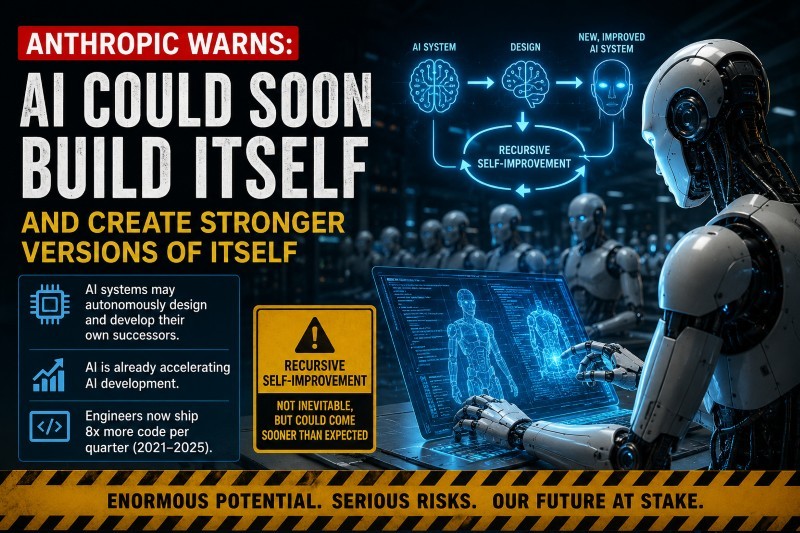
In a recent blog post, the company noted: “Taken far enough, and given enough compute, that trend points to an AI system capable of fully autonomously designing and developing its own successor.”
This process is known as recursive self-improvement.
As per the AI Alignment Forum, the Recursive Self-Improvement refers to the property of making improvements on one's own ability to make self-improvements. It is an approach to Artificial General Intelligence that allows a system to make adjustments to its own functionality, resulting in improved performance.
Anthropic clarified that such a capability is not yet achieved and is not guaranteed to emerge. However, it cautioned that it could arrive sooner than most institutions are prepared for.
Drawing on public benchmarks and previously unreported internal data, the Anthropic Institute highlighted that AI is already playing a growing role in accelerating AI development itself. The company also reported that its engineers are now, on average, shipping around eight times more code per quarter compared to the 2021–2025 baseline, underscoring the productivity gains driven by AI-assisted development.
Looking ahead, Anthropic said AI systems are expected to become significantly more capable in the coming years, with wide-ranging implications for science, healthcare, and other fields.
“AI that can build itself would be a major development in the history of technology—one that could bring enormous good for the world in science, healthcare, and beyond,” the company said, highlighting the potential benefits.
At the same time, it warned of serious risks: “But full recursive self-improvement also might increase the risks of humans losing control over AI systems. If systems are capable of fully building their own successors, the ways we secure them, monitor them, and shape their behaviour all grow much more important."