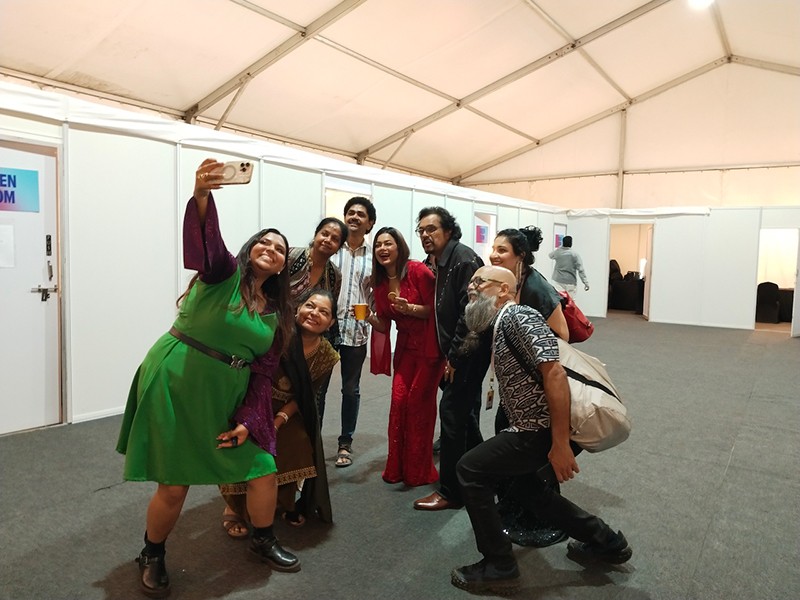
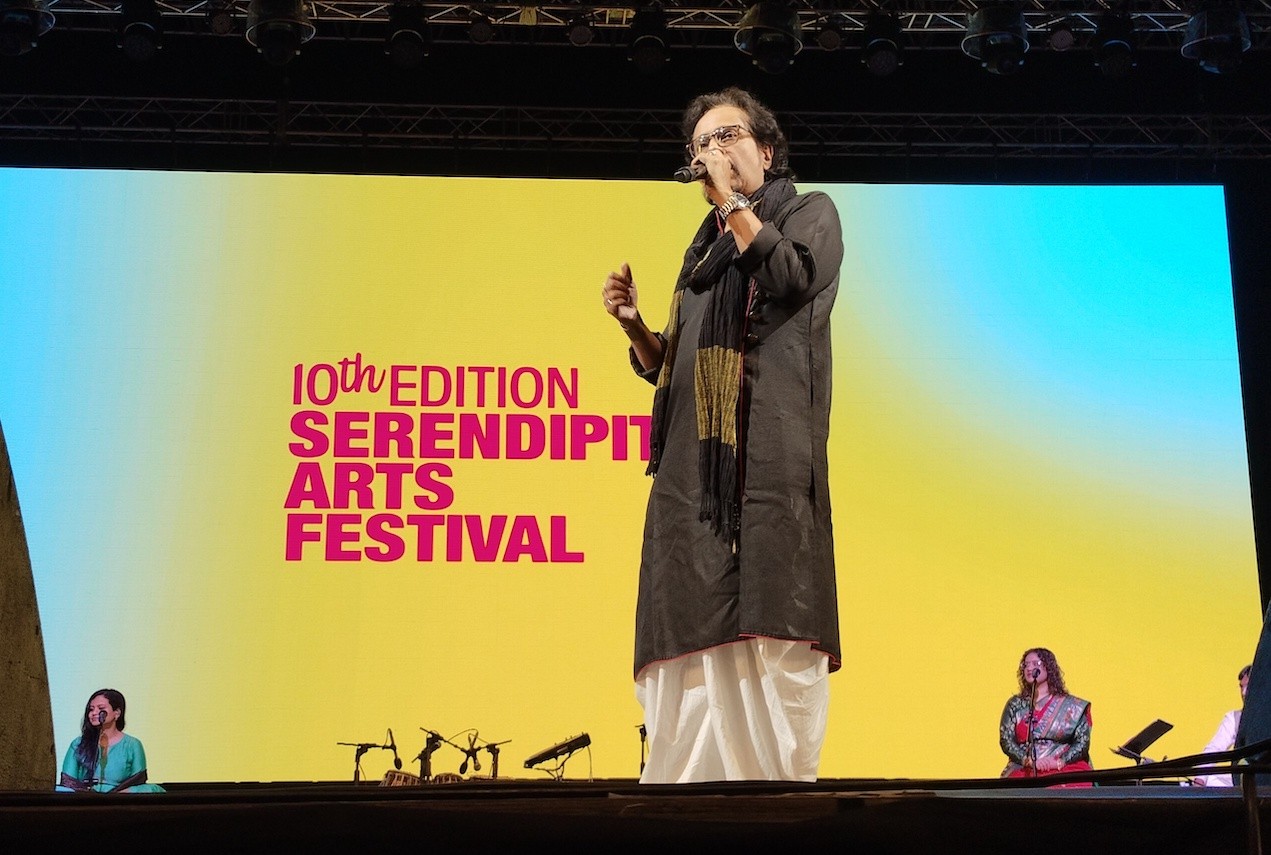
As the Serendipity Arts Festival in Goa marked a decade of shaping India’s cultural conversations, one name threaded through its musical spine with particular resonance: Bickram Ghosh.
Performer, curator, and quiet architect of musical dialogue across eras, genres, and instruments, Ghosh’s presence embodied the festival’s ethos—of nurturing artistic practice while allowing cultural heritage and contemporary expression to grow in conversation with each other.
With every show he curated, maestro Bickram Ghosh advanced a larger cultural argument: that music, when truly understood, goes beyond lazy binaries of old and new, pure and impure, classical and popular—and that fusion must be embraced, if traditions are to remain alive.
Ghosh’s philosophy of fusion is shaped by scars as much as by skill. He recalls that when he presented his first fusion concert, “the first three rows walked out… they said it was sacrilege.” But fusion, for him, is not a gimmick. It is not a random mash-up but an exploration of musical depth—"the ability to seamlessly stitch genres without losing the classical purity they carry.”
Ghosh’s authority to make this claim is not theoretical. As he often recounts with candour, he grew up in an austere Indian classical household where Bollywood was discouraged—almost forbidden. Trained thus, he performed for over a decade with Pandit Ravi Shankar and also shared the stage with Ustads like Ali Akbar Khan and Zakir Hussain.
“But when you are told not to do something,” he says, “you do it.” That early resistance seeded a lifelong curiosity: not to reject classical discipline, but to test how far its inner laws could travel—across changing instruments, contexts, and cultures.
This tension—between fidelity (of form) and freedom (of expression)—ran through Ghosh’s Serendipity curations. His programming unfolded as a three-part response to that inquiry, across the main stages and the moving theatre of the Mandovi River, over land and water.
Ghosh shaped experiences where the classical met the contemporary, and the popular met the profound—each contributing to a larger conversation about music not as a fixed inheritance, but as a living, flowing form.
Fading Traditions, Emerging Sounds
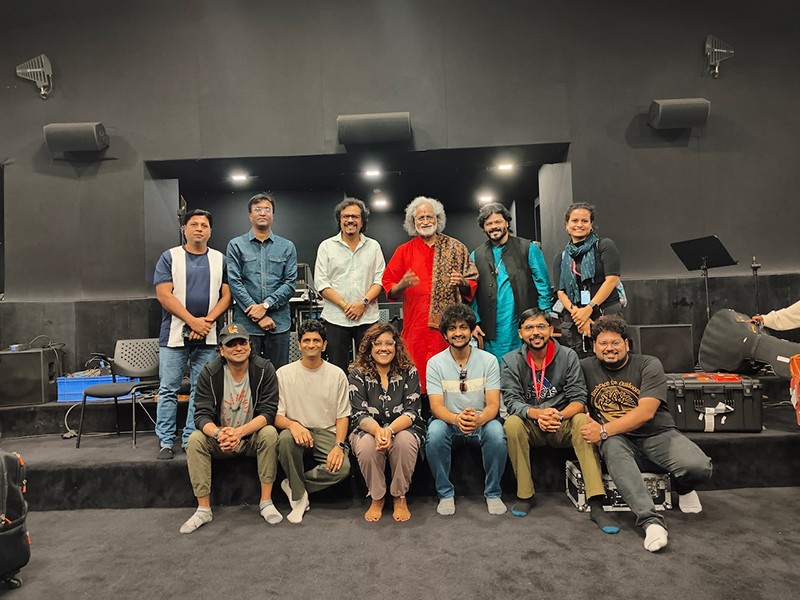
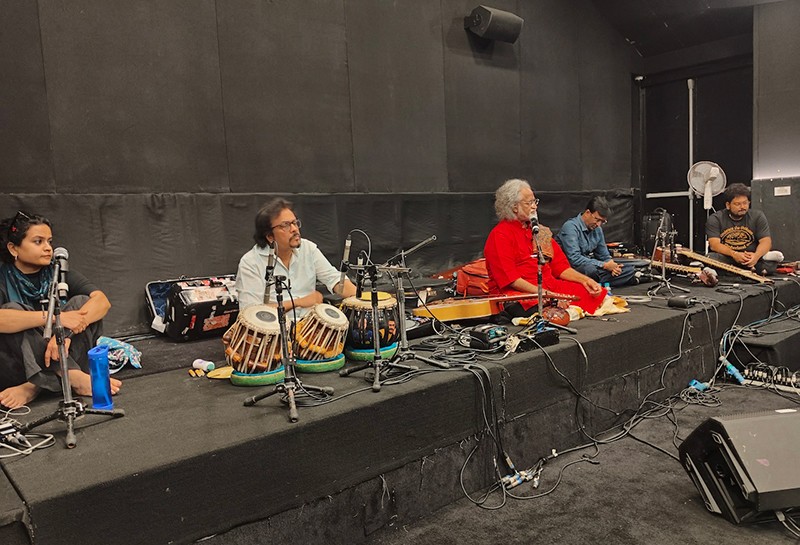
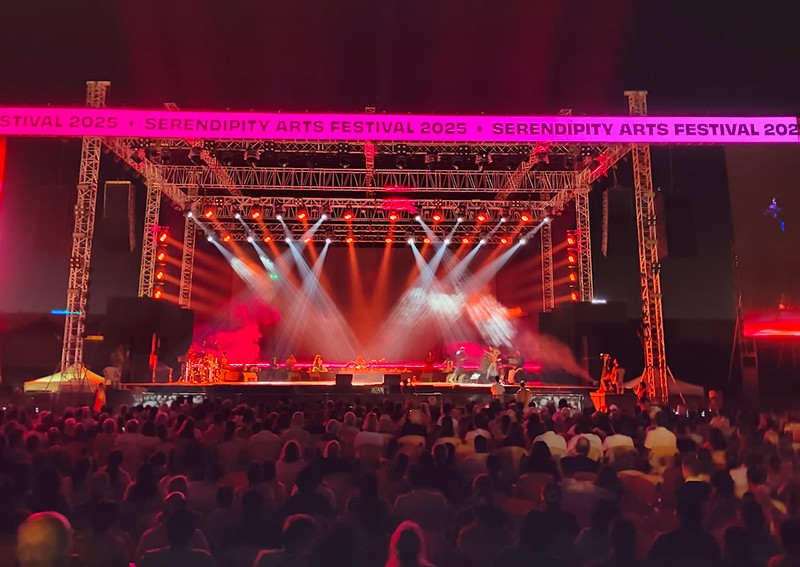
His first Main Stage curation, Fading Traditions, Emerging Sounds, confronted time head-on. It brought together revered classical maestros and contemporary musicians, even allowing unexpected elements—such as rap-inflected rhythms—to enter the soundscape as pulse rather than novelty. The performance shaped a musical terrain that was rooted yet boundless—deeply classical in spirit, yet unmistakably modern in energy.
Ghosh’s curatorial stance was unequivocal: where traditions are fading, the objective is not to preserve them behind glass, but to “carry them into the modern-day soundscape without losing their soul.” He challenged the persistent myth that Indian classical music has existed for centuries as a static, sealed form, reminding audiences that “while ragas and talas do not change, instruments and interpretation inevitably do.” Classical music, he insists, is a flowing form—"anchored in grammar and also animated by imagination.”
That belief revealed itself in the choice of artists and instrumentation. India, after all, has instruments that are hundreds of years old—some fading, some endangered more by neglect than irrelevance: like Murad Ali on the sarangi, an instrument fewer musicians now choose to learn; Kalyanjit Das on the surbahar, played today by only a handful; Ashwini Shankar on the shehnai; and Tanmay Deochake, sustaining a solo harmonium style increasingly on the wane.
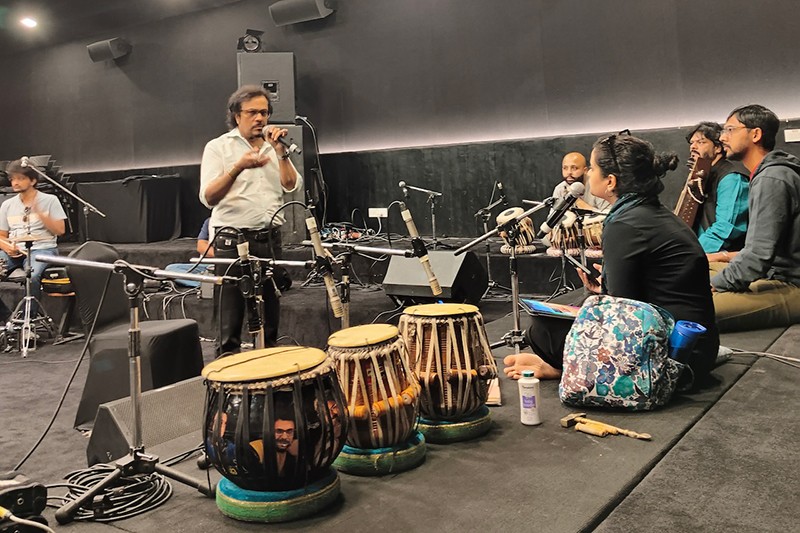
These instruments were not positioned as relics or acts of nostalgia. Instead, they were placed in active dialogue with contemporary ones—like Pranav Dath on drums, Anay Gadgil on keys, Anubrata Chatterjee on tabla, and B. C. Manjunath on mridangam—allowing the “fading” to meet the “emerging” without distortion. While Pavithrachari bridged dhrupad and khayal, Pratika brought rap as pulse. Mahesh Raghavan translated classical idioms through the iPad, and Anupam Shobhakar expanded its scope with his double-necked guitar.
The exchange between Viswamohan Bhatt on the Mohan Veena and Bickram Ghosh on tabla became the evening’s fulcrum—tradition held firm even as it moved forward. What emerged was not fusion for novelty’s sake, but a thoughtful exploration of how traditions survive precisely because they evolve.
Dard-e-Disco
If Fading Traditions, Emerging Sounds explored how classical purity survives evolution, Dard-e-Disco tested the same idea at the opposite end of the spectrum—asking whether Indian pop music, too, could be heard without prejudice and be part of that flowing musical tradition.
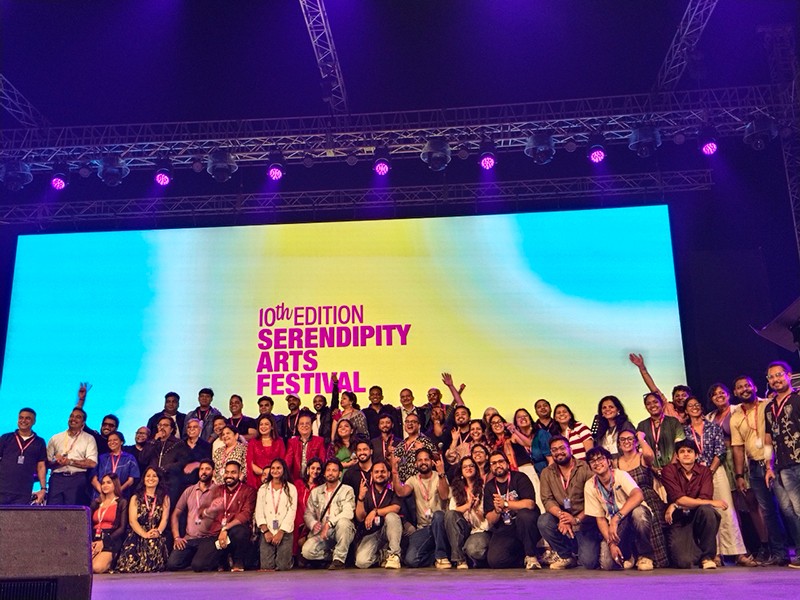
Dard-e-Disco unfolded as a loving homage to the golden age of Bollywood disco. The two-hour spectacle honoured the architects of an era—Bappi Lahiri, Kalyanji-Anandji, and Biddu—whose music once dissolved borders between Indian melody and global dance floors.
Far from revivalist kitsch, the concert leaned into bold re-interpretation. While Ghosh embraced nostalgia—appearing in a studded jacket and boot cuts—he curated a high-energy, unforgettable evening with some of the finest musicians of today. With Anupam Ghatak’s band, Arun Kumar on drums, and Rhythm Shah on guitar, the night turned electric. The vocal line-up spanned generations: the late disco icon Vijay Benedict, popular voices like Shaan and Iman Chakraborty, alongside the emerging Anjana Padmanabhan, whose presence quietly bridged eras.
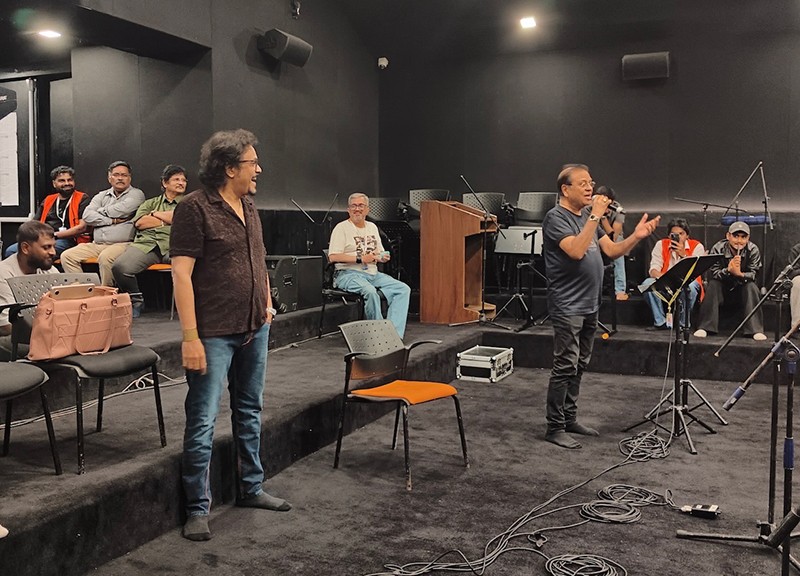
Beneath the glamour lay a sharper proposition. The implication was clear: we often belittle “pop” music in the name of taste. Dard-e-Disco challenged audience to listen without prejudice, and to see how even pop, shaped by thoughtful fusion, can enter the continuum of tradition.
River Raag
Perhaps the most poetic of Bickram Ghosh’s curatorial gestures unfolded offstage—on water. The River Raag series transformed sunset cruises from Santa Monica Jetty into floating concert halls, with the Mandovi itself becoming a metaphor for music.
River Raag: Pravaah opened with an unexpected jugalbandi: Kalyanjit Das on sitar, accompanied not by tabla but by Pranav Dath on cajón, drum pad, morsing, and konnakol—just the beginning of Bickram Ghosh’s quiet disruption of stereotypes.
In River Raag: Shehnai and Saxophone Ragas, featuring shehnai virtuoso Ashwani Shankar, Grammy-awarded Danish saxophonist Lars Møller, and tabla player Zuheb Ahmed Khan, traced a lineage spanning continents. The pairing of shehnai and saxophone—speaking different musical mother tongues—revealed unexpected kinships between khayal, dhrupad, and jazz improvisation. Supported by the Danish Cultural Institute and the Nordic Culture Fund, the evening stood as a testament to music’s essential oneness—rooted in its purity rather than its form.
In River Raag: Samvaad, this idea was carried further where Hindustani and Carnatic traditions met within the same raga and flowed seamlessly into familiar Bollywood songs, thumris, and ghazals. The performance suggested that dialogue between forms is not only possible—it enriches the listening experience.
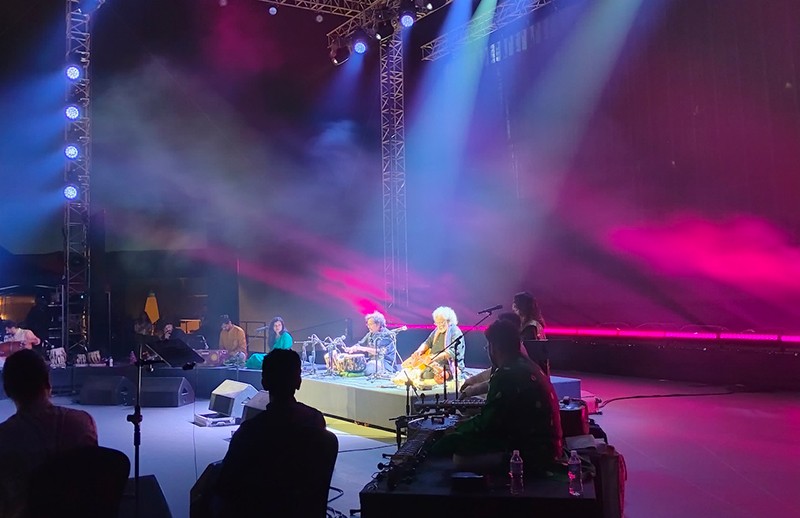
The evening gained particular resonance through its intergenerational casting. The young vocalist Anjana Padmanabhan, just 21, was a revelation, singing Begum Akhtar, Mehdi Hassan, and Jagjit Singh with remarkable elan. Paired with Anay Prakash Gadgil on keyboards, the duo expanded the idea of what a fusion classical performance can bring.
As the river carried the music forward at dusk, River Raag offered the clearest articulation of Ghosh’s curatorial premise: tradition does not survive by standing still. Like a river, it endures by moving—holding memory even as it reshapes itself with every passing moment.
A Festival Turning Ten, an Audience Being Asked to Grow
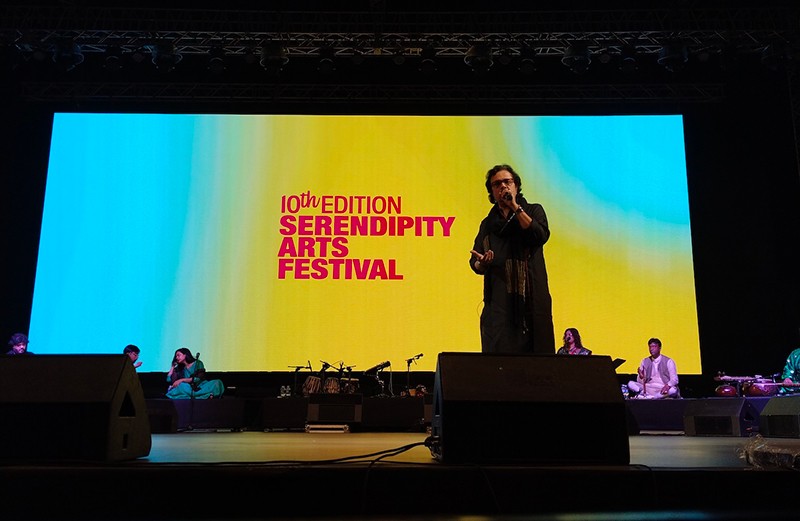
If Serendipity’s tenth year gestures toward what India’s arts festivals can become, Bickram Ghosh’s curations offer a harder truth: the audience must evolve. Not by becoming “more classical” or “more modern,” but by becoming less judgmental and more open to exploration. Music is neither heritage nor trend---and what we call “fusion” is simply what happens when skill meets grammar, and imagination honours tradition. Ghosh urges listeners to refine their taste and perceive the purity that travels beneath changing forms, and support tradition by allowing it to keep moving.