
The development marked a noticeable departure from the earlier position of the Trinamool Congress (TMC), which had largely refrained from sustained campaigns questioning EVM credibility in past elections.
High-visibility moves ahead of counting
The shift unfolded through a series of high-profile actions.
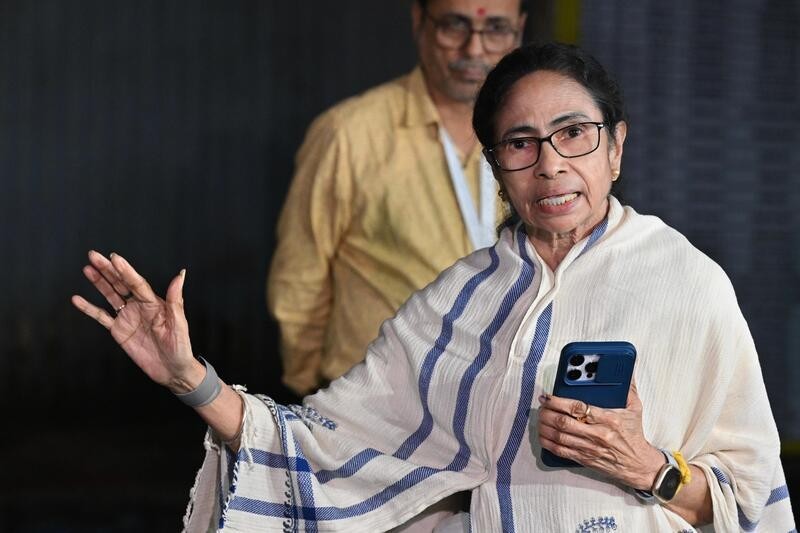
Mamata Banerjee issued a nine-minute video appeal urging party workers to maintain round-the-clock vigilance at strongrooms storing EVMs.
Later the same evening, she personally visited a strongroom facility in Kolkata, remaining there for nearly four hours amid allegations of suspicious activity.
The visit followed claims by party leaders regarding irregular handling of ballot materials at multiple locations, including a facility at Khudiram Anushilan Kendra in Netaji Indoor Stadium.
During her interaction with the media, Banerjee warned against any attempt to interfere with the counting process, even as she maintained confidence in her party’s electoral prospects.
Contrasting past position on EVM debate
The current stance contrasts with the party’s earlier approach to the EVM debate.
While the Indian National Congress and its leader Rahul Gandhi have repeatedly questioned the reliability of EVMs, the Trinamool Congress had largely limited its objections to isolated technical glitches.
TMC's National General Secretary Abhishek Banerjee had previously dismissed broader concerns around EVM hacking, instead pointing to alleged irregularities in voter rolls as the primary issue.
This divergence had earlier created visible differences within opposition ranks on the question of electoral technology.
Trigger points behind the narrative
The renewed focus on EVMs has emerged after the completion of polling phases, when votes are already sealed within the machines.
The timing coincides with the release of exit poll projections indicating a competitive contest, with most of the agencies suggesting an advantage for the Bharatiya Janata Party (BJP).
Mamata Banerjee dismissed these projections as attempts to influence public perception.
Alongside this, the Trinamool Congress has alleged a possible alignment between the BJP and the Election Commission of India (ECI), framing the contest within a broader institutional narrative.
Mobilisation and cadre engagement
The emphasis on EVM vigilance has also been accompanied by calls for continuous monitoring of strongrooms by party workers.
Banerjee’s late-night visit and public messaging have reinforced the call for organisational readiness, with instructions for round-the-clock presence at storage centres.
The approach has placed the focus on safeguarding votes already cast, while maintaining a visible political presence on the ground.
Institutional response and technical safeguards
Election authorities, including Chief Electoral Officer Manoj Kumar Agarwal, have rejected allegations of tampering, stating that the process follows strict protocols.
EVMs remain sealed within secured strongrooms under CCTV surveillance, with access regulated by established procedures.
Officials have reiterated that multiple layers of safeguards are in place to ensure the integrity of storage and counting processes.
Political reactions and counterclaims
Leaders from the BJP, including Suvendu Adhikari, have described the allegations as politically motivated, linking them to the broader contest for electoral dominance in the state.
The TMC, however, has continued to emphasise the need for vigilance, maintaining that concerns over potential irregularities require close monitoring until the counting process concludes.
Narrative battle before results
With counting scheduled for May 4, the focus on EVMs has become a central theme in the political discourse surrounding the election.
The debate now intersects with broader campaign narratives, including allegations of institutional bias, mobilisation of party workers, and the interpretation of exit poll trends.
The developments reflect an evolving electoral strategy in the final phase before results are declared.