
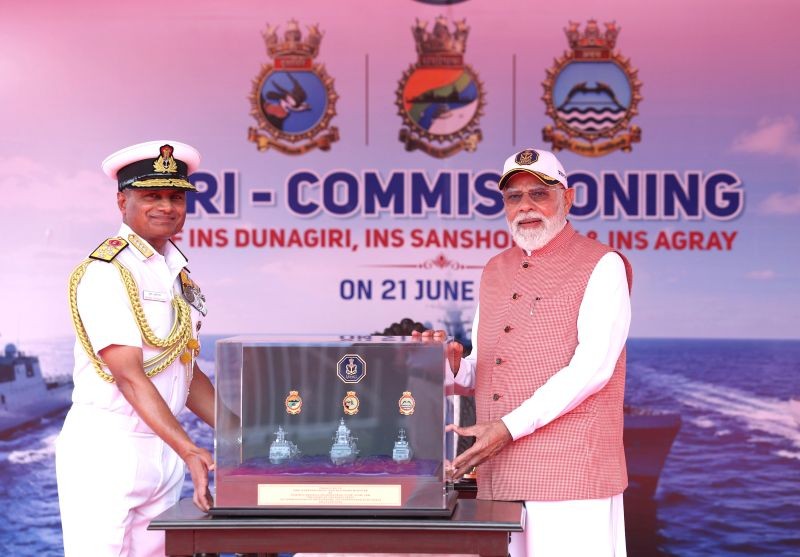
According to a government statement, the induction of the three vessels will significantly enhance India's operational capabilities, strengthen maritime domain awareness and bolster the security of the country's coastal waters against emerging geopolitical challenges.
All three ships were designed by the Indian Navy's Warship Design Bureau and constructed by Garden Reach Shipbuilders & Engineers (GRSE) in Kolkata, with the participation of more than 200 MSMEs and extensive contributions from Indian industry.
With over 75 per cent indigenous content, the vessels underscore India's commitment to self-reliance under the Aatmanirbhar Bharat initiative.
Also Read: PM Modi celebrates International Yoga Day in Kolkata, says the ancient exercise can keep you active even at 70
Addressing the gathering, Modi noted that the commissioning coincided with the International Day of Yoga, being observed worldwide, and expressed happiness at visiting the historic land of Bengal, which has played a pivotal role in India's intellectual, cultural and national renaissance while serving as a maritime gateway connecting India to the world for centuries.
Describing the event as a significant milestone in the journey towards an Aatmanirbhar Bharat, a secure India and a developed India, the Prime Minister highlighted another notable coincidence — June 21 is also observed globally as World Hydrography Day, the same day India's most advanced hydrographic survey vessel, INS Sanshodhak, entered service.
Congratulating the Indian Navy, scientists, engineers, workers and citizens, Modi said the achievement reflected India's growing technological and maritime capabilities.
"No nation can emerge as a major power without strong maritime capabilities. Development, security and prosperity are closely linked to the oceans. Most of the world's trade moves through sea routes, while vast global data networks operate beneath the oceans," he said.
The Prime Minister emphasised that critical minerals, deep-sea resources and future energy sources would increasingly be linked to the maritime domain, making maritime strength central to a nation's economic and strategic influence.
"The commissioning of these three naval platforms stands as testimony to the country's growing capabilities and skills," he said.
Recalling the commissioning of INS Vikrant, Modi said it had marked the beginning of a new chapter in India's maritime journey and signalled the country's growing naval strength to the world.
He said the journey from INS Vikrant to the commissioning of INS Agray, INS Dunagiri and INS Sanshodhak reflected India's increasing self-reliance.
"All three vessels symbolise India's commitment to indigenous design, manufacturing and innovation. Designed and built in India, they showcase the talent of Indian industries, the expertise of Indian engineers and the hard work of Indian workers," he said.
Asserting that India does not wish to remain merely a buyer in the global defence market, Modi said true military strength lies in self-reliance.
"India seeks to become a producer and manufacturer because nations that manufacture become decisive players on the global stage," he added.
Highlighting recent achievements, the Prime Minister said more than 40 indigenously built warships and submarines have been inducted into the Indian Navy in recent years. He noted that nearly every few weeks the Navy has acquired a new capability, while 45 major naval platforms are currently under construction.
"These are not just statistics but indicators of India's industrial capacity and future potential," he said.
Underscoring the employment-generating potential of the maritime sector, Modi described it as a key engine of economic growth.
"A modern ship requires large quantities of steel, electronics, machinery and thousands of components, creating opportunities across extensive industrial supply chains," he said.
Referring to the newly commissioned vessels, he noted that more than 200 MSMEs contributed to their construction, generating substantial employment and economic activity across the country.
The Prime Minister said India is now entering the next phase of maritime development and has adopted a new vision for the shipbuilding sector through a series of policy reforms aimed at strengthening domestic manufacturing.
"The ₹70,000-crore incentive package announced for the shipping sector is not merely an economic measure but an investment in India's maritime future and industrial expansion," he said, adding that initiatives such as Sagarmala are helping reduce logistics costs, accelerate industrial growth and create new opportunities in coastal regions.
Reflecting on India's defence transformation, Modi recalled that the country was once among the world's largest defence importers, creating strategic vulnerabilities.
Following the formation of his government in 2014, he said, sustained policy reforms and a strong focus on self-reliance had opened new opportunities in defence design, manufacturing and exports.
"India's defence production, which stood at around ₹40,000 crore in 2014, has now risen to nearly ₹1.8 lakh crore, reflecting significant progress towards building a strong, self-reliant and globally competitive defence industry," he said.
The Prime Minister said the progress achieved over the past twelve years demonstrated how transformative change becomes possible when policies are clear, direction is correct and all stakeholders work together towards national development.
Referring to India's rich maritime heritage, Modi said West Bengal naturally occupies a prominent place in discussions about the country's maritime legacy.
He noted that Bengal has historically played a crucial role in connecting India with the world through maritime trade, while the waters of the Hooghly River have witnessed centuries of commerce, development and historical change.
Modi also pointed out that the port is named after Dr Syama Prasad Mookerjee, Bengal's distinguished son and India's first Industry Minister, making the occasion even more significant.
"West Bengal is poised to become a major hub for India's Blue Economy, maritime manufacturing, logistics and coastal development in the years ahead," he said.
Reiterating India's longstanding approach towards the oceans, Modi said the country has always viewed maritime spaces as avenues for cooperation and connectivity.
"Security is indispensable for protecting prosperity, while self-reliance is necessary for building the future. INS Agray, INS Dunagiri and INS Sanshodhak embody these ideals and symbolise a nation that is increasingly aware of its capabilities, confident in its strengths and determined to move forward with renewed energy and purpose in the twenty-first century," he said.