
The measure will enhance Indian exporters' competitiveness in the UK market.
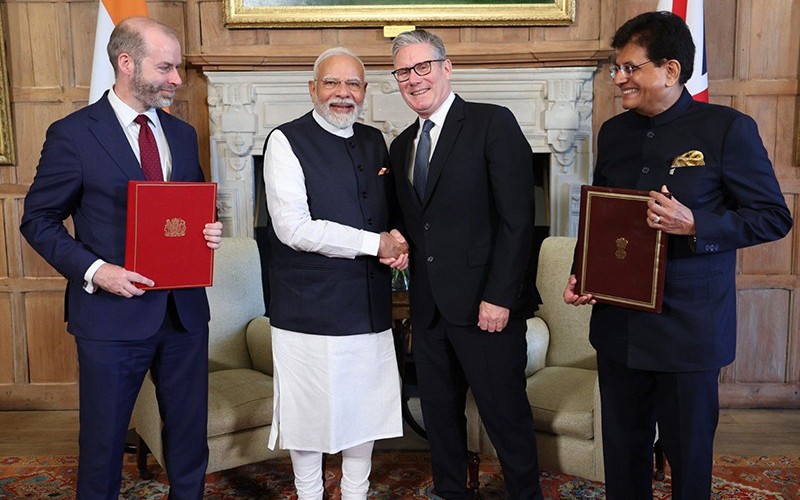
A significant milestone in India–UK economic relations was achieved with the signing of the Comprehensive Economic and Trade Agreement (CETA) on July 24, 2025.
The agreement was formalized in the presence of Prime Minister Narendra Modi and UK Prime Minister Keir Starmer, and was officially signed by India’s Minister of Commerce and Industry, Piyush Goyal, and the UK Secretary of State for Business and Trade, Jonathan Reynolds.
This is expected to particularly benefit exports of shrimp, frozen fish, and value-added marine products—boosting India’s presence in one of its major seafood destinations alongside labour-intensive sectors like textiles, leather, and gems and jewellery.
India’s key seafood exports to the UK currently include Vannamei shrimp (Litopenaeus vannamei), frozen squid, lobsters, frozen pomfret, and black tiger shrimp—all of which are expected to gain further market share under CETA’s duty-free access.
Under the India–UK Comprehensive Economic and Trade Agreement (CETA), all fish and fisheries commodities falling under the UK tariff schedule categories marked ‘A’ now enjoy 100% duty-free access from the date of entry into force of the agreement.
These products previously attracted tariffs ranging from 0% to 21.5%, all of which are now removed, substantially improving cost competitiveness in the UK market. However, products under HS 1601 (sausages and similar items) remain excluded under staging category ‘U’ and receive no preferential treatment.
India’s total seafood exports in 2024–25 reached $7.38 billion (₹60,523 crore), amounting to 1.78 million metric tonnes.
Frozen shrimp remained the top export, accounting for 66% of earnings with $4.88 billion. Marine exports to the UK specifically were valued at $104 million (₹ 879 crore), with frozen shrimp alone contributing $80 million (77%).
However, India’s share in the UK’s $5.4 billion seafood import market is just 2.25%. With CETA now in force, industry estimates project a 70% surge in marine exports to the UK in the coming years.
The fisheries sector supports the livelihoods of approximately 28 million Indians and contributes around 8% of global fish production.
Between 2014–15 and 2024–25, India's seafood exports rose from 10.51 lakh metric tonnes to 16.85 lakh metric tonnes (60% growth), while value increased from ₹33,441.61 crore to ₹62,408 crore (88% growth).
The number of export destinations expanded from 100 to 130 countries, with value-added product exports tripling to ₹7,666.38 crore signaling a shift towards high-end global markets. Coastal states like Andhra Pradesh, Kerala, Maharashtra, Tamil Nadu and Gujarat, already key players in seafood exports, are well-positioned to capitalize on CETA.
With targeted efforts to meet UK sanitary and phytosanitary (SPS) standards, these states can further expand their export footprint and enhance compliance with international norms.
The India–UK CETA marks a turning point for India’s fisheries sector not just by offering duty-free access to a premium market but also by uplifting coastal livelihoods, enhancing industry revenues, and strengthening India’s reputation as a reliable supplier of high-quality, sustainable seafood.
For fisherfolk, processors, and exporters alike, this is a unique opportunity to step onto a larger global stage. This agreement contributes meaningfully to India’s broader goal of becoming a global leader in sustainable marine trade.
Indian seafood now competes on par with countries like Vietnam and Singapore, which already benefit from FTAs with the UK i.e United Kingdom–Vietnam Free Trade Agreement -UK-VFTA and UK–Singapore Free Trade Agreement -UK-SFTA respectively.
This levels the playing field and removes tariff disadvantages that Indian exporters previously faced especially for high-value products like shrimp and value-added goods.
With India’s vast production capacity, skilled manpower, and improved traceability systems, CETA enables Indian exporters to seize a larger share of the UK market and diversify beyond traditional partners like the US and China.