
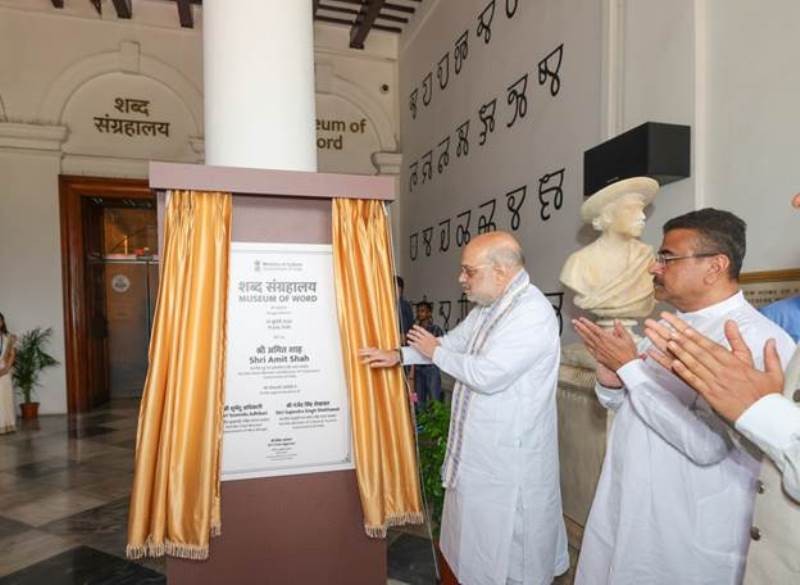
Union Home Minister Amit Shah said that the Museum of Word beautifully depicts the entire journey of the composition of Panini's grammar.
He said that the Rigveda states that noble and auspicious thoughts should continue to come to us from all directions—thoughts that are never suppressed, never obstructed, and on the basis of which we should shape and advance our social life.
Shah said that narrow-mindedness can never arise in our civilization because there is no place for narrowness in the very foundation of Indian thought.
He added that whenever we perform Bhoomi Pujan or recite the Shanti Mantra, we pray for peace not only for humanity but also for animals, plants, and the entire universe.
Therefore, he said, narrow-mindedness can never be a symbol of Indian culture.
Shah said that the Museum of Word will educate future generations about India's languages and culture for generations to come, introduce them to the country's rich cultural heritage, and also guide them in the way of life rooted in that heritage.
He said that India has never imposed restrictions on ideas or thought.
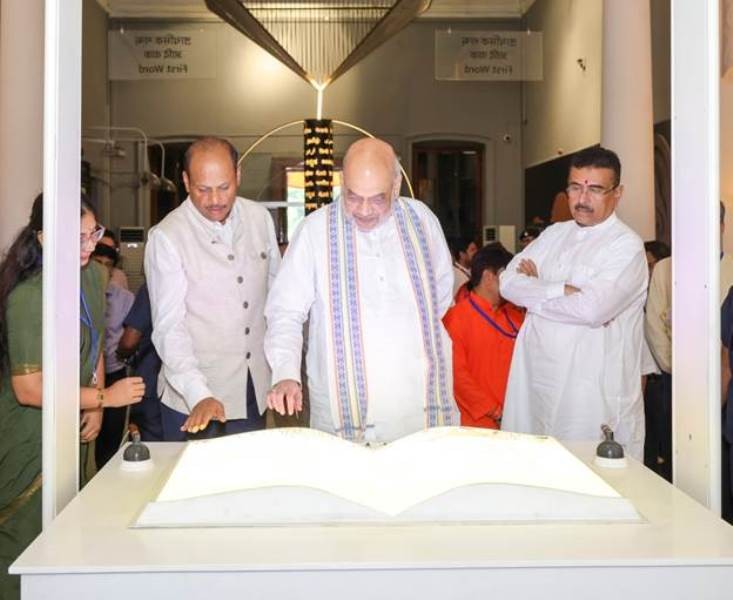
Shah noted that the museum traces the entire journey of the written word—from the sacred Omkar to the origin of words and the development of grammar; from the Shrutis and Smritis to manuscripts and inscriptions; and from the printing press to the modern era.
Union Home Minister said that the Museum of Words should be expanded to encompass digital technologies and Artificial Intelligence (AI), enabling Indian languages to evolve in line with the technologies of the future.
He said that India has never shied away from innovation and has always embraced all that is noble and auspicious. That is why, despite countless challenges and assaults, the nation's cultural journey stands as steadfast as the Himalayas.
He further said that the Museum of Words is an innovative initiative to preserve India's multilingual consciousness, knowledge traditions, and collective memory through visual, auditory, and immersive experiences.