
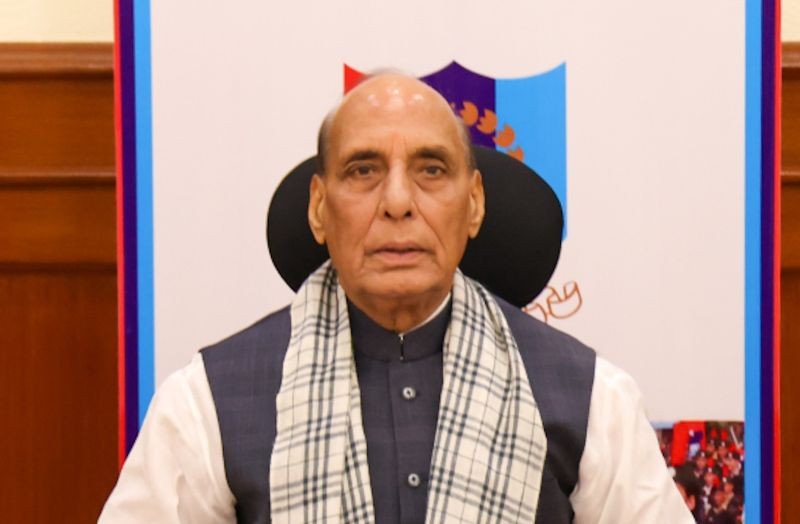
Speaking in the Lok Sabha on the debate on Operation Sindoor, Singh said: "The objective of Operation Sindoor was not to cross the border or capture the territory, it was to eliminate terror nurseries which Pakistan had nurtured for years, and provide justice to the innocent families who lost their loved ones in cross-border attacks."
He termed Pakistan-sponsored terrorism as not “Random Madness”, but a “well-planned strategy” and a “fundamental rage”, emphasising that the overall politico-military objective of Operation Sindoor was to punish Pakistan for fighting a proxy war in the form of terrorism.
Singh asserted that, during Operation Sindoor, India not only demonstrated its military capability, but also its national resolve, morality and political acumen, stressing that New Delhi will give a decisive and clear answer to any terrorist attack.
“Those who provide shelter and support to terrorism will not be spared. India is not going to bow down to any kind of nuclear blackmailing or other pressures,” he said.
Rajnath Singh described the Pahalgam terrorist attack on April 22, 2025, when 26 innocent people, including a Nepali citizen, were killed on the basis of their religion, as the vilest example of inhumanity, which tested the limits of India’s tolerance.
He stated that, immediately after the attack, PM Modi held a high-level meeting, and the Armed Forces were given the freedom to take decisive action keeping in mind discretion, strategic understanding and regional security situation.
“On May 06 & 07, 2025, the Indian Armed Forces launched Operation Sindoor, which was not just a military action, but an effective and decisive demonstration of the Government’s responsibility towards India’s sovereignty, its identity & the people of the country, as well as its policy against terrorism. Our military leadership not only showed its maturity but also demonstrated the strategic wisdom which is expected from a responsible power like India,” said Rajnath Singh.
Singh highlighted that the Armed Forces carried out Operation Sindoor after studying every aspect in depth.
“There were a number of options on the table, but we chose the option in which the terrorists and their hideouts suffered maximum damage and the common citizens of Pakistan did not suffer any harm. According to an estimate, over 100 terrorists, their trainers, handlers and associates were killed in well-coordinated strikes by our forces at nine terror infrastructure targets in Pakistan and PoK with precision. Most of the terrorists belonged to organisations like Jaish-e-Mohammed, Lashkar-e-Taiba and Hizbul Mujahideen, which have the open support of Pakistan Army and ISI. Our action was completely in self-defence. It was neither provocative nor expansionist,” he said.
Rajnath Singh further stated that, on May 10, 2025, Pakistan used missiles, drones, rockets and other long-range weapons on India, in addition to technologies related to electronic warfare, on a large scale, targeting Indian Air Force bases, Indian Army ammunition depots, airports and military cantonments.
He informed the House with pride that India’s air defence system, counter-drone system and electronic equipment completely foiled the attack, highlighting the effectiveness of S400, Akash Missile System and air defence guns.
“Our security system was foolproof and every attack was foiled. Pakistan was unable to hit any of the Indian targets and none of the important assets were damaged,” said Singh, while appreciating the soldiers for their bravery & determination.
Singh termed India’s response to Pakistan’s attack as bold, firm and effective. “The Indian Air Force targeted Pakistan’s airbases, Command and Control centers, Military infrastructures, and Air Defense Systems on the Western Front, and the mission was successfully accomplished. Our retaliatory attack was swift, proportionate and precise,” he stated.
Rajnath Singh added that the Indian Armed Forces only targeted those who were continuously involved in trying to attack India while supporting terrorists.
"The objective was never to wage war but to compel the adversary to bow down through demonstrative use of force,” he said, asserting that none of soldiers suffered any casualties during the operation.