
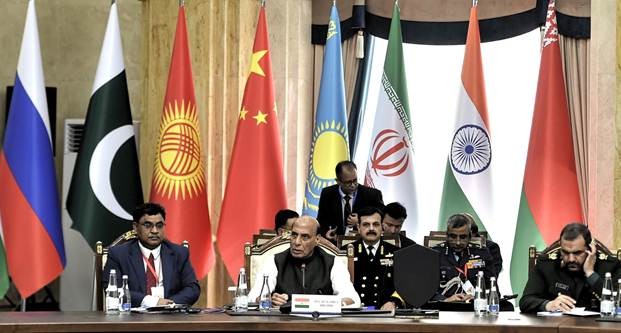
Calling for a united front against the “evils” of terrorism, separatism and extremism, Singh stressed the need to eliminate safe havens and reject political exceptions.
He asserted that the threat of state-sponsored cross-border terrorism, which attacks the sovereignty of nations, must not be ignored and said there is no place for double standards.
‘ऑपरेशन सिंदूर’ के दौरान हमने स्पष्ट कर दिया कि आतंकवाद के केंद्र अब सज़ा पाने से किसी भी तरह बच नहीं सकते। यह ऑपरेशन आतंकवाद और उसके समर्थकों के प्रति हमारे ‘zero tolerance’ दृष्टिकोण का प्रमाण है। pic.twitter.com/Qg2vA2sv9d
— Rajnath Singh (@rajnathsingh) April 28, 2026
Operation Sindoor was launched following a deadly terrorist attack on tourists in Pahalgam, Jammu and Kashmir, which Indian authorities linked to Pakistan-based terror groups.
Singh said the SCO should not hesitate in taking appropriate action against those who abet, shelter and provide safe havens to terrorists.
“By tackling terrorism, separatism and extremism without exception, we transform regional security from a challenge into a cornerstone for peace and prosperity,” he said.
Describing counter-terrorism as a foundational principle of the SCO, Singh noted that the organisation has consistently condemned such acts and ideologies in a common fight against the menace.
He recalled last year’s Tianjin Declaration, which reflected India’s firm and collective stance against terrorism, calling it a testimony to the country’s zero-tolerance approach toward terrorism and its perpetrators.
“The real test of collective credibility remains in consistency. We must not forget that terrorism has no nationality and no theology. Nations must take a firm and collective stance against terrorism,” he added.
Singh also highlighted the important role of the SCO’s Regional Anti-Terrorist Structure, noting that the joint statement of the Heads of State on ‘Countering Radicalisation leading to Terrorism, Separatism and Extremism’, issued during India’s Chairmanship, symbolised the shared commitment of member nations.
Referring to the current global uncertainties, Singh said the SCO holds a pivotal role at a time when the world appears increasingly fractured and countries are becoming more inward-looking.
“Do we need a new world order or a world that is more orderly? We need an order where every citizen of this world is treated with dignity and respect. We need an order where differences do not become disputes and disputes do not precede disasters,” he said.
“The real crisis today is not the absence of order, but the growing tendency to question the established rule-based world order. We must focus on a global consensus where co-existence, co-habitation and compassion take precedence over chaos, competition and conflict,” Singh added.
He said it is the responsibility of the SCO to ensure both regional and global peace and stability.
“We should continue to follow the path of dialogue and diplomacy, not unrelenting force. We should not allow this to become an era of violence and war, but an era of peace and prosperity,” Singh said.
“As people responsible for defence and security, we have the responsibility to uphold this spirit of brotherhood and harmony. The real test of power is not in using it against the poor and the weak, but in using it in the interest of those who are unable to defend themselves,” he added.