
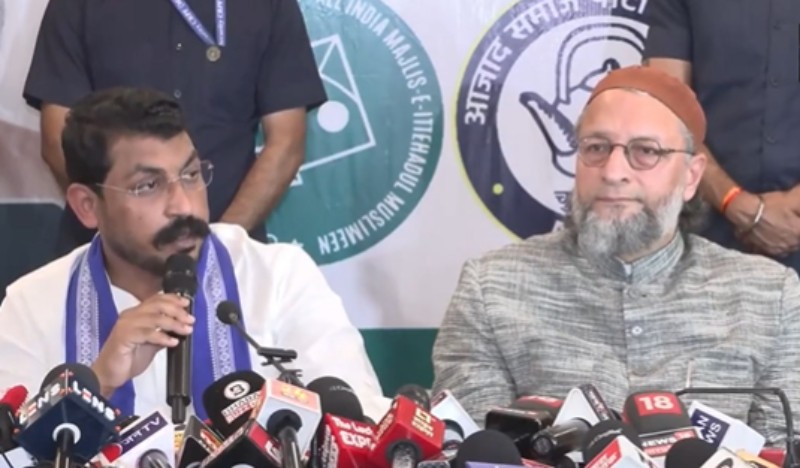
The two parties have named their new political front Samajik Parivartan Morcha, with Azad projected as its chief ministerial candidate.
The alliance was announced at a joint press conference in Lucknow on Thursday, where the leaders presented the formation as a platform for the rights of Dalits, minorities, young people, farmers and other marginalised communities.
Owaisi targets BJP 3.0
Owaisi said the alliance was intended to prevent the Bharatiya Janata Party (BJP) from returning to power for a third consecutive term in Uttar Pradesh.
“I can say with confidence that this will be a strong alternative in Uttar Pradesh to stop the BJP from coming to power for the third time,” he said.
“We will do politics for the future. We hope the people of Uttar Pradesh will join hands with Chandrashekhar Aazad to build a better future,” he added.
The announcement comes as political parties step up preparations for the 2027 Assembly elections.
The BJP is seeking another term in office, while the opposition Samajwadi Party (SP)-Congress combine is preparing to challenge its position in the state.
Asked whether the alliance was being positioned as a third political front, Azad said it was not simply another electoral alternative but a “front for social change”.
Dalit-Muslim consolidation at the centre
The alliance seeks to bring together Dalit and Muslim voters, two significant electoral groups in Uttar Pradesh.
Its leaders have framed the partnership around the political representation and rights of communities they believe remain marginalised.
For Owaisi, the arrangement could offer an opportunity to expand AIMIM’s presence in the state beyond its existing minority support base.
Azad, meanwhile, could use the partnership to widen his party’s reach among Dalit voters, particularly young people.
However, converting the proposed Dalit-Muslim combination into a cohesive electoral bloc and translating it into seats will be a major test for the new front.
Owaisi turns to Azad after INDIA bloc talks stall
The alliance follows Owaisi’s unsuccessful efforts to secure a place for AIMIM in the opposition INDIA bloc’s electoral arrangement in Uttar Pradesh.
His proposal to participate in seat-sharing discussions with the SP and Congress did not receive a favourable response.
Owaisi had earlier set October 2 as the deadline for the two parties to respond to his offer.
With no agreement emerging, AIMIM explored an alternative arrangement with Azad’s party, eventually leading to the formation of the Samajik Parivartan Morcha.
The new alliance adds another political player to a contest that has largely revolved around the BJP-led National Democratic Alliance (NDA) and the opposition grouping led by the SP and Congress.
What the 2022 election results show
The electoral performance of the parties in the previous Assembly elections highlights the challenge facing the new front.
In the 2022 Uttar Pradesh Assembly elections, the BJP won 255 of the state’s 403 seats, while the Samajwadi Party secured 111.
The Bahujan Samaj Party (BSP) won just one seat, and the Congress managed two.
AIMIM contested 95 constituencies but failed to win a single seat, securing around 0.49 percent of the total vote. The Azad Samaj Party also failed to open its account.
The alliance will therefore seek to build a stronger electoral presence by combining the organisational networks and support bases of the two parties.
Mayawati’s BSP remains a factor
The BSP remains an important factor in Uttar Pradesh’s electoral calculations, particularly because of its established support among Dalit voters.
Party chief Mayawati has indicated that the BSP will contest the 2027 Assembly elections independently as it seeks to rebuild its political base.
The decision adds another dimension to the competition for Dalit votes, with the BSP, the Samajik Parivartan Morcha and other political formations likely to seek support from overlapping sections of the electorate.