
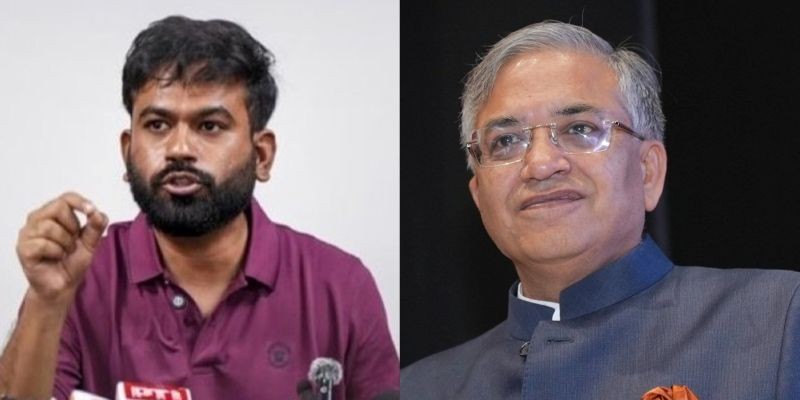
The CJP has warned of a nationwide agitation if Kumar does not resign within the deadline.
CJP demands Gyanesh Kumar's resignation
Addressing a press conference, CJP founder and convener Abhijeet Dipke said the issue was not about political parties or the Opposition but the individual rights of voters.
“It is not a matter for political parties or the Opposition; it is about the individual rights of voters. Voters are being denied their rights, and this cannot be allowed. Gyanesh Kumar, in particular, cannot take away such a right.
“How long will voters stand in queues and vote for change, only to see their efforts go in vain? Therefore, Gyanesh Kumar must vacate his post to ensure free and fair elections. If Gyanesh Kumar does not resign within 48 hours, the Cockroach Janta Party will launch a nationwide agitation. We will not back down until he resigns,” he said.
If CEC Gyanesh Kumar doesn’t resign in 48 hours, we will start a nationwide agitation.
— Cockroach Janta Party - CJP (@Cockroachisback) September 24, 2026
Gyanesh Kumar Isteefa Do! pic.twitter.com/mzsU8i5pft
"CEC Gyanesh Kumar is the biggest Anti National in this country. He should resign immediately," Dipke added.
CEC Gyanesh Kumar is the biggest Anti National in this country.
— Cockroach Janta Party - CJP (@Cockroachisback) September 24, 2026
He should resign immediately. pic.twitter.com/NXx68NShPm
CJP's earlier protest
Earlier this year, the CJP claimed that its protests over the alleged NEET question paper leak had led to the resignation of Union Education Minister Dharmendra Pradhan in an unusual political development during the Modi government.
Investigative report on SIR
The controversy follows a report by The Indian Express that detailed differences within the three-member Election Commission involving CEC Gyanesh Kumar and Election Commissioners Sukhbir Singh Sandhu and Vivek Joshi.
According to the investigation, Sandhu and Joshi formally raised objections at least 14 times over a period of 10 months to decisions and orders concerning electoral rolls and the SIR. They reportedly said some decisions had been taken without their knowledge.
The objections covered changes to Form 6, access to the electoral-roll database, deletion and restoration of voter names, appeals related to electoral rolls and aspects of the ECI's internal decision-making.
The two Election Commissioners also reportedly raised concerns over what they described as the gradual centralisation of the electoral-roll database.
Electoral Registration Officers (EROs) at the constituency level have statutory responsibility for preparing and maintaining electoral rolls.
According to the investigation, Joshi called for an audit to ensure that only authorised statutory officials could alter the voter database, while Sandhu recorded complaints from state-level officials that they did not have "proper and complete access" to the relevant systems.
The report also said the two Commissioners separately wrote to Cabinet Secretary T V Somanathan over changes in the ECI's work allocation that they felt could further concentrate control over the IT systems handling electoral rolls.
Election Commission rejects claims of internal rift
The Election Commission has disputed the interpretation of the report, saying that written objections, suggestions and differing views are part of its internal deliberative process.
EC sources said all decisions, including those concerning the SIR, were taken with the approval of all three Election Commissioners and were unanimous.