
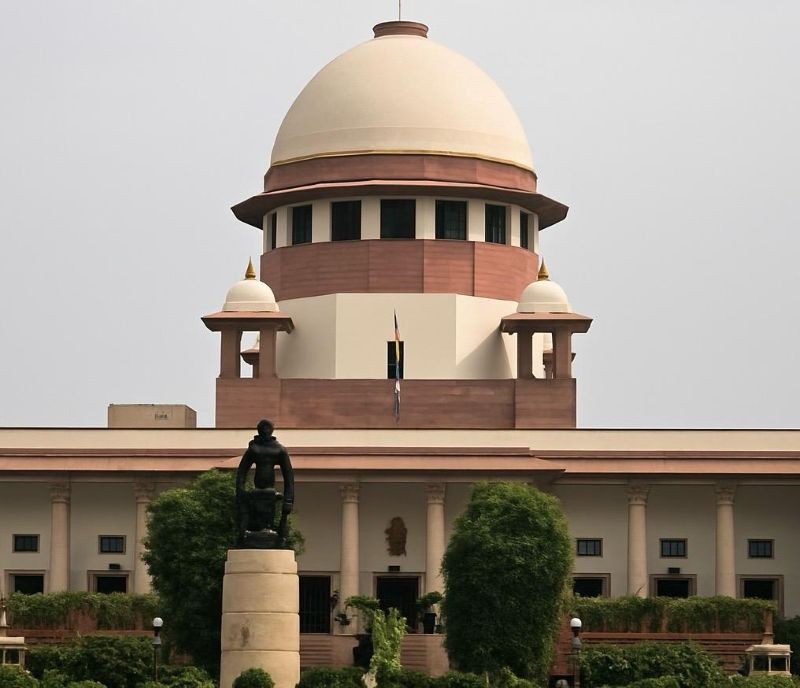
Supreme Court rules BCI cannot act against law students
The top court said that neither the BCI nor State Bar Councils have the authority to initiate disciplinary proceedings against law students.
It clarified that the Bar Councils can exercise their jurisdiction against a law graduate only after the person is enrolled as an advocate.
A bench comprising Chief Justice of India Surya Kant and Justices Joymalya Bagchi and V. Mohana observed that disciplinary action against students can be initiated only by their parent educational institution or any competent authority empowered under the institution's rules.
BCI directed State Bar Councils to withhold enrolment
The BCI had directed State Bar Councils not to enrol the 2026 graduating batch of NALSAR University of Law as advocates.
The directive followed a controversy involving students who had questioned a proposed invitation to CJI Surya Kant as the chief guest at the university's convocation.
BCI later withdrew enrolment directive
The BCI subsequently withdrew its enrolment-related action after considering representations and reactions, clearing the way for the graduates to enrol as advocates.
During an earlier hearing, CJI Kant had asked the BCI to refrain from interfering in the matter, describing it as an issue between him and the students.
The CJI had also recalled his own experience of participating in student protests.
Why did NALSAR students object?
The controversy began after a group of graduating students submitted a representation to the Vice-Chancellor, Registrar and professors, urging the university to reconsider the reported invitation to CJI Surya Kant.
The students argued that the convocation should reflect NALSAR's stated commitment to constitutional rights, access to justice and reasoned engagement with grievances.
Their objection was linked to remarks reportedly made by CJI Kant during Supreme Court proceedings concerning alleged police action against protesters at Delhi's Jantar Mantar.
Jantar Mantar protest at centre of dispute
The proceedings followed a July 20 "Chalo Sansad" demonstration organised by the Cockroach Janta Party.
Protesters had raised several issues, including concerns over the NEET examination and the functioning of the National Testing Agency (NTA).
The protesters attempted to march towards Parliament, resulting in clashes with security personnel.
Two days later, a lawyer sought urgent listing of a petition alleging police excesses against the protesters.
The matter was mentioned before a Supreme Court bench headed by CJI Kant and comprising Justices Joymalya Bagchi and V. Mohana.
The lawyer alleged that students had been subjected to police brutality and told the court that video evidence was available.
During the exchange, CJI Kant reportedly said, "don't waste our time and yours" and "we don't want to watch any videos".
The remarks subsequently became a point of contention for the NALSAR students who opposed the proposed invitation.