
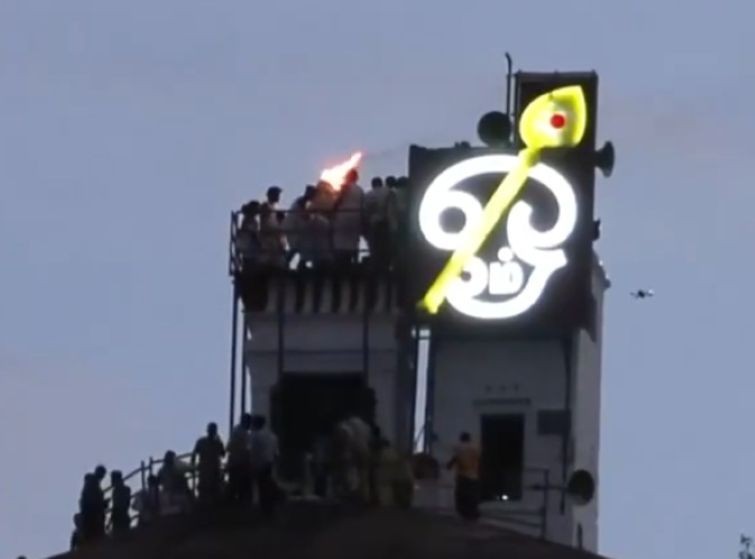
The district Collector had been designated by the Supreme Court as the nodal officer for implementing the order.
Neither the ruling TVK nor the Hindu Religious and Charitable Endowments Department has so far explained why the lamp was not lit at the hilltop pillar.
#BREAKING Has Vijay’s TVK government defied the Supreme Court’s order? The Karthigai Deepam was lit at its traditional spot at the Ucchi Pillayar temple in Thiruparankundram, Madurai So far no lamp has been lit at the disputed Deepathoon site, despite Supreme court orders 👇🏻 https://t.co/CUfCGW3BZC
— Nabila Jamal (@nabilajamal_) November 24, 2026
The decision could invite further legal scrutiny, particularly as a contempt petition over earlier non-compliance with the Madras High Court's directions is already pending.
Deepam lit at traditional location
The temple administration said the Karthigai Maha Deepam was lit at the Deepa Mandapam near the Uchi Pillaiyar temple, maintaining that the practice was rooted in age-old customs, rituals and Agama rules.
Law-and-order concerns appear to have played a major role in the decision. The district administration imposed prohibitory orders on Monday night, citing intelligence inputs that groups from both communities could gather in large numbers at Thiruparankundram.
BJP leaders L Murugan and Nainar Nagendran were also prevented from proceeding to the hill.
State Law Minister Nirmal Kumar announced the lighting at the traditional location but did not address why the Supreme Court-permitted lighting at the hilltop pillar was not carried out.
Political reactions intensify
The decision triggered sharp reactions. Congress MP Manickam Tagore took a swipe at those he accused of politicising the festival, saying, "Those who came to do politics at the Deepam festival have been left disappointed."
BJP leader Tamilisai Soundararajan criticised the government, accusing it of disregarding Hindu sentiments and the law.
The AIADMK and BJP have also attacked the TVK government, with the BJP alleging minority appeasement.
What is the Thiruparankundram Deepam controversy?
The dispute centres on whether the Karthigai Deepam should also be lit at a stone pillar on the summit of Thiruparankundram hill, close to a Dargah. Petitioners have described the pillar as a Deepathoon, or lamp pillar.
In its December 1, 2025 judgment, the Madras High Court directed that the Deepam be lit at the hilltop pillar in addition to the customary location near the Uchi Pillaiyar temple.
The direction was subsequently upheld in proceedings before the Supreme Court.
The then DMK government had resisted the direction, citing law-and-order concerns and arguing that the established practice was to light the lamp near Uchi Pillaiyar.
It also disputed the pillar's character, maintaining that it was a survey stone and that there was no historical evidence of it being used for lighting lamps.
The dispute has historical roots, with attempts to light the Deepam at the hilltop location recorded in 1862 and 1912, both stopped by authorities citing the absence of an established custom and the possibility of a breach of peace. A similar dispute arose in 1996.
On November 20, the Supreme Court permitted a one-time lighting at the hilltop pillar on November 24.
The permission did not establish a permanent customary, religious or proprietary right and did not displace the traditional observance near Uchi Pillaiyar.
The Tamil Nadu government subsequently filed a review petition seeking reconsideration of the order, but it was not taken up on Tuesday.
Vijay Government faces political and legal dilemma
The episode places Chief Minister Vijay's government in a politically delicate position. The TVK runs a minority government and depends on allies, including the VCK and IUML, which have expressed reservations about lighting the Deepam at the hilltop pillar over concerns about communal harmony.
Implementing the Supreme Court's interim order could have exposed the government to political criticism from its allies, while not implementing it risks questions over its commitment to judicial authority and the rule of law.
The TVK has consistently positioned the BJP as its ideological opponent, making the issue politically sensitive.
Government sources maintain that local Hindu and Muslim communities have no dispute over existing religious practices at Thiruparankundram and argue that the demand for lighting at the hilltop pillar has been driven by right-wing groups from outside the area.
The episode also raises a broader constitutional question: how far can a state government invoke law-and-order concerns to justify not implementing a judicial order?