
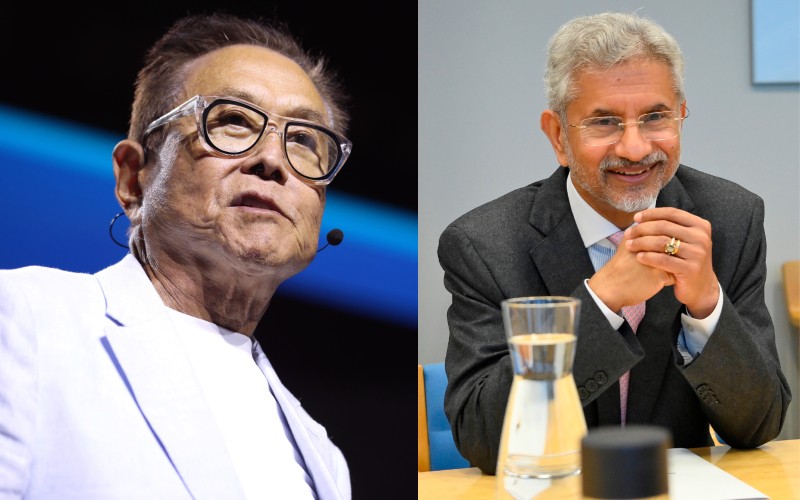
The development has drawn international attention, including praise from renowned investor and author Robert Kiyosaki.
Kiyosaki, best known for the book Rich Dad Poor Dad, highlighted India’s diplomatic manoeuvre in a social media post, noting that ships linked to the United States, Europe and Israel faced blockades or attacks in the region while Indian tankers were allowed safe passage.
He noted that New Delhi managed to safeguard its shipping routes and energy supplies without any military action, operating a 24-hour monitoring control room and reportedly securing safe passage after just three phone conversations between External Affairs Minister S. Jaishankar and his Iranian counterpart.
Shenlong tanker completes risky passage
The Liberia-flagged oil tanker Shenlong became a key example of this diplomatic breakthrough.
The vessel, captained by an Indian, departed the Saudi Arabian port of Ras Tanura on March 1 carrying 135,335 metric tonnes of crude oil.
By March 8, the tanker had entered the Strait of Hormuz, one of the world’s most strategically sensitive maritime corridors.
Shortly afterwards, the vessel disappeared from public tracking systems after its crew switched off the mandatory Automatic Identification System transponder.
The ship resurfaced on monitoring networks the following day after clearing the narrow waterway and subsequently docked at Mumbai Port on March 11.
The successful transit marked one of the first crude shipments to reach India safely since the regional conflict escalated.
Diplomatic talks with Iran
Kiyosaki suggested that India’s success was rooted in direct diplomatic engagement with Tehran.
According to him, Jaishankar held three conversations within two weeks with Iranian Foreign Minister Abbas Araghchi.
The discussions reportedly focused on ensuring the safety of Indian shipping and maintaining uninterrupted energy supplies.
The talks took place on February 28, March 5 and March 10, shortly before the successful tanker transit.
Kiyosaki summarised the situation by stating that vessels connected to the United States and Europe were blocked while those linked to Israel were targeted.
In contrast, Indian ships were allowed to pass through the strategic chokepoint.
Rising risks in Strait of Hormuz
The Strait of Hormuz remains one of the most crucial energy corridors in the world, handling close to 20 million barrels of oil daily.
However, the waterway has become increasingly dangerous amid the ongoing regional conflict.
Iranian authorities have reportedly warned that vessels must seek permission before crossing the strait.
Ships attempting to pass without clearance risk interception or attack by the Islamic Revolutionary Guard Corps.
Two vessels, Express Rome and Mayuree Naree, were recently struck while navigating the area after reportedly ignoring warnings.
These incidents intensified concerns about the security of maritime traffic in the region.
More Indian tankers cross Hormuz
Following the successful passage of Shenlong, two additional vessels—Pushpak and Parimal—also reportedly navigated the strait safely.
Kiyosaki described the development as a notable diplomatic achievement, arguing that India effectively secured a safe corridor for its vessels through negotiation rather than confrontation.
He emphasised that India’s approach demonstrated how strategic diplomacy can protect national interests even in volatile geopolitical environments.
Protecting India’s energy security
The stakes are high for India because more than half of its crude oil and natural gas imports typically pass through the Strait of Hormuz.
Any prolonged disruption in the waterway could significantly affect the country’s energy supply.
According to Kiyosaki, India’s government established a 24-hour monitoring system to track shipping movements in the region.
The control room, reportedly operational since February 28, oversees Indian vessels operating in the Persian Gulf.
At present, around 28 Indian-flagged ships are active in the Gulf region, while hundreds of Indian seafarers remain stationed west of the strait.
Kiyosaki argued that this coordinated strategy helped ensure the safe transit of oil cargoes and protected India’s energy lifeline during a period of heightened global tension.
Reflecting on the episode, he concluded that India managed to secure its critical supply routes without firing a single shot, highlighting diplomacy as the key factor behind the country’s successful navigation of one of the world’s most dangerous maritime chokepoints.