
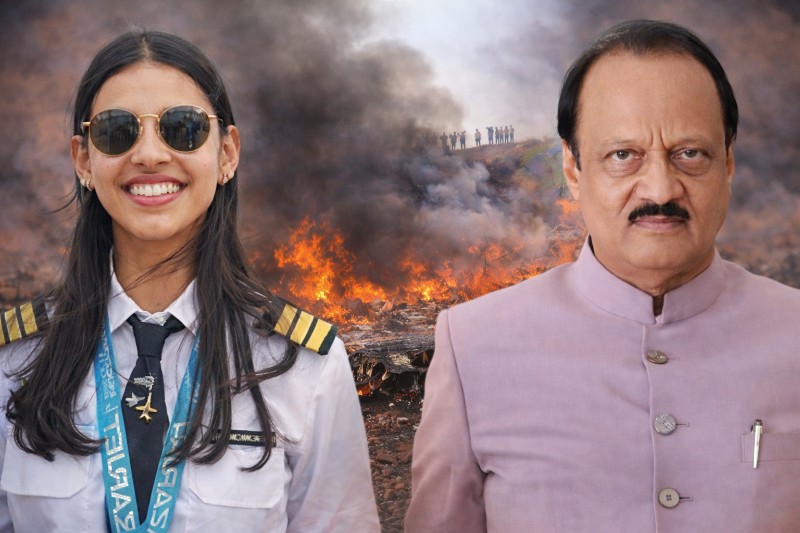
The Learjet 45 aircraft crash claimed five lives, including Maharashtra Deputy Chief Minister Ajit Pawar, his personal security officer, an aide, and two cockpit crew members.
The jet went down during a second landing attempt at the Baramati table-top airstrip around 8:45 am.
The aircraft was operated by Delhi-based VSR Ventures Pvt Ltd.
Those killed in the crash included 66-year-old Ajit Pawar, pilot-in-command Sumit Kapur, first officer Shambhavi Pathak, Pawar’s personal security officer Vidip Jadhav, and his attendant Pinky Mali.
According to a senior official from the Directorate General of Civil Aviation (DGCA), the brief but alarming cockpit exchange was captured shortly before the aircraft lost control.
“The last words heard from the crew were ‘oh sh*t’,” the official said, indicating a sudden realisation of imminent danger.
Officials said air traffic coordination at Baramati airport is overseen by pilot cadets from two private aviation academies in the town — Redbird Aviation and Carver Aviation — who serve as the point of contact for incoming aircraft.
Later in the evening, a specialised team from the Aircraft Accident Investigation Bureau (AAIB) reached the crash site to launch a detailed forensic investigation into the sequence of events and technical failures that led to the disaster.
Maharashtra Deputy CM Ajit Pawar dies in a plane crash in Baramati. Visuals of fire and thick smoke at the crash site #AjitPawar #Baramati #PlaneCrash #Maharashtra #DeputyCM #BreakingNews #NCP #IndiaNews #AviationAccident pic.twitter.com/L4n8HvT6V6
— India Blooms (@indiablooms) January 28, 2026
What happened before the crash
A statement issued by the Civil Aviation Ministry laid out a minute-by-minute account of the aircraft’s final moments, flagging several procedural and situational concerns.
At 8:18 am, the aircraft, registered as VT-SSK, established contact with Baramati airport.
The crew was informed of prevailing weather conditions and advised to land at their discretion.
Captain Kapur had logged over 15,000 flying hours, while co-pilot Pathak had approximately 1,500 hours of experience.
The pilots sought updates on wind and visibility and were informed that visibility stood at around three kilometres, generally considered sufficient for landing.
First landing aborted amid poor visibility
During the first approach to Runway 11, the crew reported that the runway was not visible, prompting air traffic control to instruct a go-around — a standard aviation procedure when landing conditions are deemed unsafe.
Following the aborted attempt, the aircraft repositioned for a second approach. The pilots reported being on final approach again and confirmed that the runway was now visible.
Missed readback raises red flags
At 8:43 am, the aircraft was cleared to land.
However, investigators noted a potentially critical lapse: the crew did not provide a readback confirming receipt of the landing clearance.
Just a minute later, at 8:44 am, air traffic controllers observed flames near the threshold of Runway 11, indicating that the aircraft had already crashed.
Eyewitnesses describe explosions and fire
Residents living near Baramati airport recounted dramatic scenes moments before and after the crash.
Several villagers said the aircraft appeared unstable during descent and crashed nearly 100 feet short of the runway.
CCTV footage captured the jet overturning mid-approach, followed by explosions and towering flames.
Witnesses reported four to five successive blasts after the initial impact.
Rescue attempts thwarted by intense fire
Locals rushed towards the crash site but were unable to assist due to the ferocity of the fire and thick smoke engulfing the wreckage.
Some villagers said debris from the aircraft was hurled into nearby homes after the explosion, underlining the force of the impact.
Investigation underway
With cockpit audio, procedural gaps, and challenging weather conditions now under scrutiny, investigators from the AAIB and DGCA are working to piece together the precise chain of failures that led to one of Maharashtra’s most tragic aviation accidents in recent years.
The final accident report is expected to shed light on whether human error, environmental factors, or technical malfunction played the decisive role in the crash.