
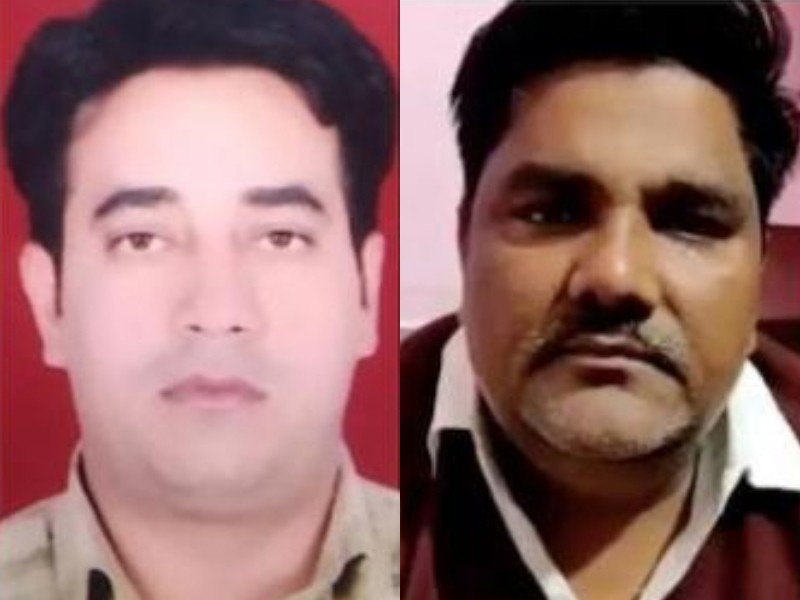
The Karkardooma court in Delhi, while declining the prosecution's request for the death penalty, described the manner of Sharma's killing as being of “utmost brutality” and said the crime had been committed on religious grounds.
The court sentenced Hussain, Nazim, Qasim, Javed and Anas to life imprisonment after convicting them earlier this month of murder, criminal conspiracy and other offences in connection with Sharma's death.
‘Utmost brutality’
While pronouncing the sentence, the court said the circumstances surrounding Sharma's death had deeply disturbed society.
“The manner of the crime was of utmost brutality,” the court observed, adding that the offence was committed “solely on the ground of religion”.
The court also referred to the treatment of Sharma's body after the attack. “The savagery did not end with the murder. His body was dragged into a drain nearby as if the hatred was still not satiated,” it said.
The judge further described the barbarity involved in the incident as “nauseating and sickening”.
Sharma, 26, was working as a security assistant with the IB when he was killed during the violence that swept through parts of northeast Delhi in February 2020.
According to the prosecution case, he was attacked with knives, sticks, rods and stones before his body was taken to a nearby drain.
His body was recovered the following day with at least 51 knife wounds.
Court rejects death penalty plea
Delhi Police had sought the death penalty for Hussain and the other convicts, arguing that the case qualified as one of the “rarest of rare” offences.
The court, however, stopped short of imposing capital punishment.
It noted that the prosecution had not produced material showing that the convicts had a continuing propensity towards violence or that they posed an irreversible threat to society.
The court also took into account the absence of previous criminal records.
“The final test is whether the convict is beyond redemption or not,” the court said, while noting that individual circumstances could constitute mitigating factors.
It further observed that participation in an unlawful assembly and commission of the offence, by themselves, did not automatically justify capital punishment.
Prosecution's case in Ankit Sharma murder
According to the chargesheet, Sharma was attempting to pacify two groups near Hussain's residence at around 5 pm on February 25, 2020, when he was surrounded by a mob.
The prosecution alleged that Sharma was subsequently assaulted and killed before his body was dragged towards Chand Bagh Pulia and dumped in a drain.
The case became one of the most prominent prosecutions arising from the communal violence that erupted in northeast Delhi in February 2020.
Tahir Hussain plans to challenge verdict
Hussain has rejected the allegations against him and said he would challenge the verdict before the Delhi High Court.
Speaking after the sentencing, the former AAP councillor said, “We will go to the High Court. We will get justice from the High Court.”
He also described the proceedings as a “fixed match”, saying, “Ye match fixed tha. Insaaf milega toh High Court se milega. (This match was fixed. If I get justice, it will be from the High Court.)”
His lawyer Tara Narula said the defence believed Hussain had not directly participated in the killing.
“The court has only two options - life sentence or death sentence. The court agreed that it was a case of vicarious liability,” Narula told reporters.
She added that none of the five accused had used a knife and said the defence was preparing to appeal.
Another defence lawyer, Abdul Gaffar Khan, also said an appeal would be filed for the accused he represented.
“I cannot speak for Mr Tahir Hussain, as I was not representing him; he was a co-accused in this matter. However, for the accused I represent, we will certainly file an appeal,” Khan said.
Kapil Mishra seeks death penalty
Delhi Law Minister Kapil Mishra welcomed the life sentence but said he wanted the punishment to be enhanced to death by the High Court.
In a post on X, Mishra said, “Life imprisonment for Tahir Hussain is the beginning of justice.”
He referred to the circumstances surrounding Sharma's death and said the case “certainly” qualified as a “rarest of rare” matter. Mishra expressed hope that the High Court would convert the life sentence into capital punishment.
ताहिर हुसैन को उम्रकैद न्याय की शुरुआत है
— Kapil Mishra (@KapilMishra_IND) July 31, 2026
जिस निर्ममता से मासूम, निहत्थे अंकित शर्मा जी की हत्या की गई थी ये Rarest of Rare case है
दिल्ली दंगों में सुनियोजित तरीके से हिंदुओं के खिलाफ हिंसा की गई, आशा करता हूँ जब ये मामला हाइकोर्ट में जाएगा तब ये उम्रकैद फांसी में बदली जाएगी pic.twitter.com/EvxgjBgNOe
Delhi minister Parvesh Sahib Singh also welcomed the verdict, describing it as a victory for the rule of law while acknowledging the continuing pain of Sharma's family.
Delhi govt reacts to verdict
Delhi Chief Minister Rekha Gupta also welcomed the court's decision and said the life sentence reinforced faith in the judiciary and the rule of law.
आईबी अधिकारी स्वर्गीय अंकित शर्मा हत्याकांड में माननीय न्यायालय द्वारा आम आदमी पार्टी के पूर्व पार्षद ताहिर हुसैन और अन्य 5 दोषियों को आजीवन कारावास की सजा सुनाए जाने का हम स्वागत करते हैं।
— Rekha Gupta (@gupta_rekha) July 31, 2026
आज दिल्ली की जनता आम आदमी पार्टी से जवाब चाहती है। ताहिर हुसैन को हत्या के आरोप में…
She also criticised the AAP leadership over its alleged support for Hussain following his arrest and called on former Delhi Chief Minister Arvind Kejriwal and former deputy chief minister Manish Sisodia to explain their position during the investigation into the riots.
2020 Delhi riots
The communal violence in northeast Delhi in February 2020 left more than 50 people dead and hundreds injured.
Sharma's murder became one of the cases investigated in connection with the violence.
The Karkardooma court had convicted Hussain, Nazim, Qasim, Javed and Anas on charges including murder and criminal conspiracy earlier in July.
The sentencing proceedings subsequently focused on whether the circumstances warranted the death penalty or life imprisonment.