
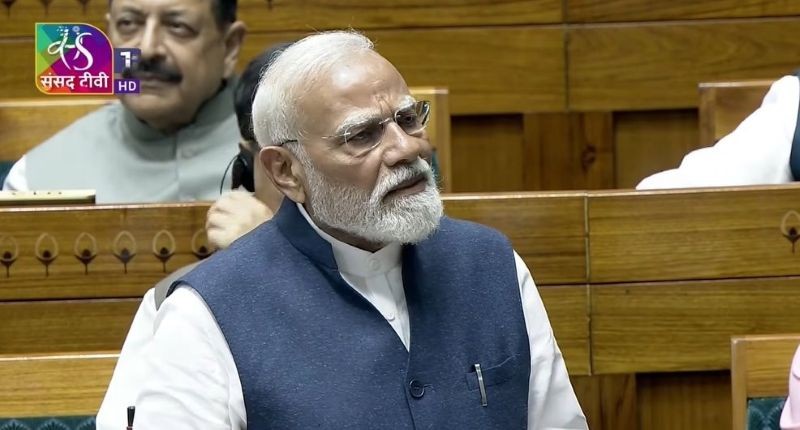
PM Modi Warns Opposition Over Past Stand
Speaking during the debate in the Lok Sabha, Prime Minister Narendra Modi cautioned the Opposition over their earlier resistance to women’s reservation, saying it could have electoral consequences.
“Those who opposed giving this right to women have not been forgiven by the women of this country. They have faced the consequences,” he said.
‘Decision For Democracy, Not Any Party’
The Prime Minister stressed that the legislation should not be viewed through a partisan lens.
“If we all move forward together, this decision will not go in favour of any one political party, but in favour of the country’s democracy,” Modi said.
References to Past Opposition
Recalling earlier debates, he noted that resistance to women’s reservation was not new.
“25–30 years ago, those who opposed women's reservation didn't let their opposition go below the political surface. Don't make the mistake of thinking that today,” he added.
Assurance on Regional Fairness
Responding to concerns raised by the Opposition, Modi assured that the process would be fair to all regions.
“Whether it is the South, the North, the East, the West, small states or large states... this decision-making process will not discriminate against or do injustice to anyone,” he said.
Delimitation and Proportional Balance
He further clarified that existing proportional balances would be maintained during implementation.
“In the past government that was in power, in whose time the delimitation took place, there will be no change in that proportion either, and the increase will also be in the same proportion,” he said.
‘Guarantee of Fair Implementation’
Reiterating his commitment, the Prime Minister said the process would remain transparent and fair.
“If you need a guarantee, I give you a guarantee; if you need a promise, I make a promise... because if the intention is clear, there is no need to play games with words,” he added.
About the Women’s Reservation Bill
The Women’s Reservation Bill aims to increase women’s representation in the Lok Sabha, State Legislative Assemblies, and the Delhi Assembly by reserving one-third (33%) of seats for women.
The proposal will be implemented through a rotational system after delimitation exercises to ensure equitable distribution across constituencies over time.