
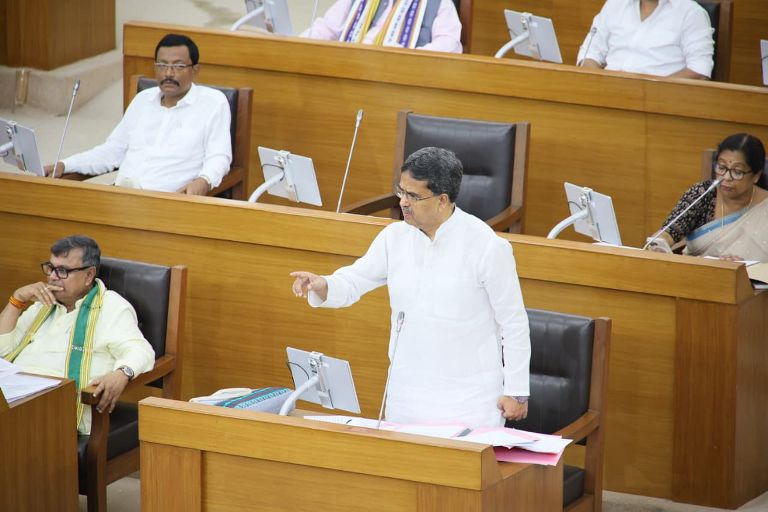
Tripura Chief Minister Dr Manik Saha on Friday said the state government has adopted a zero-tolerance policy against narcotics and is intensifying its crackdown on drug trafficking, while expressing concern over the growing prevalence of synthetic drugs replacing traditional narcotics.
Replying to a series of questions raised by senior Congress MLA Gopal Chandra Roy during the second day of the Monsoon Session of the Tripura Assembly, the Chief Minister said the state government, in coordination with security agencies and the state police, has been making sustained efforts to curb the smuggling and illegal trade of narcotics.
Dr Saha, who also holds the Home portfolio, informed the House that the conviction rate in narcotics-related cases has improved due to intensified enforcement.
“Because of the state government's sustained efforts, the conviction rate of drug peddlers and illegal traders has increased to 14.7 per cent till July this year, compared to 11.7 per cent in 2023,” he said.
Responding to allegations by Congress MLA Gopal Chandra Roy that some police personnel were involved in drug trafficking and other narcotics-related activities, the Chief Minister asserted that no individual found involved in such illegal activities would be spared.
He said the government has adopted a multi-pronged strategy to combat drug abuse, combining strict law enforcement with extensive public awareness campaigns highlighting the harmful effects of narcotics.
“I have personally urged parents and guardians to remain vigilant so that their school- and college-going children do not fall prey to drug addiction,” Dr Saha said.
The Chief Minister also said coordination between the police and the judiciary has been strengthened to improve conviction rates. In addition, the Tripura Police have established a dedicated unit to investigate cases registered under the Narcotic Drugs and Psychotropic Substances (NDPS) Act, 1985.
During the discussion, Congress MLA Roy alleged that narcotics were being smuggled into Tripura through railway routes and claimed that the illegal drug trade had spread extensively across the state. Senior police officials, meanwhile, said methamphetamine (Yaba) tablets, heroin and other narcotic substances are smuggled into Tripura from various parts of the country, including Northeastern states. They also noted that cough syrups containing Codeine Phosphate, which are illegally used as intoxicants in Bangladesh, are among the substances trafficked through the region.
Officials said Mizoram and Manipur have emerged as major drug-trafficking corridors in the Northeast because of their long and porous international borders with Myanmar and their proximity to the Golden Triangle, one of the world's largest illicit narcotics-producing regions.
Myanmar shares a 1,643-km border with Arunachal Pradesh, Manipur, Nagaland and Mizoram, with large stretches remaining unfenced, making the region vulnerable to cross-border trafficking of heroin, methamphetamine and other contraband.
Police officials further said Myanmar's Chin State has become a key transit route for smuggling narcotics, wildlife products and other illegal goods into India through six districts of Mizoram. Similarly, five border districts of Manipur have also emerged as vulnerable corridors for cross-border drug trafficking due to their unfenced frontier with Myanmar.