
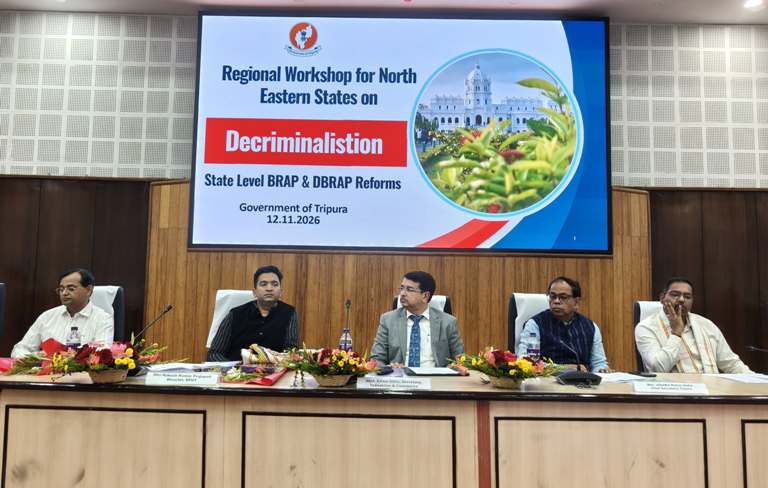
A one-day workshop on State-Level Decriminalization Reforms, Business Reforms Action Plan (BRAP) and District Business Reforms Action Plan (DBRAP) was held at Pragna Bhavan in Agartala on Thursday with an aim to simplify legal procedures related to minor procedural violations in the business sector and improve the ease of doing business in the state.
The workshop was inaugurated by Tripura Chief Secretary J.K. Sinha. Secretaries from various departments, including Industries and Commerce, Finance, Tribal Welfare, Urban Development, Rural Development, and Agriculture and Farmers’ Welfare, along with District Magistrates, Collectors, field-level officials, representatives of industrial and business organizations, and delegates from Assam, Meghalaya and Mizoram, attended the programme.
Addressing the gathering, Chief Secretary J.K. Sinha said the state government had taken significant initiatives under BRAP and DBRAP and achieved the top position nationally in reducing compliance burdens and implementing deregulation measures within a short period. However, he stressed that the actual success of these reforms would depend on effective implementation at the grassroots level.
He further informed that a district-wise ranking system had been proposed to evaluate the progress of implementation. He also said that the Centre’s confidence in Tripura’s reform initiatives had enabled the state to receive major responsibilities, including the upcoming Destination Tripura 2026 initiative.
Industries and Commerce Secretary Kiran Gitte highlighted the steps taken by the state government to reduce legal complexities in business operations. He presented the implementation status of BRAP and DBRAP reforms and urged departments and district administrations to take proactive steps for timely execution of deregulation-related measures.
DPIIT Director Rakesh Kumar Prajapati spoke about the importance of Jan Vishwas decriminalisation reforms at the state level. He said all eight northeastern states had taken legislative measures to replace criminal penalties for minor procedural offences with simpler civil remedies. He also stressed the need to empower regional start-ups under the Start-up India initiative by reducing regulatory complexities.
During technical sessions, representatives from DPIIT and various states exchanged views, experiences and best practices related to business reforms. Director of Industries and Commerce Deepak Kumar also addressed the gathering.