
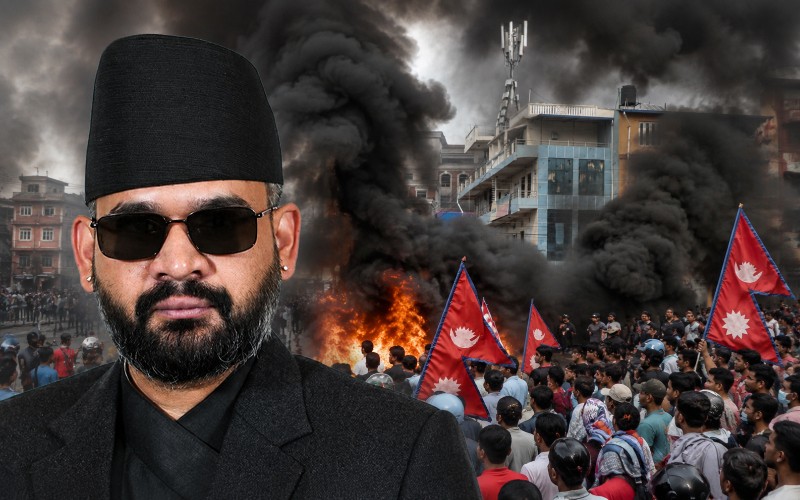
The incident has revived criticism of the capital's municipal authorities and renewed scrutiny of the aggressive enforcement methods adopted under Shah's leadership, despite his administration securing overwhelming public support less than a year ago.
Fatal incident triggers public outrage
According to The Kathmandu Post, Ganesh Nepali was waiting for a passenger on a Kathmandu street on Thursday when municipal police officers approached him and locked the wheel of his motorcycle.
Eyewitnesses told the publication that, in an apparent act of desperation, Nepali poured petrol over himself and set himself ablaze.
He was rushed to the hospital immediately but died from his burn injuries on Friday.
His death quickly became a rallying point for public anger over what many see as long-standing grievances involving the conduct of the Kathmandu Metropolitan City administration.
1/4 GEN-Z PROTEST RETURNS TO NEPAL
— The Wonk (@thewonkin) July 13, 2026
The youth who helped bring Prime Minister Balendra "Balen" Shah to power are now protesting against him in Kathmandu, Nepal
A self-immolation, forced eviction have sparked GenZ Protest 2.0 in Nepal👇#NepalProtest #รักลืมตายQ9 グラント博士 pic.twitter.com/mP72OvRZdG
Hundreds protest outside govt secretariat
On Sunday, hundreds of demonstrators gathered outside the Singhdurbar Secretariat in Kathmandu, calling for accountability over the incident.
Protesters carried placards bearing messages such as "End atrocity against the poor" and "Respect human rights." Others urged the authorities to stop what they described as illegal arrests and demanded protection for squatters who have been displaced during the city's eviction campaigns under the Balen Shah administration.
The demonstrations reflected growing dissatisfaction among young Nepalis, particularly members of Generation Z, who have increasingly questioned the government's approach to law enforcement and urban management.
Aggressive municipal enforcement
Nepali media reports state that Kathmandu Metropolitan City police have adopted a more assertive approach since Balendra Shah became mayor in 2022.
Shah's administration has prioritised clearing pavements, removing informal street markets and dismantling riverside squatter settlements as part of its urban management agenda.
Several anti-encroachment drives have led to confrontations between municipal authorities and residents, prompting criticism over the treatment of low-income communities and concerns about the administration's handling of vulnerable groups.
Legal experts question municipal police conduct
Legal experts have argued that Kathmandu Metropolitan City's municipal police have repeatedly exceeded the authority granted to them under Nepal's constitutional framework.
According to The Kathmandu Post, senior advocate Raju Chapagain said the municipal police were intended to function as an administrative support body rather than an enforcement agency with coercive powers.
"The legal framework does not envision the municipal police as a force authorised to use physical coercion or riot-control tactics. Their primary mandate is to facilitate administrative functions within the metropolis through persuasion and community engagement," Chapagain told the publication.
"When issues arise regarding traffic or street obstructions, the matter should be referred directly to the traffic police. Instead, we have witnessed municipal officers relentlessly chasing vendors, confiscating private property, and physically assaulting citizens, which is entirely illegal," he added.
What Nepal's law allows
Nepal's Constitution permits local governments to establish and manage municipal police forces.
Acting under this provision, the Kathmandu Metropolitan City Municipal Police Act 2023 was enacted during Shah's tenure as mayor.
However, legal experts note that the legislation defines the duties of municipal police without granting them powers to detain citizens, carry out baton charges or independently conduct crowd-control operations.
Under the Act, municipal police are responsible for safeguarding municipal property, protecting public parks, monitoring compliance with sanitation regulations, and assisting with local festivals and cultural events.
'Use of force has no legal basis'
Retired Nepal Police Deputy Inspector General Purna Chandra Joshi told The Kathmandu Post that municipal police are not legally authorised to use force during public disturbances.
"They are purely a facilitation mechanism. If a situation escalates into a public disturbance or requires physical intervention, the municipal authorities are legally obligated to call upon the Nepal Police. They cannot independently execute crowd control," Joshi said.
Despite these legal limitations, protesters allege that municipal police under Shah's administration have repeatedly taken action against daily wage vendors and informal traders.
Videos showing confrontations between municipal officers and street vendors have circulated widely on social media in recent years, contributing to broader criticism of Kathmandu's model of urban governance and influencing similar enforcement practices in other municipalities across Nepal.