
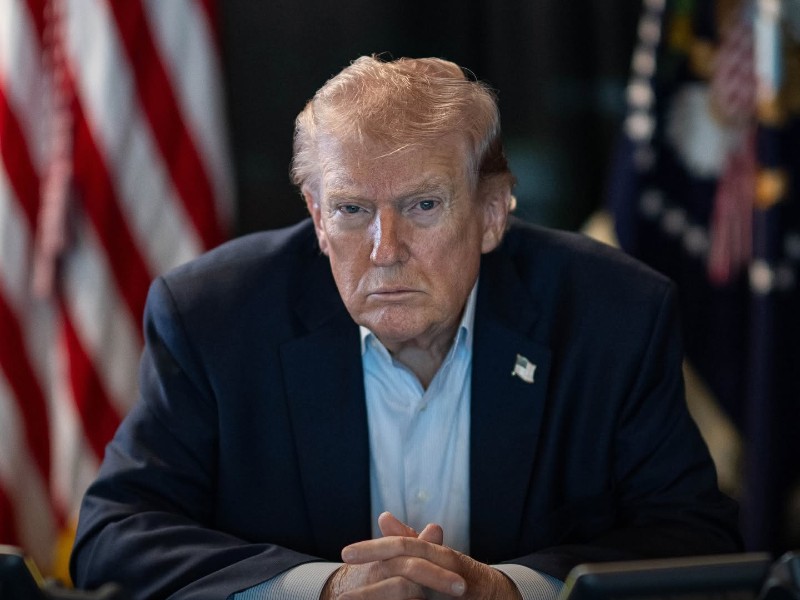
Speaking at the G7 Summit in France, Trump made the remarks just days before the US and Iran are expected to formally sign the agreement in Switzerland, highlighting continued uncertainty surrounding the proposed deal.
“It’s not final. It’s a memorandum of understanding, and if I don’t like it, if they (Iran) don’t behave, we’ll go right back to dropping bombs right smack in the middle of their head... because they have misbehaved for 47 years,” Trump said.
His comments came a day after he reiterated that Iran would “never have a nuclear weapon” under the proposed arrangement.
Trump defends deal at G7
Throughout the G7 gathering, Trump repeatedly praised the framework agreement, claiming it had helped avert a major global economic crisis.
The US President argued that his administration had prevented what he described as a potential worldwide depression, while criticising unnamed opponents of the deal.
BREAKING: "If I don't like it, we'll go back to shooting at them, dropping bombs on their head."
— Fox News (@FoxNews) June 17, 2026
President Trump warns Iran that any change to the peace agreement or failure to comply could bring an immediate military response.
"If they don't behave, we'll go right back to… pic.twitter.com/67JRcDptYS
Trump also maintained that no previous American leader had been able to secure such an agreement with Tehran.
“Nobody could have done it except me,” he said, while contrasting the proposed deal with policies pursued by former President Barack Obama.
Criticism of Obama-era Iran policy
Trump used the occasion to attack the Obama administration’s handling of relations with Iran, claiming previous efforts had failed despite significant financial concessions.
“He (Obama) gave them (Iranians) billions and billions of dollars... he gave them $1.7 billion in cash, green cash from banks into a Boeing 757 and flew into Iran,” Trump said.
“The Iranians laughed at Obama, and they said, ‘he is a stupid son of a b***h’,” he added.
The comments formed part of Trump's broader argument that the current agreement imposes stricter limits on Iran’s nuclear ambitions than previous arrangements.
Hormuz reopening expected soon
Trump also provided an update on the Strait of Hormuz, one of the world's most critical energy shipping routes, saying the waterway had already begun reopening.
“The Strait is already partially opened,” Trump said, adding that it was “going to be opening up soon in full over the next day or two”.
The strategic passage has faced major disruptions since the outbreak of the regional conflict earlier this year, contributing to volatility in global energy markets and concerns over oil supplies.
Dispute over reconstruction funding
The United States and Iran announced a framework agreement shortly before the G7 Summit began, with both sides signalling an intention to halt hostilities that have affected large parts of the Middle East since late February.
While full details of the accord remain undisclosed, the framework reportedly includes a 60-day ceasefire, the reopening of the Strait of Hormuz and the removal of the US naval blockade on Iran.
Iran and Pakistan, which reportedly helped facilitate negotiations alongside Qatar, have stated that the understanding also includes an immediate halt to fighting in Lebanon.
Reports citing a leaked draft suggested that Iran would be permitted to export oil without restrictions and that the United States would contribute as much as $300 billion towards reconstruction and economic development projects in Iran.
Trump, however, firmly denied any such financial commitment.
“We are not putting up 10 cents. We are not investing, and we do not have a fund,” he said.
G7 leaders seek further commitments
As discussions continued in France, G7 leaders welcomed progress towards a US-Iran agreement but called for additional negotiations addressing Tehran’s ballistic missile programme.
The proposed memorandum is expected to be formally signed on June 19, with international attention focused on the final text and the mechanisms for implementing its provisions.
The agreement's details are expected to play a key role in shaping future negotiations over Iran’s nuclear activities, missile capabilities and broader regional security issues.