
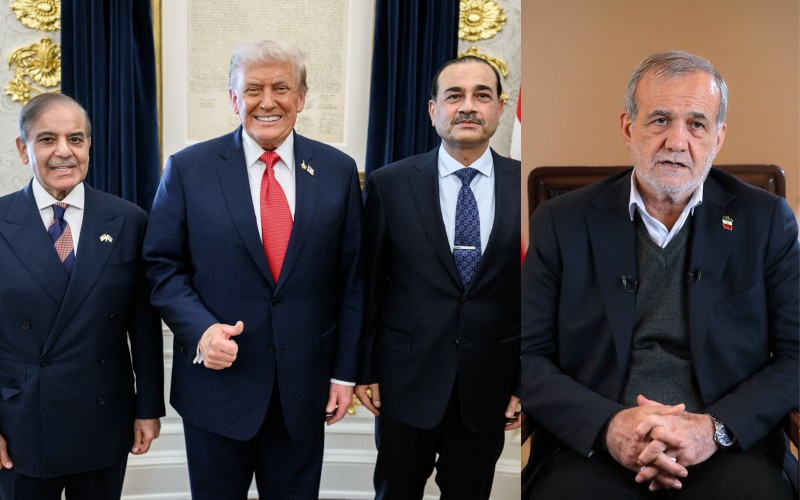
Islamabad has moved swiftly to position itself as a potential mediator, even offering to host talks.
The push reflects a mix of strategic necessity and geopolitical calculation rather than purely diplomatic intent.
Pakistan’s military leadership, led by Asim Munir, has taken a central role in this effort.
Reports indicate that Munir recently held discussions with Donald Trump, while Prime Minister Shehbaz Sharif has engaged directly with Masoud Pezeshkian.
These developments coincided with Washington’s decision to temporarily pause planned strikes on Iranian infrastructure, highlighting the timing of Islamabad’s outreach.
A rare position between Washington and Tehran
Pakistan occupies a unique diplomatic space, maintaining working relationships with both Washington and Tehran.
Unlike many regional actors, it has managed to sustain engagement with both sides, enabling it to act as a communication bridge.
Geography plays a key role. Pakistan shares a nearly 1,000-kilometre border with Iran, alongside long-standing political and security ties.
It also represents Iranian diplomatic interests in the United States, where Tehran lacks a formal embassy.
This dual connectivity has made Pakistan one of the few countries capable of facilitating indirect dialogue.
At the same time, Islamabad has strengthened ties with the United States in recent months, further enhancing its ability to engage both sides simultaneously.
Economic pressures driving urgency
Pakistan’s mediation push is closely linked to its economic vulnerabilities.
The ongoing conflict has disrupted the Strait of Hormuz, a critical route through which roughly 20 percent of global energy supplies pass.
For Pakistan, which imports about 85 percent of its energy needs, the consequences are immediate.
Rising oil prices have intensified inflationary pressures and strained foreign exchange reserves.
Reports suggest the government has already implemented fuel-saving measures, including reduced public activity and higher fuel prices.
A prolonged conflict risks deepening these challenges, making de-escalation a pressing priority for Islamabad.
Strategic balancing and Gulf dynamics
Pakistan’s outreach also reflects its need to maintain equilibrium with Gulf powers.
Its ties with Saudi Arabia have strengthened in recent years, including a defence arrangement that could draw Islamabad into a broader conflict if tensions escalate further.
This creates a complex dilemma. While Pakistan seeks to avoid confrontation with Iran, it cannot afford to alienate key Gulf allies.
Any escalation involving Riyadh could force Islamabad into a difficult strategic position.
At the same time, Pakistan has worked to rebuild relations with the Organisation of Islamic Cooperation after earlier diplomatic strains, adding another layer to its regional calculations.
Security risks and regional spillover
Beyond economics and diplomacy, security concerns are central to Pakistan’s actions.
A prolonged war in Iran raises the risk of instability spilling across the border, particularly into Pakistan’s already volatile Balochistan region.
There are also fears of increased refugee flows and heightened sectarian tensions within Pakistan, given its significant Shia population.
These internal risks make de-escalation not just a diplomatic goal but a domestic necessity.
Mediation as image recalibration
Pakistan’s diplomatic push also comes at a time when its global image has faced scrutiny.
Recent military actions in Kabul drew criticism internationally, prompting Islamabad to recalibrate its positioning.
By stepping into a mediation role, Pakistan aims to project itself as a stabilising force rather than a source of regional tension.