
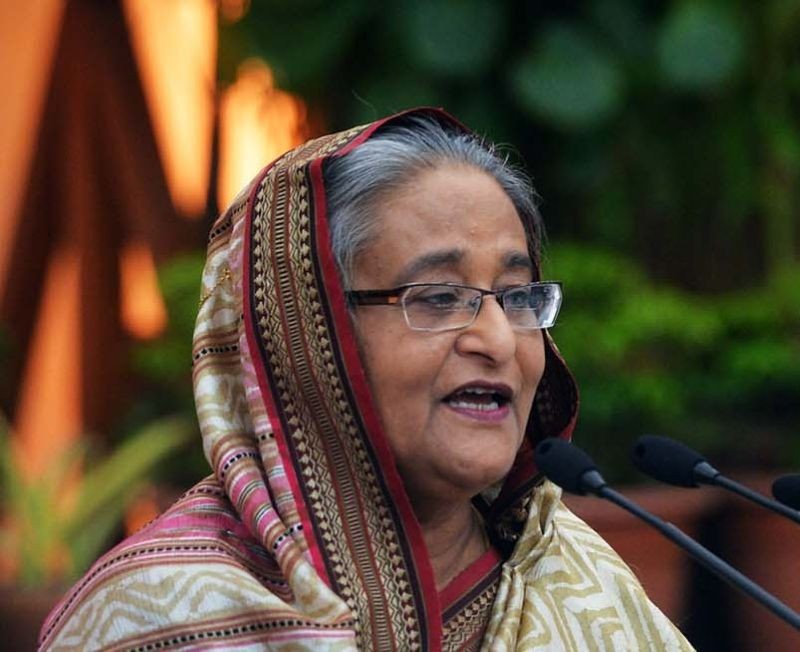
Abu Obaidha Arin, a key aide to Hasina, told the BBC that the former prime minister remains determined to return to Bangladesh on the date she has set for her homecoming.
"She is even prepared to walk into Bangladesh," Arin told the BBC.
According to Arin, Hasina's supporters have identified nine possible crossing points along the 4,096-km (2,545-mile) India-Bangladesh border, which is shared by five Indian states.
"This is a carefully thought-out, precise plan. This is serious," Arin said.
He added that Hasina has remained in regular contact with Awami League leaders and party workers through interactive audio conversations on Telegram, maintaining her political network while living in exile.
Arin claimed that Hasina had conducted more than 300 such meetings with party workers over the past 18 months, reaching supporters across 300 districts of Bangladesh.
These interactions allow Hasina to hear directly from party workers, understand their grievances and assess developments on the ground, he said.
Arin further claimed that the party could mobilise five million people to welcome Hasina along the route from the border to Dhaka, forming a human chain.
"We have the organisational capacity to make that happen," he said.
However, Bangladesh State Minister for Foreign Affairs Humaiun Kobir has reiterated that Hasina will not be allowed to return to the country in December.
"I have already said at a meeting in Sylhet that Sheikh Hasina will not come in December... nobody will come in December; only winter will come," he was quoted as saying by the Dhaka Tribune.
Kobir said Hasina would have to be brought back through a formal handover, either in handcuffs aboard an aircraft or under strict surveillance.
"This is the only way she can come back," he said.
The minister also maintained that Hasina and other individuals accused of committing crimes in Bangladesh should be handed over by India under the bilateral extradition treaty.
"Under the extradition treaty, she has to be handed over," he said.
"We have made our requests and placed them before the relevant authorities. So, let's see," Kobir added.
Political violence continues in Bangladesh
Meanwhile, political violence continues to be reported in several parts of Bangladesh, with Gopalganj emerging as a major flashpoint.
According to local media reports, Awami League supporters, whose party is currently banned in Bangladesh, have attacked police stations, set vehicles on fire and targeted homes and offices belonging to leaders of the ruling Bangladesh Nationalist Party (BNP).
Data from conflict-monitoring organisation Armed Conflict Location and Event Data (ACLED), cited by the BBC, showed that supporters had staged 40 demonstrations and more than 140 riots up to November 23.
At least 11 people, including two civilians, were killed in political violence during November, with six deaths directly linked to the unrest, according to the organisation.
The Awami League was banned in Bangladesh months after Hasina left the country on August 5, 2024, following a massive wave of anti-government protests that brought an end to her long tenure as prime minister.
Why is December 16 significant for Bangladesh?
December 16 is celebrated as Victory Day in Bangladesh. The day commemorates the country's victory over Pakistan in the 1971 Liberation War and marks the emergence of Bangladesh as an independent nation.