
By: Anupam Guha
Since 1970, Earth Day has been celebrated worldwide to promote environmental awareness and conservation. The idea originated in 1969 during a UNESCO conference in San Francisco, where organizers proposed dedicating a day to protect the Earth. Initially, it was suggested that Earth Day be observed on March 21, the first day of spring in the Northern Hemisphere. However, U.S. Senator Gaylord Nelson recommended setting the date as April 22, 1970, to encourage greater participation and focus on environmental issues. In 1992, the first International Earth Summit was held in Rio de Janeiro, Brazil, bringing together representatives from around 178 countries to discuss critical topics related to environmental conservation and socio-economic development. The main goal of Earth Day is to promote the preservation of natural resources and sustainable development. On this day, activities such as planting trees, recycling, reducing carbon footprints, and raising awareness about climate change, air and water pollution, biodiversity, sustainable agriculture, and plastic pollution are carried out. Environmental advocates often organize rallies and campaigns to promote a healthier, greener planet.
Historical review reveals that, along with the Industrial Revolution in America, deforestation began as early as the 1800s. Coal transitioned into thermal power, becoming a major energy source, which also led to pollution. In 1892, John Muir and his friends established the Sierra Club, with the aim of "Doing something for Wilderness and making the Mountains Glad." At the beginning of the 20th century, events such as the First World War, the Great Depression, and then World War II caused environmental conservation efforts in America to be overshadowed. However, changes came after World War II. North America transitioned from an agricultural society to an industrial-based society, which once again gave rise to environmental movements.
Currently, people across our country and the entire world are suffering due to climate change. Massive deforestation, destruction of forests, draining water bodies, global warming, extensive plundering of natural resources, and wars have all disrupted the centuries-old interrelationship between humans and nature. Problems today are caused more by human-made disasters than natural calamities. Facing extreme heat, some people consider installing air conditioners at home, while others advocate planting more trees. In environmental science books, we have read about planting trees, and in moral stories, trees are called our friends; we have memorized lists of what trees do. However, reality tells a different story.
Despite unprecedented advancements in modern technology, the Earth continues to experience severe droughts in some places and devastating floods in others. Recently, the COVID-19 pandemic struck! Can such events truly be considered nature's way of repaying its debt? Can't everyone collectively take responsibility for the planet? From childhood to old age, nature has nurtured all living beings, but today, it is in great distress. Every year, there is excitement over celebrating Earth Day, but throughout the year, very few people think seriously about the state of the planet. Most people damage the Earth daily. Globally, climate change (Global Warming) is steadily increasing day by day. What will happen to the Earth in a few years is hard to predict. Despite witnessing one disaster after another, people remain unalert. How many individuals think about planting trees? Perhaps only a handful. And implementing such ideas is quite difficult. No one truly considers that if everyone committed to planting at least one tree daily, we wouldn't have to lament the rising heat, or have to abandon homes due to floods or droughts. Environmental scientists constantly express concern, warning that the Earth is becoming uninhabitable day by day. Developed countries are filled with pollution. In the quest to showcase a modern world, some places face extreme droughts while others suffer from severe floods. Can't everyone take responsibility for the planet? It is truly time to think. It's a day to pledge to save our lush and prosperous Earth. Many people are unaware that Earth Day exists or understand its significance. This day is designated to protect the planet. Each year, on April 22nd, various steps are taken to prevent the destruction of Earth. Different programs are organized to conserve the environment and nature. Issues like rapid population growth, soil erosion, water pollution, and deforestation are addressed to raise awareness. Much of the damage to our planet is caused by human actions. Understanding why our Earth is suffering and how to reduce this harm is essential. To spread awareness in society, this day is observed annually with different themes.
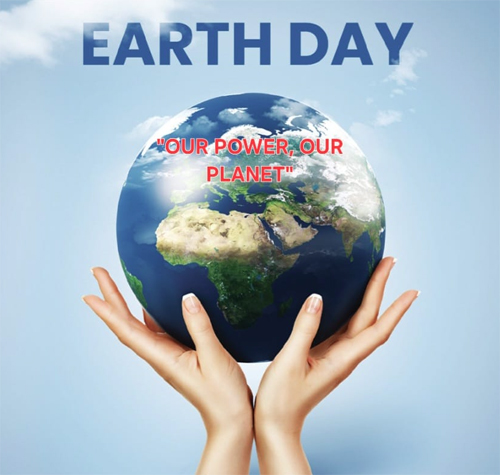
This year's theme is "Our Power, Our Planet." This theme emphasizes taking concrete actions to protect the environment through personal and local initiatives, empowering ordinary people in the fight against climate change and ensuring a sustainable future. Key messages include: Moving beyond symbolic protests and making changes in daily habits to safeguard the environment. Actively participating in waste reduction, promoting sustainable energy, and supporting local environmental laws through community efforts. Urging a swift transition to environmentally friendly energy sources for long-term planetary stability. Primarily, this day is observed to raise awareness about protecting the environment and nature, and to encourage specific actions to preserve our planet for future generations.
According to the recent reports (2024-2025) by the Food and Agriculture Organization (FAO) and the United Nations Environment Programme (UNEP), the current status of forest conservation and sustainable development shows that approximately 31-32% of the world's land area is covered by forests, amounting to about 4.1-4.14 billion hectares. The rate of deforestation between 2000 and 2020 was about 10 million hectares annually. However, there is positive news: the rate of deforestation has decreased. Between 1990 and 2000, the annual loss was 17.6 million hectares, but this has reduced to 10.9 million hectares during 2015-2025. Under sustainable forest management (SDG 15.2), over 55% of the forested areas are now under long-term management plans, representing a significant improvement compared to 1990. Additionally, approximately 20% of the world's forests (813 million hectares) are legally protected areas, which has increased by 251 million hectares since 1990.
Although the rate of deforestation is decreasing, the world is still far from achieving the target of halting it completely by 2030. Agricultural expansion remains the primary cause of deforestation, accounting for approximately 90%. According to data from 2024, forest degradation has increased due to wildfires. Between 2022 and 2024, government investment in forest conservation has increased; however, there is still a significant shortfall in the necessary funding to achieve sustainable goals. Under the United Nations Sustainable Development Goal (SDG 15 - Life on Land), these statistics are reviewed and monitored with the aim of reducing deforestation to zero by 2030.
Currently, various countries around the world have adopted innovative and specialized initiatives for forest conservation and sustainable development. According to data from 2025-2026, several notable efforts include: India is placing special emphasis on afforestation. Among their main initiatives are the 'Ek Ped Maa Ke Naam' (A Tree in Honor of Mother) campaign, which encourages many people to plant trees in honor of their mothers. Additionally, India is restoring forests through the 'Compensatory Afforestation Fund Management and Planning Authority' (CAMPA) and reforestation projects like 'Araballi Landscape Restoration' or the Green Wall initiative. China has adopted the 'Shan-Shui' (Mountain and Water) Initiative to protect forest resources and biodiversity. Moreover, China and India jointly contribute approximately 70% of the world's agroforestry (agriculture-based reforestation). Suriname, one of the countries with the highest forest coverage, conserves about 94.5% of its forest area, creating a model for sustainable development. Brazil is working to safeguard the Amazon Rainforest through the 'Community Forest Carbon Project' and employs technology-driven monitoring to prevent illegal logging. Across Africa, 22 countries have collectively committed under the AFR100 initiative to restore 100 million hectares of degraded land by 2030.
In addition to individual country initiatives, the United Nations Environment Programme (UNEP) through the UN-REDD program is providing financial and technical support to 65 countries to reduce deforestation and promote sustainable forest management. Current efforts are not limited to just planting trees; they also focus on involving local communities, enforcing forest laws (such as FRA, 2006), utilizing technology to monitor forest health, and integrating forests into a green economy.
Earth Day is more than just a date on the calendar; it is a solemn promise to protect our planet. While Earth provides us with everything we need, human activities often threaten its health and sustainability. Therefore, we should go beyond celebrating on April 22nd and commit to leading an eco-friendly lifestyle every day. The primary purpose of Earth Day is to ensure that we leave behind a green, healthy, and pollution-free planet for future generations to enjoy.
About Author: Dr. Anupam Guha, is the Principal of Michael Madhusudhan Dutta College, Sabroom, South Tripura.