
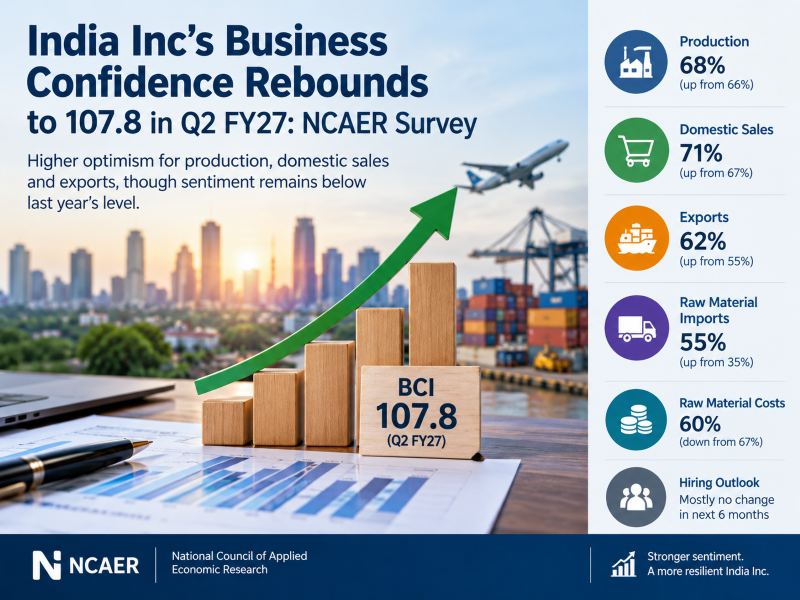
The Business Confidence Index (BCI) climbed to 107.8 in Q2 from 99.8 in Q1, reflecting a broad-based improvement in business sentiment ahead of the festive season.
However, the latest reading remained significantly below the 142.6 recorded in the corresponding quarter of the previous financial year.
Conducted in September, the NCAER Business Expectations Survey covered 502 firms of different sizes across six cities: Delhi-NCR, Bengaluru, Chennai, Kolkata, Mumbai and Pune.
Confidence improves across key business indicators
The increase in the BCI was supported by improved expectations across all four indicators used to assess business sentiment.
These include the outlook for overall economic conditions and firms’ financial positions over the next six months, perceptions of the current investment climate, and capacity utilisation levels.
The proportion of firms expecting overall economic conditions to improve over the next six months rose to 50% in Q2 from 43% in Q1. Similarly, the share anticipating an improvement in their financial position increased from 37% to 41%.
Optimism about the investment environment also strengthened, with 30% of firms viewing current investment conditions positively, compared with 26% in the previous quarter.
Meanwhile, the proportion of firms reporting capacity utilisation close to or above optimal levels edged up from 91% to 94%.
MSMEs and large firms record higher confidence
Business sentiment improved among both micro, small and medium enterprises (MSMEs) and large companies during the quarter.
The BCI for MSMEs increased from 93 in Q1 to 100 in Q2, while the index for large firms rose from 111.6 to 120.3 over the same period.
Professor Bornali Bhandari of NCAER, who led the survey, said the findings pointed to a broad-based recovery in business confidence across both categories of firms.
She also noted that domestic and international business prospects had improved, while concerns over rising costs had eased.
Production, domestic sales and exports show positive outlook
The survey indicated stronger expectations for business activity over the coming six months, with firms expressing greater optimism about production, sales and exports.
The share of companies expecting production to increase rose to 68% in Q2 from 66% in Q1. Expectations for domestic sales also strengthened, with 71% of firms anticipating an increase, compared with 67% in the previous quarter.
Export-oriented businesses reported improved prospects as well. The proportion of exporting firms expecting shipments of finished products to rise increased from 55% in Q1 to 62% in Q2.
Expectations for raw material imports registered a particularly sharp increase. The share of firms anticipating higher imports rose from 35% to 55%, signalling a potential pickup in production-related activity.
Raw material cost pressures ease, hiring remains subdued
Alongside the improvement in business confidence, firms reported some moderation in cost pressures, particularly those associated with raw materials.
The proportion of companies expecting raw material costs to increase over the next six months declined from 67% in Q1 to 60% in Q2. Sentiment regarding electricity and labour costs also moderated during the quarter.
However, employment expectations remained subdued. Most firms anticipated no change in hiring over the next six months, suggesting that the recovery in business sentiment has yet to translate into stronger recruitment plans.
While the latest survey points to improving confidence and stronger expectations for economic activity, the BCI’s continued gap from its year-earlier level highlights the challenges businesses face amid persistent global uncertainties.