
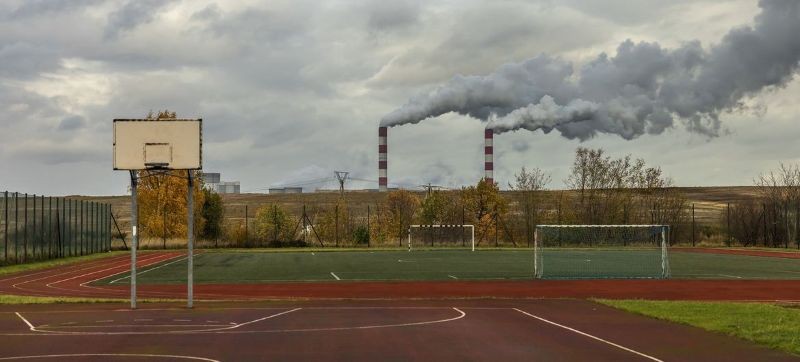
“Air quality respects no boundaries,” said Lorenzo Labrador, Scientific Officer at the World Meteorological Organization (WMO). “The smoke and the pollution that issues from the wildfires in this record-breaking season in the Iberian Peninsula has been detected over Western Europe already [and]…can travel basically throughout the rest of the European continent.”
Presenting the latest WMO Air Quality and Climate Bulletin which crunches data from different global datasets, Labrador announced a continuing pattern of pollution “degradation” worldwide.
He pointed to a map of the world in 2024 showing telltale fine particle markers known as “PM 2.5” from wildfires concentrated in deep red blotches in Chile, Brazil and Ecuador, along with Canada, central Africa and Siberia.
The data confirms a disturbing trend in air quality loss already noted in previous years.
“We know that the wildfire season has the tendency to be stronger and longer every year, as a result of climate change,” Mr. Labrador explained.
China, Europe provide hope
In more positive news, the WMO scientist underscored a reduction in emissions in some parts of the world, “particularly eastern China and Europe, year on year”.
“When we see that countries or regions or cities are taking measures to fight against bad air quality, it works,” said Paolo Laj, Chief of Global Atmosphere at WMO.
A good example is eastern China, in cities such as Shanghai, where progress has been made to boost air quality by opening more parks and planting more trees.
And although there is still heavy vehicle traffic, many are now electric, WMO spokesperson Clare Nullis noted.
Despite these successes, very few cities worldwide have air quality levels below those recommended by the UN World Health Organization (WHO), stressed WMO’s Laj. “This means that, despite recent improvements, air quality remains a significant public health concern.”
He explained that although main pollutants such as sulphur dioxide (SO₂) and nitrogen oxide (NOₓ) are decreasing as emission controls kick in, ground-level ozone levels – the main ingredient of smog – have not declined.
“This is partly a consequence of global warming, as ozone is a secondary pollutant formed through chemical reactions in the atmosphere that require sunlight,” Laj continued.
Covering wildfires, winter fog, shipping emissions and pollution in urban spaces, the WMO air quality bulletin highlights the close connection between air quality and climate change.
“Climate change and air quality cannot be addressed in isolation. They go hand-in-hand and must be tackled together in order to protect the health of our planet, our communities and our economies,” said WMO Deputy Secretary-General Ko Barrett.
The UN is leading efforts to tackle household air pollution which is one of the world’s greatest public health threats and particularly harmful for children.
“The good news is that cleaner cooking technology is plentiful, relatively inexpensive, and already helping to save lives,” insisted Martina Otto, Head of Secretariat of the Climate and Clean Air Coalition hosted by the UN Environment Programme (UNEP).
“The challenge now is to get this technology into the hands of more people.”