
Breaking
Loading breaking news...
Loading...
Northeast Herald Logo

Holi 2025 to coincide with a total lunar eclipse, but India will miss the spectacle

New Delhi: The vibrant festivities of Holi on March 14 will coincide with a rare celestial phenomenon—a total lunar eclipse.

IBNS
5 min read
Holi 2025 to coincide with a total lunar eclipse, but India will miss the spectacle
Share this article:

Holi, celebrated for its colours and the victory of good over evil, will have an added cosmic spectacle as the full moon undergoes a total eclipse on the same day.

A total lunar eclipse occurs when the Earth aligns between the Sun and the Moon, casting its shadow across the lunar surface.

This event will be visible in several parts of the world, offering a captivating experience for sky gazers.

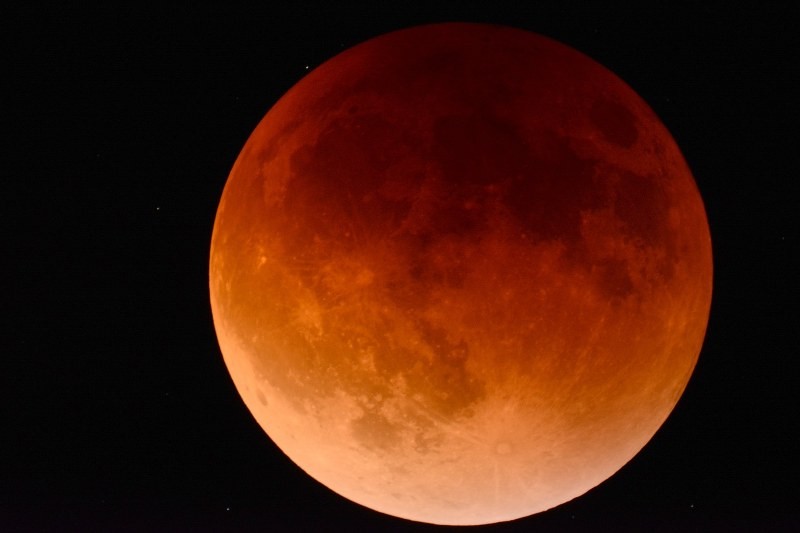
NASA states that this type of eclipse is often referred to as a "blood moon" because the Moon can take on a reddish-orange hue during totality.

This colouring happens as sunlight passes through Earth's atmosphere before reaching the Moon.

Shorter wavelengths, like blue and violet, are scattered and do not reach the lunar surface, while longer wavelengths, such as red and orange, illuminate it.

Consequently, the presence of more atmospheric elements—such as clouds or dust—intensifies the Moon’s red appearance during the eclipse.

"Keep a close eye on the weather forecast leading up to the eclipse," said NASA Chief Scientist Renee Weber in a statement. "That totality will last for close to an hour, so even if it's cloudy, you may still be able to glimpse it if the clouds are scattered."

Where will the eclipse be visible?

The total lunar eclipse will be visible across North and South America, Western Europe, and Western Africa. Prime viewing locations include New York, Los Angeles, Paris, and Madrid.

Some cities that will witness at least a part of the total lunar eclipse include Casablanca, Dublin, Lisbon, Honolulu, São Paulo, Buenos Aires, Guatemala City, Rio de Janeiro, Toronto, Caracas, and Mexico City. The duration of the eclipse is expected to be around 65 minutes.

Meanwhile, a partial lunar eclipse will be visible from cities such as Cairo, Athens, Warsaw, Berlin, London, Madrid, Sydney, Tokyo, and Seoul.

Will India witness the eclipse?

Unfortunately, skywatchers in India will miss out on the total lunar eclipse, as it will occur during daylight hours in the region.

While India won’t experience this Blood Moon event, it remains a significant astronomical occurrence, aligning celestial wonder with cultural celebrations worldwide.

Tags:
#agartala news#tripura news#northeast herald#health news

IBNS

Senior Staff Reporter at Northeast Herald, covering news from Tripura and Northeast India.

Related Articles

India’s Cheetah comeback gains momentum as Jwala delivers 5 cubs at Kuno

India’s Cheetah comeback gains momentum as Jwala delivers 5 cubs at Kuno

Union Minister for Environment, Forest and Climate Change Bhupender Yadav on Monday announced that Jwala, a Namibian cheetah and a successful third-time mother, has given birth to five cubs at Kuno National Park.

IBNSMar 09
AI Robot replaces humans in dangerous canal cleaning in Thiruvananthapuram — Here’s how G-SPIDER works

AI Robot replaces humans in dangerous canal cleaning in Thiruvananthapuram — Here’s how G-SPIDER works

Under the Swachh Bharat Mission–Urban 2.0, the Thiruvananthapuram Municipal Corporation in south India has deployed an AI-powered G-SPIDER robotic system to enable safe, precise, and human-free canal cleaning in high-risk areas.

IBNSMar 06
One in five kids now overweight: Study highlights global obesity crisis

One in five kids now overweight: Study highlights global obesity crisis

The World Obesity Federation has warned on Wednesday that the world was set to miss the 2025 global target to halt the rise in childhood obesity. And despite the deadline now being extended to 2030, most countries remain off track.

IBNSMar 04
Breast cancer cases expected to reach over 3.5 million globally by 2050: Study

Breast cancer cases expected to reach over 3.5 million globally by 2050: Study

Despite recent advancements in breast cancer treatments, new breast cancer cases in women are predicted to rise by a third globally from 2.3 million in 2023 to more than 3.5 million in 2050. Similarly, yearly deaths from the disease are projected to surge 44%, from around 764,000 to 1.4 million, with disproportionate impact in countries with limited resources, according to a major new analysis from the Global Burden of Disease Study Breast Cancer Collaborators, published in The Lancet Onco...

IBNSMar 03