
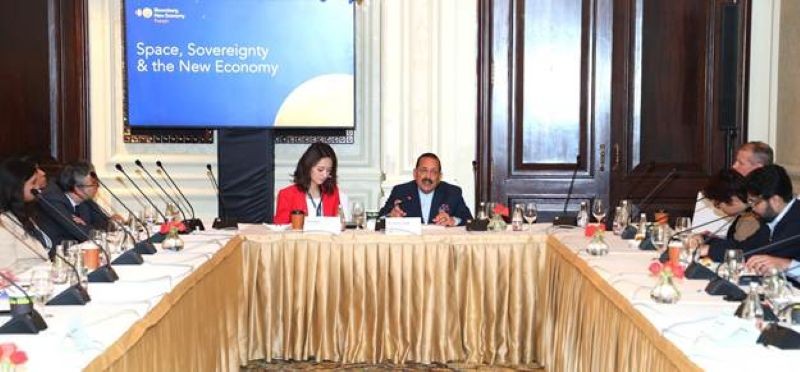
Speaking at a roundtable on “Space, Sovereignty and New Economy”, organised by the Bloomberg New Economy Forum, Singh said India must move beyond demonstrating its technological capabilities and focus on building globally competitive commercial space enterprises.
He emphasised that increased domestic and international investment, predictable demand, faster regulatory approvals and sustainable business models would be essential to scaling up Indian space companies and expanding their presence in global markets.
The discussion examined how countries can translate sovereign space capabilities into commercially competitive industries, attract private investment and strengthen supply chains while safeguarding national interests. Participants also discussed the evolving global space economy, international partnerships and the challenges facing private space enterprises as they scale up.
Other prominent participants included Vinod Kumar, Director (Promotion) at the Indian National Space Promotion and Authorisation Centre (IN-SPACe), and Aisha Bowe, founder and CEO of STEMBoard and LINGO, a former NASA engineer and Blue Origin astronaut. The session brought together representatives from the space industry, entrepreneurship, academia and the international space community.
Singh said the opening of India’s space sector to private participation in 2019–2020 under Prime Minister Narendra Modi’s leadership had delivered significant results within five to six years.
He said India’s experience demonstrated the potential of bringing government institutions and private industry together in a sector requiring substantial technological expertise, investment and long-term commitment. The priority now, he added, was to translate these capabilities into commercially viable businesses capable of competing internationally.
Predictable demand, investment key to growth
Singh stressed that generating demand would be critical to the growth of private space companies. Referring to the government’s use-case-based approach, he said anchor government customers and support for proof-of-concept projects could help enterprises demonstrate their technologies and move towards commercial deployment.
A predictable customer base would give companies the confidence to invest in production, develop market-ready products and establish sustainable revenue streams, he said.
The Minister also called for timely regulatory approvals, lower business costs and stronger supply-chain integration. Companies seeking installation or export licences should be able to secure the necessary approvals within clearly defined timeframes, he added.
Referring to GST-related measures for space products, Singh said policy reforms must translate into tangible benefits for industry. Sustainable investment, he noted, depended on predictable demand, efficient processes and a clear pathway to commercial growth.
India seeks investment while strengthening indigenous capabilities
On investment and international cooperation, Singh said India was opening up opportunities for capital and partnerships while continuing to strengthen its indigenous capabilities.
Greater investment could support technology development, manufacturing and access to international markets, while domestic capabilities remained crucial for national security and strategic autonomy, he said.
He called for stronger collaboration between government institutions and private enterprises in India, complemented by partnerships with international counterparts. Such cooperation could help Indian companies integrate into global supply chains, expand their customer base and contribute to the wider space economy without compromising national interests.
The objective, he said, was to combine the strengths of India’s public and private enterprises with the capabilities of international partners.
Space technology supporting development on Earth
Singh said India’s space programme was distinguished not only by its achievements in space but also by the extensive use of space technology in addressing challenges on Earth.
Satellite communications, geospatial applications and Earth observation are supporting infrastructure development, project monitoring, agriculture, disaster management and defence, he said.
He also highlighted the use of space technology for project clearances, monitoring implementation timelines and geotagging development works. India is providing space-based information and support for disaster management to neighbouring countries, including Myanmar, Bangladesh and Sri Lanka.
These applications demonstrate how investments in space capabilities can improve public services, support development and create opportunities for commercial applications, he said.
The wider economic value of the space sector lies in connecting technological achievements with practical applications and citizens’ needs, Singh added. Alongside launch vehicles and satellites, downstream services, data-driven solutions and industrial applications will be crucial to expanding the market for Indian space companies.
Public-private partnerships to drive next phase of growth
Singh emphasised that national space capabilities and international cooperation need not be competing objectives. India must continue to strengthen its technological capabilities while working with global partners to expand opportunities for domestic industry, he said.
Stronger public-private partnerships, both within India and internationally, could support investment, technology development, supply-chain integration and access to new markets.
He also underscored the importance of remaining open to progressive ideas and adapting policies as technology and industry requirements evolve. The opening of the space sector to private participation, he said, reflected the value of enabling new players to contribute alongside established public institutions.
India’s next phase of space-sector growth will depend on translating technological strengths into commercially successful enterprises. Increased investment, predictable demand, efficient regulatory processes, indigenous capabilities and international partnerships will be central to this transition, positioning India for a larger role in the global space economy.