
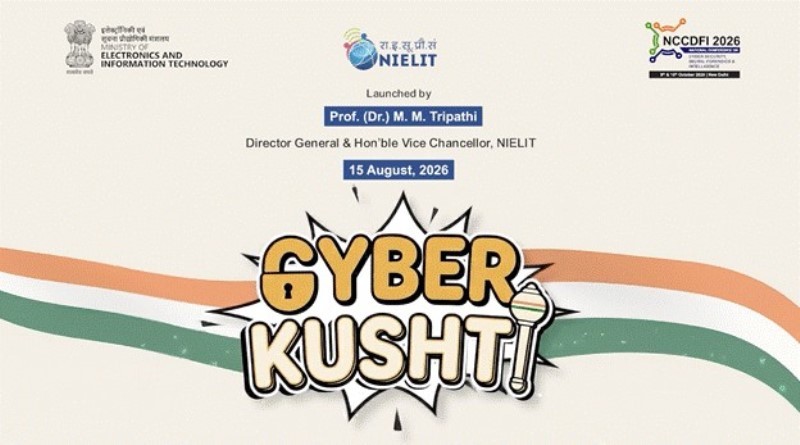
The hackathon was formally launched by Prof. (Dr.) M. M. Tripathi, Director General, NIELIT and Vice Chancellor, NIELIT Deemed to be University, as the official parallel technical track of the 3rd National Conference on Cyber Security, Digital Forensics and Intelligence (NCCDFI 2026).
The competition is being conducted in collaboration with the Information Sharing and Analysis Center (ISAC Foundation) under the National Security Database (NSD), with CERT-In as the Knowledge Partner.
Registration for Cyber Kushti 2026 opened on August 15th, and will remain open until 10 September 2026. Participation is free and open to students and independent researchers in teams of three.
A Hackathon Focused on Judgment, Not Just Detection
Unlike conventional cybersecurity competitions that primarily focus on vulnerability discovery or Capture The Flag (CTF) challenges, Cyber Kushti 2026 is designed to assess the ability of participants to evaluate, prioritise and defend cybersecurity decisions.
Each participating team will receive an identical and deliberately imperfect Security Assessment Package, comprising AI-generated findings, static analysis outputs, dependency and secrets scans, architecture documentation, source code and application logs.
The package will contain false, duplicated and genuine findings, while some actual vulnerabilities will be deliberately omitted. Teams will be required to produce a corrected and prioritised security assessment and defend the decisions made. The competition will reward participants not only for identifying genuine issues but also for correctly rejecting false findings.
Speaking on the occasion, Prof. (Dr.) M. M. Tripathi, Director General, NIELIT, said,“The most difficult part of security work has shifted. For a generation, the scarce skill was finding the problem. Today, machines generate findings faster than any team can read them. What they cannot yet do reliably is tell us which findings are real, which matter most, and what must be fixed first. That judgment is now the skill our institutions must build, and it is the only thing this competition measures.”
Since the same tool-generated material will be provided to every team simultaneously, the format is designed to minimise the advantage of expensive security tools. Participants will also be free to use any Artificial Intelligence tools of their choice.
Prof. (Dr.) Tripathi further said, “A student from a college in any part of the country can compete on entirely equal terms with a corporate team. That is deliberate. We are launching on Independence Day because independence, in an era of increasingly capable machines, means something quite specific: the confidence to examine what one is handed, to disagree with it, and to say precisely why.”
Three Rounds: Akhada, Dangal and Kesari
CYBER KUSHTI 2026 will be conducted in three progressive rounds:
Round 1 – The Akhada: Online round on 15 September 2026, from which 50 teams will advance.
Round 2 – The Dangal: Online round on 24 September 2026, from which 10 finalist teams will be selected.
Final Round – The Kesari: To be held in person on 9 October 2026 at the Dr. Ambedkar International Centre, New Delhi, where the ten finalist teams will work under supervision before presenting and defending their assessments on the main stage of NCCDFI 2026.
During the final round, an automated analysis of the same assessment material will be displayed alongside the teams’ presentations. This will allow delegates to observe where machine-generated analysis and expert human judgment converge and where they differ.
Recognition and Awards
The finalists will be assessed by an eminent jury jointly constituted by NIELIT and ISAC, comprising senior cybersecurity practitioners and experts from government, industry and academia, including National Cyber Security Scholars recognised under the National Security Database (NSD).
The winning team will be awarded the title “Cyber Kesari 2026” and presented the traditional Gada. The runners-up will be recognised with the titles “Rustam” and “Pahalwan.”
Participants in Round 1 will receive a Certificate of Participation and an individual scorecard, while participants advancing beyond Round 1 will receive NSD recognition credits. A special award will also recognise the most instructive incorrect submission, rewarding clearly documented reasoning that has instructional value.