
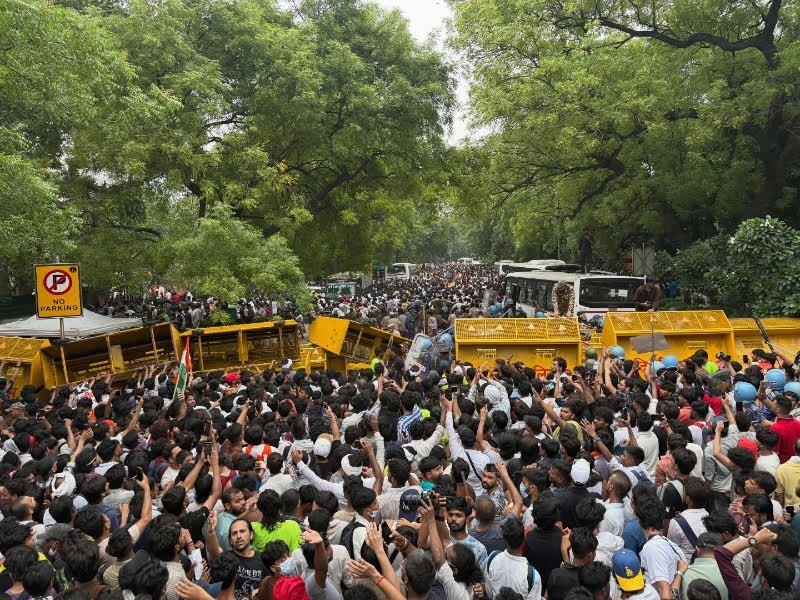
The shutdown will take effect at 10 pm on Friday, October 9, and remain in force until 10 pm on Saturday, October 10, 2026.
The order was issued by the office of the Deputy Commissioner of Police on Friday evening and communicated to telecom operators Airtel, Vodafone Idea, Jio and MTNL.
The decision comes hours after the Supreme Court questioned the government's extensive restrictions on public transportation ahead of the protest, observing that authorities could not use excessive measures to address a potential law-and-order situation.
Several key areas to face Internet disruption
According to the order, the Union Home Secretary considered the police's request to suspend mobile internet services across all technologies under the Telecommunications (Temporary Suspension of Services) Rules, 2024, read with the Telecommunications Act, 2023.
Telecom operators have been directed to take the necessary steps to implement the shutdown immediately.
The affected zone will include parts or all of Connaught Place, Mandi House, Pragati Maidan, Gurdwara Bangla Sahib, Barakhamba Road, Khan Market, Lodhi Road and Jangpura.
Police officials have maintained that the restrictions are necessary to maintain law and order during the protest.
Metro closures, train cancellations add to commuters' concerns
The internet shutdown comes amid a series of restrictions announced ahead of the CJP demonstration.
Entry and exit gates at 57 Delhi Metro stations, including Rajiv Chowk, New Delhi, Central Secretariat, Patel Chowk and Kashmere Gate, were scheduled to remain closed from 9 pm on Friday.
In addition, more than 60 trains originating from other states and scheduled to arrive at New Delhi and Hazrat Nizamuddin railway stations between 4 am and 2 pm on Saturday were cancelled.
The restrictions have raised concerns over commuters' access to essential public transport and their ability to travel across the national capital.
Supreme Court questions sweeping restrictions
Earlier on Friday, the Supreme Court questioned the extensive curbs imposed on Metro services and incoming trains in connection with the protest.
A bench led by Chief Justice of India Surya Kant stressed that authorities must distinguish between regulating public movement and imposing a complete shutdown of essential services.
"Young people and the elderly all travel. Commuters have a right to basic facilities. There is a distinction between restriction and complete closure," the bench observed.
The court said law enforcement agencies were entitled to take regulatory measures to prevent uncontrolled movement but cautioned against bringing public transportation to a complete halt and leaving commuters without alternatives.
Solicitor General Tushar Mehta told the court that the government had a responsibility to safeguard both the right to protest and the rights and safety of the general public.
In its order, the court noted that the notifications appeared to go beyond reasonable restrictions by imposing a complete ban on essential public transportation.
Following the court's observations, the Solicitor General agreed to urge the authorities to reconsider the prohibitions.
Internet shutdowns during previous CJP protest
This is not the first time mobile internet services have been suspended during a CJP-led demonstration. Similar restrictions were imposed for several days during the party's July protest at Jantar Mantar over the NEET paper leak controversy.
The earlier shutdown covered a radius of around 1.5 km and disrupted protesters' ability to upload videos and share updates on social media platforms, including YouTube.
It also affected the timely dissemination of information about the agitation.
The latest order expands the affected radius to 4 km, covering a significantly wider area of central Delhi.
With internet restrictions now added to Metro closures and train cancellations, the measures have intensified scrutiny over the balance between maintaining public order and protecting citizens' access to essential services and information.