
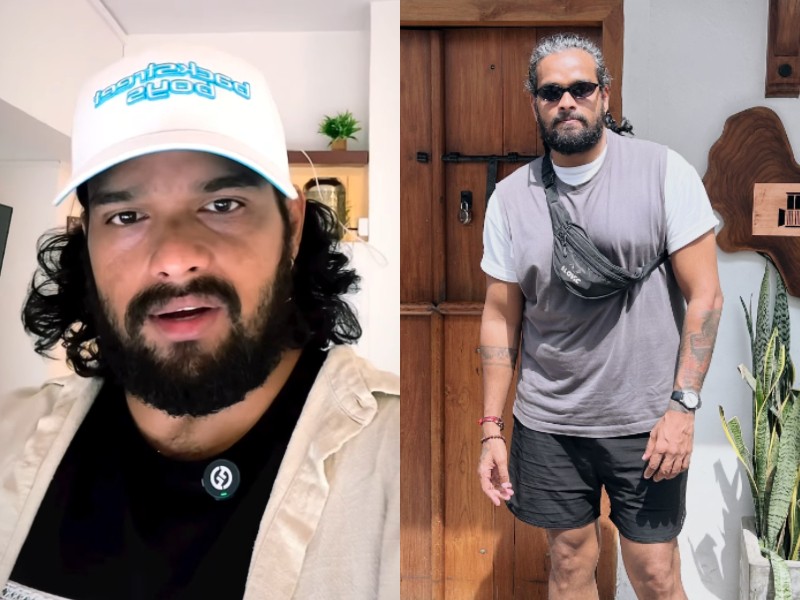
The video, titled ‘Keralam is in Danger’, has triggered controversy over allegations that the vlogger misrepresented Kerala's social and cultural landscape.
In the recording, he claimed that Muslims dominated Fort Kochi, criticised a cafe serving beef under the name Kashi and called for the Union government to intervene, warning that the state was in danger.
The remarks have drawn criticism from political leaders and social media users, with opponents accusing the vlogger of attempting to create communal divisions in a region known for its cultural diversity.
Police have booked Amrit under Sections 353(2) and 192 of the Bharatiya Nyaya Sanhita (BNS).
Section 353(2) concerns the circulation of false information or rumours intended to promote enmity or hatred between communities, groups or castes, while Section 192 deals with provocation intended to cause a riot.
Vlogger questions cafe's name and beef menu
In the video, Amrit begins by discussing Kashi Art Cafe in Fort Kochi, questioning its name and the artwork displayed inside the establishment.
He claims that the cafe had no connection with Banaras or the Hindu deity Mahadeva, despite using the name Kashi.
He then criticises the presence of an artwork featuring Mahatma Gandhi and Muhammad Ali Jinnah, alongside the cafe's menu, which he says was entirely focused on beef.
“When I went inside the cafe, for the first time I saw Jinahh’s face in Bharat along with Gandhi. When I checked the menu, the entire menu was all about beef. Naming it Kashi, putting Jinnah’s photo and serving Beef,” he says in the video.
He subsequently suggests that the cafe should change its name from Kashi to Karachi.
The artwork depicting Gandhi and Jinnah was created by artist Riyaz Komu.
As described by The Hindu, the work draws on the history of Partition and the enduring divisions associated with the subcontinent's political past.
The artwork and the cafe's menu became central to the vlogger's criticism, which subsequently expanded into broader claims about the religious composition of Fort Kochi and the state government's approach to the region.
Claims about Muslim population spark backlash
In the video, Amrit alleges that Muslims dominate businesses and everyday commercial activities in Fort Kochi, citing shopkeepers, taxi and auto-rickshaw drivers, street vendors and other small business owners.
He claims that approximately 95 percent of business owners and people engaged in various local trades are Muslims, although the supplied report does not cite demographic data supporting that figure.
“And I’m totally shocked to see the population and the surroundings—it is all about Islam in Fort Kochi,” he says.
The vlogger also alleges that local Hindus and right-wing residents were afraid to speak openly.
He further claims that the state government was receiving funding from Arab countries to promote Islam, without providing evidence for the allegation in the supplied material.
“What is going on in Kerala is dangerous. If the central government doesn’t pay attention to this, then Kerala is a gone case; Kerala has slipped out of our hands,” he says.
He also claims that Hindus and right-wing residents in the state cannot express their views openly.
The video has faced criticism over its portrayal of Kerala's population, religious communities and cultural traditions.
Critics have accused the vlogger of using the cafe's name, menu and artwork to advance a broader communal narrative about the state.
Diya Krishna clarifies ‘sad reality’ comment
The controversy intensified after social media content creator Diya Krishna, daughter of BJP leader Krishna Kumar, commented “sad reality” on the video.
Her response prompted considerable online discussion, with some users interpreting the comment as an endorsement of the vlogger's wider allegations about Fort Kochi.
Diya later released a clarification video in which she apologised for reacting after watching only the first half of the recording.
She said her comment referred specifically to the depiction of Jinnah alongside Gandhi in the cafe's artwork and was not intended to endorse the vlogger's communal remarks about Kerala or its population.
Her clarification followed the backlash surrounding the original comment and the wider debate over the content of Amrit's video.
Kerala leaders condemn communal remarks
Kerala political leaders criticised the video, with opposition leader Pinarayi Vijayan accusing the vlogger of using online platforms to spread communal hostility.
In a post on X, Vijayan described Fort Kochi and Varkala as places shaped by cultural exchange and diversity.
He accused the vlogger of attempting to portray these destinations through a communal lens.
“Fort Kochi and Varkala are places where cultures meet, histories intertwine, and diversity thrives. Now, a vlogger peddling hate for profit seeks to paint these vibrant destinations in communal colours,” Vijayan wrote.
He also accused the Sangh Parivar of using online personalities to promote divisive messaging after failing to divide Kerala through other means.
“But Keralam’s secular spirit will not yield to their politics of hatred,” he added.
Chief Minister VD Satheesan also condemned the video, saying that attempts to spread misinformation and divide communities were unacceptable.
“Keralam stands united. Communal hatred has no place here,” Satheesan wrote.
He said a case had been registered and that the law would take its course, adding that the UDF government remained committed to communal harmony and justice without fear or favour.
Rajeev Chandrasekhar raises questions over political culture
BJP leader and Nemom MLA Rajeev Chandrasekhar also responded to the controversy, stating that the people of Kerala should determine the state's future and preserve their cultural traditions.
“Keralam is for all Malayalees. Malayalees alone will decide the present & future of Keralam. Our food, our culture, our celebrations,” he wrote.
Chandrasekhar said he agreed with the Chief Minister's emphasis on communal harmony but raised questions about the state's political culture.
He questioned why some people glorified Jinnah, whom he described as a figure associated with the Partition of India, and criticised what he alleged was the justification or support for proscribed terrorist organisations such as Hamas.
He also questioned political alliances involving the Congress, the Communist Party of India (Marxist) and Jamaat-e-Islami, describing the latter as anti-secular and anti-constitutional.
His comments added another dimension to the political debate surrounding the vlogger's allegations, with leaders across the political spectrum responding to different aspects of the controversy.
Police register case under BNS
The Kerala Police have registered a case against Amrit under Sections 353(2) and 192 of the Bharatiya Nyaya Sanhita.
Section 353(2) addresses the circulation of false information, rumours or reports with the intention of promoting enmity or hatred between different communities, groups or castes.
Section 192 concerns deliberately provoking another person with the intention of causing a riot.
The case follows the circulation of the video and the public reaction to its claims about Fort Kochi, its Muslim residents and the Kerala government.
The allegations against the vlogger remain subject to the legal process.