
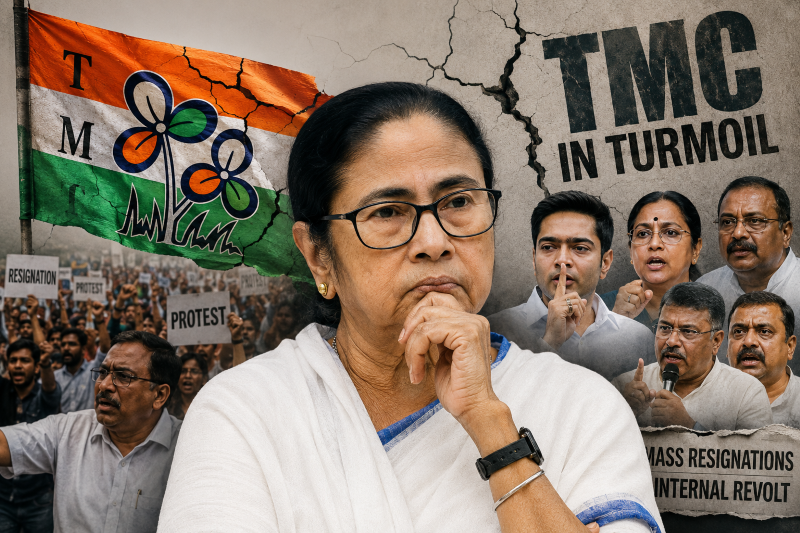
From Dominance to Disarray
A single poll defeat in 15 years, and Trinamool has plunged into a daily spectacle of dissent, infighting and revolts, in what increasingly looks like the prelude to a virtual disintegration.
Mamata Banerjee, who had once championed street politics for decades as an opposition leader against the Left, is now largely confined to her Kalighat residence—presiding over abrupt party meetings, writing poetry, and venting her anger through Facebook Live sessions.
Absence on the Ground, Rising Political Heat
When illegal street hawkers were evicted from railway stations and unauthorised constructions bulldozed, Left leaders rushed to the streets in protest—but Banerjee was seen nowhere on the ground.
As widely predicted by several analysts in the run-up to the 2026 Assembly Elections, TMC now stares at a mini-collapse within weeks of going out of office, as civic representatives to parliamentarians begin rebelling against the functioning of a party that has dominated state politics since 2009.
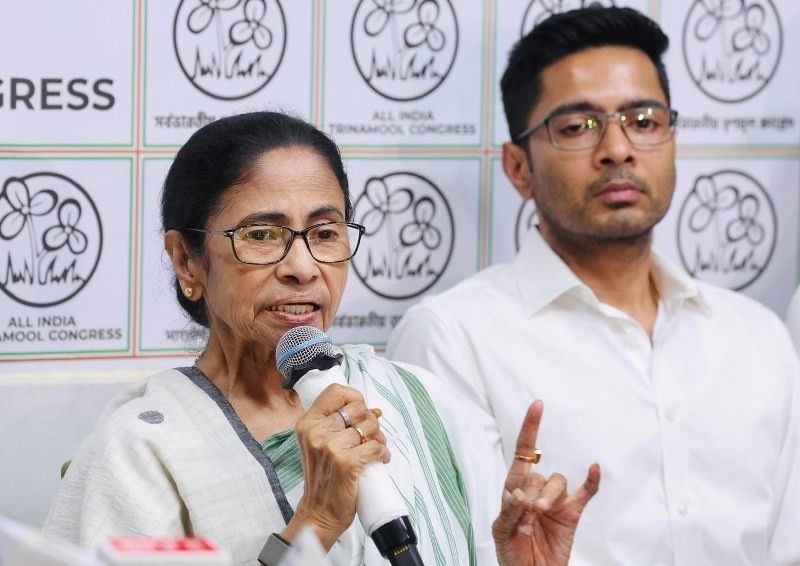 Mamata Banerjee with her nephew and TMC top leader Abhishek Banerjee at a press conference post election defeat. Photo: Avishek Mitra/IBNS
Struggling to Hold the Organisation Together
Let alone confronting the new Bharatiya Janata Party-led government, which stormed to power with 208 seats, TMC now appears to be struggling to keep its own flock together.
The wave of resignations from TMC leaders across civic bodies peaked when Mamata Banerjee’s close associate and Lok Sabha MP Kakoli Ghosh Dastidar revolted within hours of being replaced by Kalyan Banerjee as chief whip in the Lok Sabha.
Dastidar further deepened the embarrassment by attending an administrative meeting chaired by Chief Minister Suvendu Adhikari, who openly admitted to selectively inviting TMC leaders “who were finally speaking their mind”.
Resignations Spread Across Civic Bodies
Dastidar was not the first—and is unlikely to be the last.
TMC councillors Sushanta Ghosh and Arup Chakraborty earlier this week resigned from their posts in the Kolkata Municipal Corporation and later aired their grievances against the top leadership on television debates—even as Arup Chakraborty had defended the party leadership just weeks ago.
Santanu Sen Exit Widens the Rift
The cracks widened further when Santanu Sen resigned as TMC national spokesperson.
More worryingly for Banerjee, he also publicly commented on his understanding of the RG Kar incident during a YouTube interview.
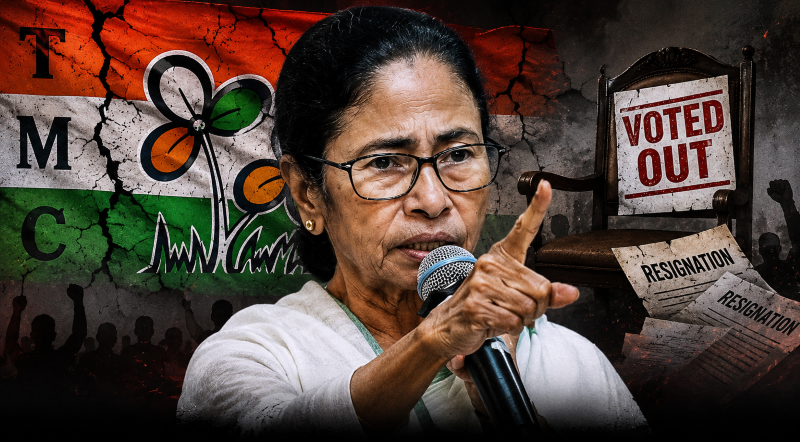 Mamata Banerjee herself was defeated by now Chief Minister Suvendu Adhikari in Bhabanipur in 2026. Photo: ChatGPT
Abhishek Banerjee at the Centre of Internal Backlash
Though TMC remains heavily centred around Mamata Banerjee’s personal charisma and is often criticised for lacking organisational depth, much of the current revolt is being directed at her nephew Abhishek Banerjee and his style of functioning.
For the uninitiated, Abhishek is the national general secretary and the de facto number two in the party.
Speaking on ABP Ananda, Arup Chakraborty openly admitted that Abhishek’s aggressive and often threatening campaign remarks were “not called for”.
Several leaders, including Dastidar, have also criticised the influence of I-PAC and what they describe as a corporate-style functioning associated with Abhishek Banerjee.
His “Diamond Harbour Model” also collapsed in the Falta repoll, which pushed TMC to fourth position behind the Left and Congress amid a saffron wave.
Growing Anger Over ‘Consultancy-Driven Politics’
“I have been in politics for 40–42 years, but I had to follow diktats of I-PAC employees whose ages were half of my political experience,” Dastidar reportedly said, sharply rejecting the consultancy-driven model that had helped TMC bounce back in 2021.
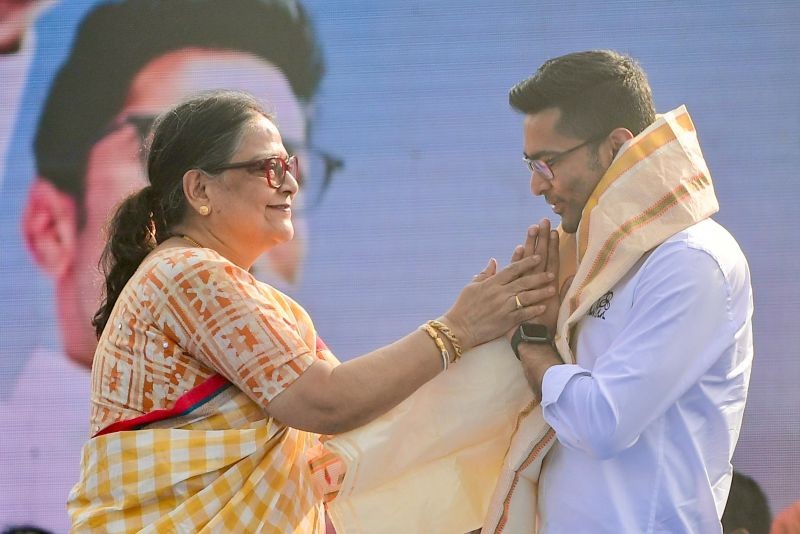 Kakoli Ghosh Dastidar with Abhishek Banerjee. Photo: Kakoli Ghosh Dastidar/Facebook
Crossroads for Disgruntled Leaders
For disgruntled leaders, options now appear limited—either rebuild their faction, switch to the BJP or Congress, or step away into post-political retirement.
A section of rebels may find the BJP the most viable destination, given its strong legislative presence, though it still lacks the deep grassroots organisation that is crucial for sustaining politics in West Bengal.
BJP Opens Door—With Conditions
BJP state president Samik Bhattacharya, who had earlier ruled out an immediate joining spree, has now left the door open for entrants—but with clear conditions.
His remarks about welcoming “bhalo Trinamool” or “uncorrupted Trinamool” elements backfired, drawing sharp backlash from BJP supporters who rejected the idea outright.
The online response quickly turned into memes and trolling, reflecting resistance within the party’s own ecosystem.
Bhattacharya defended his statement, saying, “The reactions show how much people hate the TMC.”
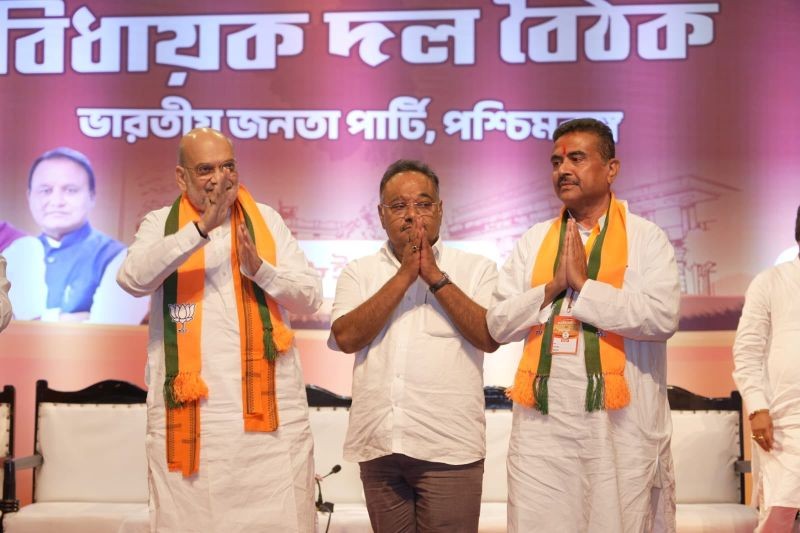 (L-R) Union Home Minister Amit Shah, BJP state president Samik Bhattacharya and Chief Minister Suvendu Adhikari. Photo: Samik Bhattacharya/Facebook
BJP Rejects Large-Scale Induction Theory
BJP MP Rahul Sinha dismissed the idea of mass TMC defections strengthening the saffron party, asserting confidence in the party’s organisational strength.
“Our party got such a big mandate riding on our own cadre base, so we do not need any corrupt leaders from outside to expand our footprint,” Sinha said.
Limited but Strategic Realignments Ahead
Political analyst Biswanath Chakraborty suggested that while large-scale defections may not happen immediately, a section of TMC MPs could gradually align with the BJP without formally defecting, while others may drift towards the Congress.
“About 19 TMC MPs may turn pro-Modi without defecting… some may even float their own platform,” Chakraborty said speaking to HOW, adding that a section of TMC MLAs could also eventually move towards the Congress.