
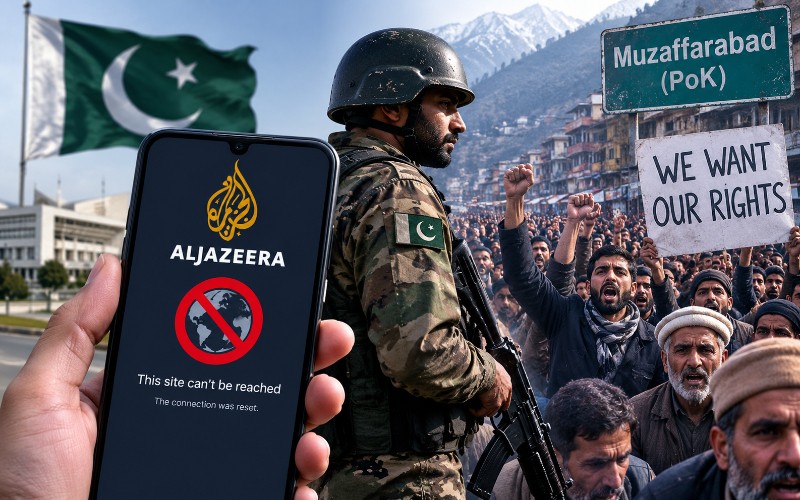
While the Pakistani government has not officially acknowledged imposing any restrictions on the Qatar-based news network, activists, opposition leaders and internet users have alleged that access to Al Jazeera English was curtailed shortly after it published a series of reports from Muzaffarabad documenting security operations, civilian protests and the ongoing political unrest.
The reported disruption has intensified concerns about press freedom as Islamabad faces growing international scrutiny over its handling of the crisis in PoK.
Reports have also suggested that several local and regional digital news platforms experienced similar restrictions, although no official notification has been issued by Pakistani authorities confirming any such action.
Claims of restrictions gain momentum
Reports of restricted access first surfaced on social media, where users across Pakistan claimed they were unable to access Al Jazeera's English-language website.
The allegations quickly gained traction after activists linked the apparent disruption to the broadcaster's detailed reporting from Pakistan-Occupied Kashmir.
Among those raising the issue was Sohaib Khan, former deputy general secretary of the Jammu Kashmir Liberation Front (JKLF) AJK-GB Zone.
In a post on X, he wrote: "Just confirmed from Islamabad: The AJEnglish website has been restricted in Pakistan following its coverage of recent events" in Pakistan-Occupied Kashmir.
"Silencing independent media will not hide the truth," he added.
The allegations were later echoed by Pakistan Tehreek-e-Insaf (PTI) leader Faiza Murad, who is based in London.
In a post translated from Urdu, Murad claimed that following Al Jazeera's coverage of the PoK elections, Pakistan's Ministry of Information and Broadcasting had reminded foreign journalists that reporting from areas outside Lahore, Islamabad and Karachi would require prior No Objection Certificates (NOCs) under the country's Foreign Media Facilitation Guidelines.
"This is proof that this hybrid regime wants to further restrict free journalism and foreign media access in Pakistan," she alleged.
Despite the growing claims, neither the Pakistan Electronic Media Regulatory Authority (PEMRA), the Ministry of Information and Broadcasting nor any other government agency has publicly confirmed that Al Jazeera has been blocked.
Al Jazeera's extensive reporting from Muzaffarabad
Al Jazeera has been among the few major international broadcasters providing sustained ground coverage of the political crisis unfolding in Pakistan-Occupied Kashmir.
Its reports from Muzaffarabad documented widespread strikes, shuttered markets, blocked highways, election-related tensions, internet disruptions and the impact of security measures on daily life.
The broadcaster also highlighted how communication blackouts affected schools, businesses, healthcare services and ordinary residents across the region.
Its correspondents reported that voter turnout appeared lower than expected as many residents chose to boycott polling in solidarity with the protest movement.
Coverage also described deserted streets, extensive security deployments and allegations by opposition groups that the electoral process lacked a level playing field because of curfews, roadblocks and restrictions on political activity.
Al Jazeera additionally carried voices critical of Pakistan's political and military establishment while documenting allegations of electoral manipulation, public frustration and the broader governance crisis.
One Muzaffarabad resident, Nadia Khitab Raja, told the broadcaster: "Protests are going on here. People and many parties have boycotted it. Women aren't coming out to vote. People are disgusted with the system. They got fed up."
The network's reporting brought international attention to developments that had otherwise received limited global coverage.
Protests continue across PoK
The demonstrations began in June and have since developed into one of the largest protest movements witnessed in Pakistan-Occupied Kashmir in recent years.
The movement is being led by the Joint Awami Action Committee (JAAC), which Pakistani authorities have declared an outlawed organisation.
Although the protests initially centred on opposition to reserved seats in the region's so-called legislative assembly, the movement has expanded to include demands relating to political rights, governance, economic reforms and greater regional autonomy.
Protesters have called for reduced interference by Islamabad in local administration, the release of detained JAAC activists, accountability for civilians killed during the security crackdown, transparent governance, equitable resource distribution and regulation of wheat and other essential commodity prices.
The movement has also demanded implementation of earlier commitments allegedly made by local authorities and greater democratic accountability.
As demonstrations intensified, repeated confrontations between protesters and security personnel led to widespread road blockades, communication blackouts and prolonged disruption to everyday life.
Activists have cited reports claiming that the violence resulted in heavy civilian casualties.
One estimate suggested that at least 80 civilians had died during the unrest, while JAAC claimed more than 50 people were killed and hundreds injured during four days of clashes with security forces.
Pakistani authorities have not confirmed either figure, and the reported casualty numbers could not be independently verified.
JAAC member Sardar Umar Nazir Kashmiri alleged on social media that security forces had launched a violent crackdown on demonstrators, while the organisation maintained that protests continued across the Muzaffarabad region despite security operations.
Reports have also indicated that some demonstrators raised slogans sharply critical of Pakistan's political and military establishment, including chants calling for the road to India to be opened.
India has consistently maintained that Pakistan-Occupied Kashmir is an integral part of India and remains under Pakistan's illegal occupation following the 1947-48 conflict.
International concern over the unrest
The ongoing violence has also drawn attention from international rights organisations.
The US-based Human Rights Foundation (HRF) urged Pakistani authorities to refrain from using excessive force against protesters, restore communication services and ensure accountability for any unlawful actions.
Quoting local civil society organisations, HRF alleged that security personnel had opened fire on peaceful demonstrators.
India has also criticised Islamabad's handling of the unrest.
On July 31, New Delhi urged the international community to closely monitor Pakistan's handling of the protests and hold Islamabad accountable for what it described as the "ruthless" use of force against peaceful demonstrators in Pakistan-Occupied Kashmir.
Earlier, India said the protests reflected decades of "systemic exploitation, denial of fundamental rights and administrative oppression" in the territory.
As allegations of media restrictions continue to circulate, the reported inaccessibility of Al Jazeera has further fuelled debate over press freedom, access to independent reporting and transparency during one of the most significant political crises to unfold in Pakistan-Occupied Kashmir in recent years.