
The petitions come after the dissident MPs claimed they had merged with the Nationalist Citizens Party of India (NCPI) and sought recognition as a separate group in Parliament.
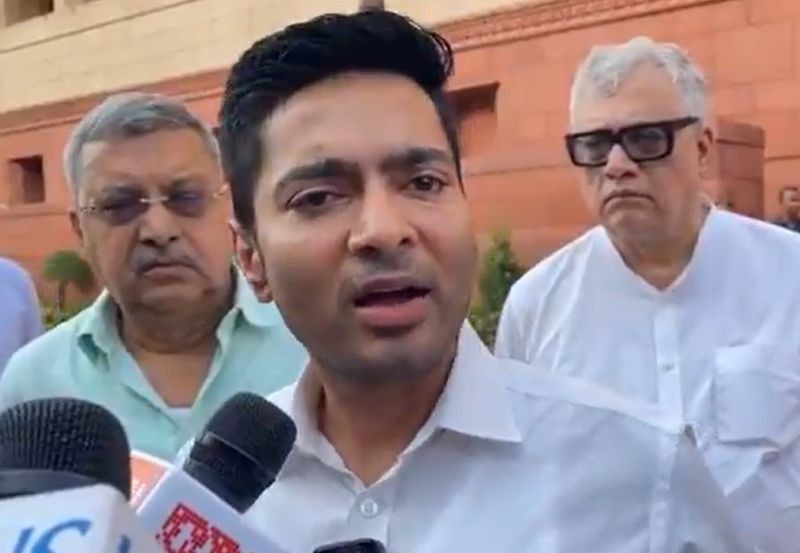
Speaking after meeting the Speaker, Banerjee said the rebels had first approached Birla seeking recognition as a separate parliamentary bloc before later claiming affiliation with NCPI.
"Twenty people met the Speaker and claimed they should be treated as a separate group. Later, we got to know those MPs claimed to have joined another party, NCPI; nobody has heard the name of this group. Even they had not heard the name of this party," Banerjee said.
19 June 2026 | Shri @abhishekaitc addresses the media in Delhi. pic.twitter.com/jv7IX9JQzG
— All India Trinamool Congress (@AITCofficial) June 19, 2026
'Membership should go'
Invoking the anti-defection provisions under the Tenth Schedule of the Constitution, Banerjee argued that any MP who voluntarily gives up membership of the party on whose symbol they were elected automatically incurs disqualification.
"So if they have been elected on a symbol and are claiming after two years that they are joining a new party, their membership should go," he said.
The Trinamool leader urged the Speaker to dispose of the petitions quickly, noting that the Supreme Court has held that such matters should ordinarily be decided within three months.
'People of Bengal will not forgive them'
Banerjee launched a sharp attack on the dissident lawmakers, accusing them of betraying the mandate of the people and succumbing to pressure from central agencies.
"They have torn apart the Tenth Schedule. They have sold their conscience and their honour. The people of Bengal will not forgive them," he alleged.
He further claimed that the rebels defected out of fear of the Enforcement Directorate (ED) and Central Bureau of Investigation (CBI) and were induced by monetary incentives.
Maharashtra parallel drawn
Drawing comparisons with political developments in Maharashtra, Banerjee accused the BJP-led establishment of attempting to weaken opposition parties through institutions.
"We saw in Maharashtra how they are trying to break the Shiv Sena. They are not contesting the elections democratically. The Election Commission, CBI and ED are all being misused," he alleged.
TMC's constitutional argument
The meeting followed an earlier letter written by Banerjee to the Speaker on June 10, urging him not to grant recognition, status or facilities to any group claiming to represent a separate faction of the Trinamool Congress.
In the letter, Banerjee argued that the Constitution and anti-defection law recognise only one political party and do not permit the creation of rival factions within a party in Parliament.
Citing the Supreme Court's Constitution Bench judgment in the Maharashtra political crisis case, he maintained that the defence of a "split" is no longer available under the Tenth Schedule.
He also contended that a valid merger requires both the merger of the political party itself and the support of at least two-thirds of its legislators, and that meeting only one of those conditions is insufficient.
Speaker's decision expected soon
The rebellion within the Trinamool parliamentary party comes in the wake of the party's defeat in the West Bengal Assembly elections.
The dissident camp claims the support of 22 Lok Sabha MPs and is seeking recognition as a separate parliamentary bloc.
A similar power struggle is underway in the West Bengal Assembly, where 64 of the party's 80 MLAs have already broken away and secured recognition as a separate legislative formation.
The Mamata Banerjee-led faction has challenged that decision before the Calcutta High Court.
According to reports, Speaker Om Birla is expected to decide on the status of the 20 rebel MPs before the Monsoon Session of Parliament, which is likely to begin in the third week of July.
The Speaker has already heard submissions from both sides regarding the rebels' demand for separate seating arrangements and recognition as members of NCPI.