
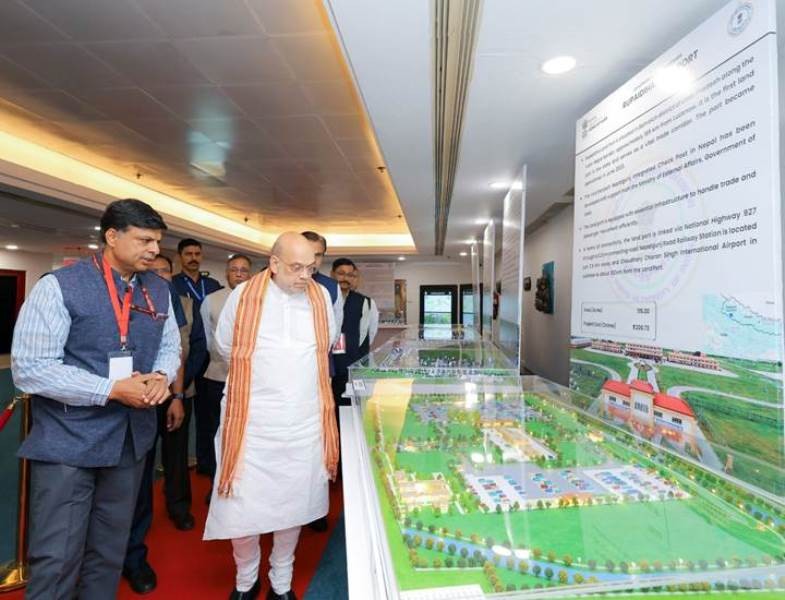
Addressing the event, Shah said that under the visionary leadership of Prime Minister Narendra Modi since 2014, the Land Ports Authority of India has been given a renewed and expanded mandate.
He said land ports have moved beyond a purely security-centric approach and are now positioned as the first line of defence, a facilitator of trade, and a bridge for people-to-people connectivity.
“Land ports have played a significant role in the holistic development of border areas by promoting legitimate trade, addressing challenges such as migration from border villages and districts, and strengthening cultural exchange. Easier cross-border movement has also helped build mutual trust between people of neighbouring countries,” Shah said.
He noted that the Ministry of Home Affairs is implementing a four-pronged strategy to strengthen India’s borders under the Smart Border framework, with the Land Ports Authority playing a key role in this vision.
Shah said the LPMS has been designed to meet the needs of all stakeholders while placing strong emphasis on security. He added that the system, along with the Smart Border initiative, will help build a robust, modern, and “impregnable” border management framework.
The Home Minister said the LPMS represents a major step towards digitisation and integration, bringing all stakeholders onto a single platform for real-time management of cargo, passengers, and vehicles.
He said the system will significantly reduce paperwork—by nearly 90%—through a Single Electronic Window and an Automatic Number Plate Recognition (ANPR)-based gate operation system. This, he added, will lead to substantial time savings at border points.
Truck waiting time is expected to come down by around 40% to 60%, while gate processing time could reduce by 22% to 35%, he said.
Shah further said that the initiative will not only boost trade but also promote tourism and strengthen coordination, dialogue, and cultural exchange between neighbouring countries.
He added that LPMS will enable real-time data sharing among agencies including ICEGATE, the Motor Vehicle System, CBIC, BSF, DGFT, UIDAI, and ULIP through a common platform, significantly improving inter-agency coordination at border points.
Describing land ports as a key driver of transformation over the past 12 years, Shah said trade through land ports has increased from around ₹5,000 crore in 2014 to about ₹83,000 crore at present—reflecting a nearly 16-fold rise.
He also noted that 15 land ports are currently operational, while 11 more are expected to become operational over the next two to three years.