
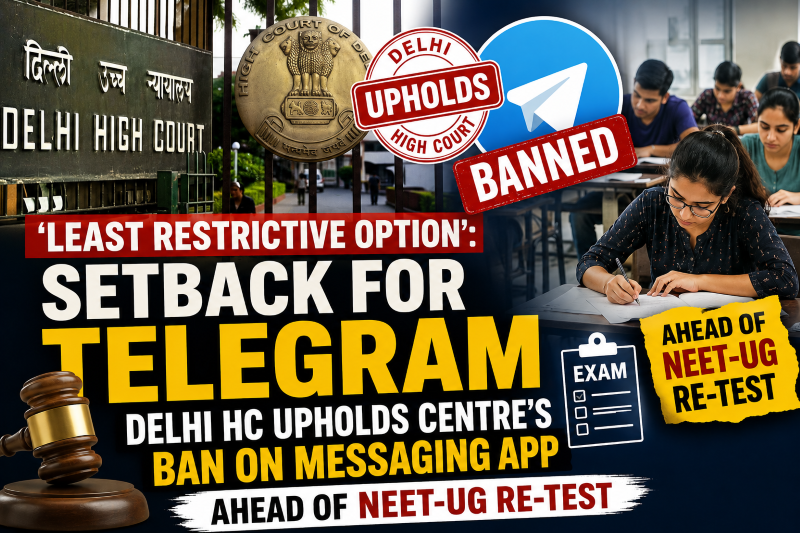
Court Says Move Was Necessary to Protect Exam Integrity
A single-judge bench of Justice Tejas Karia ruled that the government's action was justified to safeguard the integrity of the examination process.
The court observed that the temporary restriction was the least restrictive option available to the Centre under the circumstances.
Ban Held Valid Under IT Act
The court further noted that the government's order was in accordance with Section 69A of the Information Technology Act, which empowers authorities to block access to online content under specified conditions.
Telegram's Challenge Rejected
Telegram had challenged the temporary ban, arguing that the blockage was excessive and unlawful.
However, the High Court rejected the platform's plea, holding that the government's action was proportionate and warranted given the concerns over examination security.
Curbs Imposed Ahead of NEET-UG Re-Test
The temporary restrictions were introduced as a precautionary measure ahead of the NEET-UG re-examination, amid concerns that messaging platforms could be used to facilitate the circulation of leaked examination papers.
The court's ruling reinforces the government's authority to take targeted digital measures to protect the integrity of high-stakes examinations.
Telegram Restricted Until June 22
As part of the preventive measures, the Ministry of Electronics and Information Technology (MeitY) has suspended Telegram services across the country until June 22.
In addition, Telegram has reportedly been directed to disable the message-editing feature for already-posted messages until June 30, 2026, to prevent the alteration of content that could be used to mislead candidates or obstruct investigations.
NEET-UG Re-Examination Scheduled for June 21
The re-examination for NEET-UG 2026 is scheduled to be held on June 21 following widespread allegations of question paper leaks during the original examination conducted on May 3.
Authorities are taking extra precautions to ensure the integrity of the test and restore confidence among candidates and parents.
NTA Welcomes Government's Decision
The National Testing Agency (NTA) has welcomed the government's move, stating that the restrictions were imposed in the interest of public order.
According to the NTA, the measures were necessary in response to the organised use of Telegram by cheating syndicates and fraudsters seeking to exploit candidates appearing for the re-examination.
Why Telegram?
The NTA said investigations and monitoring by the Indian Cyber Crime Coordination Centre (I4C), state police forces and other agencies uncovered several Telegram channels, groups and bots allegedly being used to spread misinformation regarding the re-examination.
Several channels operating under names such as "PAPER LEAKED NEET" and "RE-NEET 2026" were reportedly demanding payments ranging from a few thousand rupees to several lakh rupees from candidates and their families in exchange for purported question papers.
Exam cancelled after ‘guess paper’ controversy
The examination was cancelled after questions from a circulated “guess paper” allegedly matched the main examination conducted on May 3.
The NTA decided to reschedule the examination on a separate date. Nearly 22 lakh candidates had appeared for the test.
Protests erupt over NEET cancellation
Protests demanding the cancellation of the NEET erupted across several parts of India after allegations of paper leaks, irregularities, and unfair evaluation practices surfaced.
Students and opposition parties accused authorities of failing to ensure transparency and merit in one of the country’s most competitive medical entrance examinations.
Demonstrators demanded a re-examination, accountability from the NTA, and reforms in the examination system to restore trust among aspirants.
The central government has ordered a Central Bureau of Investigation (CBI) probe into the alleged malpractice associated with the examination.