
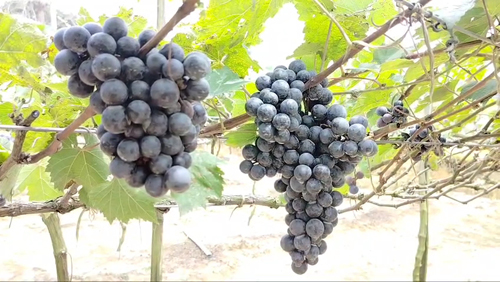
Experimental grape cultivation in Kailashahar, the district headquarters of Unakoti district of Tripura, may open a new chapter in Tripura’s agricultural sector. Until now, the state has been better known for cultivating fruits such as pineapple, orange, lemon, and dragon fruit. Now, grapes may soon join that list. Promising research based on a two-decade-old experiment shows encouraging results under the leadership of horticulture scientist Dr Ratan Das.
A research-based grape cultivation project initiated by the Krishi Vigyan Kendra (KVK) at Chanatil area in Kailashahar has already generated significant interest in agricultural circles. The project is being supported by the National Research Centre for Grapes, Pune, and NABARD. The research is being led by horticulture scientist and Principal Investigator (Grapes), Dr. Ratan Das.
Speaking to the media , Dr. Das said the initiative aims to scientifically assess the potential of grape cultivation in Tripura’s soil and climatic conditions. According to him, the ongoing observations regarding plant growth, environmental adaptation, and fruit quality have shown encouraging results so far.
However, the roots of this research date back nearly two decades. Dr. Das revealed that in 2002, then Assistant Director Pratap Chandra Das had initiated an experimental grape cultivation project in the fruit orchard area of Chanatil village. Although the plants showed good growth and yield at that time, the grapes lacked the desired sweetness. Experts believe that the absence of suitable grape varieties, limited climate-specific technologies, and inadequate scientific management were the key reasons behind the shortcomings. Nevertheless, that early experiment later became the inspiration for the current research initiative.
Dr. Ratan Das stated that the new project was planned after carefully analyzing the findings of the earlier experiment. He emphasized that with modern technology, improved grape varieties, and scientific cultivation methods, Tripura could emerge as a promising region for grape farming.
In 2024, an experimental plot was established near the office premises of the Krishi Vigyan Kendra. Advanced grape saplings and technical support were brought in from the National Research Centre for Grapes in Pune, while NABARD provided financial and infrastructural assistance. Researchers are currently conducting detailed observations on the adaptability of different grape varieties, disease resistance, fruit quality, and compatibility with the local climate.
Agricultural experts point out that grape cultivation is generally considered suitable for the comparatively dry climates of Maharashtra, Karnataka, and other southern Indian states. In that context, the possibility of successfully cultivating grapes in a humid region like Tripura is considered highly significant. Experts believe that if the research succeeds, it could open a new horizon for agriculture across Northeast India.
The project led by Dr. Ratan Das has already become a major point of discussion among agricultural researchers and local farmers. Many farmers are regularly visiting the Krishi Vigyan Kendra to inspect the grape plantation and are expressing interest in adopting grape cultivation in the future.
Dr. Das noted that there was once skepticism regarding the cultivation of improved mango varieties in Tripura as well. However, many farmers are now successfully cultivating those varieties using scientific methods. Inspired by that experience, efforts are now being made to explore the possibilities of grape farming in the state.
He further said that diversification in agriculture has become the need of the hour. Alongside traditional crops, increasing emphasis on high-value fruit cultivation could significantly enhance farmers’ income. Since grapes enjoy strong market demand and comparatively high prices, they may emerge as a profitable alternative crop in the future.
If the research achieves complete success, there are plans to expand grape cultivation commercially on a larger scale in the coming years. The Krishi Vigyan Kendra may also take initiatives to provide farmers with training, demonstration plots, quality saplings, and technical support. This could create new opportunities for fruit processing industries, cold storage facilities, and agricultural marketing at the local level.
According to local farmers, successful grape cultivation in Unakoti’s soil could trigger a new agricultural revolution in the district. It may particularly create new employment and entrepreneurial opportunities for young farmers.
Overall, what began as a limited experimental effort years ago has now evolved into a highly promising agricultural research initiative. Horticulture scientist and Principal Investigator Dr. Ratan Das continues to work tirelessly to transform this possibility into reality. Agricultural experts believe that if the initiative succeeds, “Tripura Grapes” could one day earn a unique place on India’s agricultural map.