
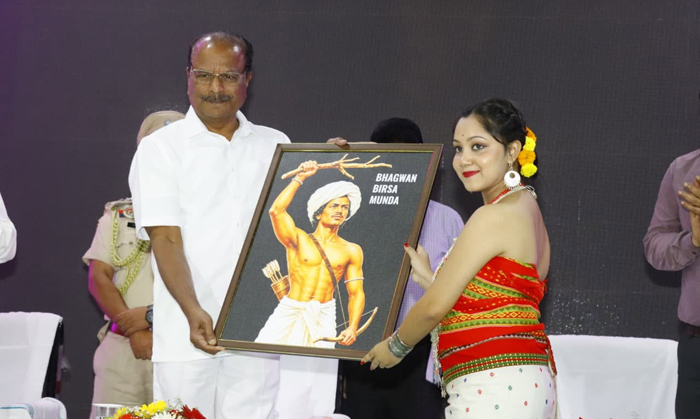
The sixth Janjatiya Gaurav Diwas celebrations organised by the Directorate of Tribal Research and Cultural Institute under the state government at Dasharath Deb State Auditorium in Supari Bagan, Agartala was inaugurated by the Governor Indrasena Reddy Nallu on Sunday. The occasion also marked the 151st birth anniversary of Bhagwan Birsa Munda.
Janjatiya Gaurav Diwas is observed across the country on Birsa Munda’s birth anniversary to honour the courage, contributions and rich cultural heritage of tribal communities.
Addressing the gathering, the Governor said tribal communities were not merely beneficiaries of development initiatives but also guardians of forests, traditional knowledge and indigenous ways of life. He described them as the inheritors of Bhagwan Birsa Munda’s courage and legacy and stressed their significant role in building a developed and self-reliant Tripura.
He called for renewed commitment to ensuring quality education for every tribal child, protecting the land rights of tribal families, strengthening the Tripura Tribal Areas Autonomous District Council (TTAADC) and preserving the culture, languages and religious beliefs of all tribal communities.
The Governor emphasised that tribal heritage should not remain confined to history books or cultural exhibitions but must be preserved as a living tradition to strengthen the identity, confidence and pride of future generations.
Recalling Birsa Munda’s historic struggle, he referred to the 'Ulgulan' or Great Revolt of 1899 against colonial exploitation, unjust land laws and restrictions on forest rights. He said Birsa Munda’s struggle symbolised the determination of tribal communities to protect their land, forests, religious beliefs and traditional way of life. His ideals and contributions to India's freedom struggle continue to inspire generations, he added.
Highlighting the importance of education in connecting tribal heritage with emerging opportunities, the Governor referred to various educational initiatives in Tripura, including Eklavya Model Residential Schools (EMRS), residential schools and ashram schools.
He said 12 Eklavya Model Residential Schools were currently operational in Tripura, while the Central Government had approved 21 more. Around 34,000 tribal students were pursuing their studies in 407 government hostels across the state. In addition, 29 new hostels had been constructed in rural areas.
The Governor also highlighted efforts to strengthen the Post-Matric Scholarship Scheme to enable tribal students to pursue higher education without financial difficulties. He said initiatives were underway to bring private educational institutions under the scheme.
Referring to major Central government initiatives for tribal welfare, he mentioned the Pradhan Mantri Janjati Adivasi Nyaya Maha Abhiyan (PM-JANMAN), launched in November 2023 for the welfare and development of Particularly Vulnerable Tribal Groups (PVTGs), and the Dharti Aaba Janjatiya Gram Utkarsh Abhiyan.
He also highlighted the role of Van Dhan Vikas Kendras under the Pradhan Mantri Janjatiya Vikas Mission, saying these centres were creating sustainable livelihood and economic opportunities for tribal communities by utilising forest resources and traditional skills.
Referring to the World Bank-supported Tripura Rural Economic Growth and Service Delivery Project, the Governor said special emphasis would be laid on the development of 23 tribal-dominated blocks, including 12 aspirational blocks. The project envisages improving educational standards, expanding road connectivity, creating sustainable livelihood opportunities and strengthening public service delivery.
Under the project, 121 roads covering a total length of 416 km have been proposed for construction. Around 75,000 families are expected to benefit from livelihood opportunities, while infrastructure development is planned for 16 schools.
Describing development as a right to be pursued with dignity rather than an act of charity or benevolence, the Governor stressed the need to ensure that the benefits of development reach people living in remote tribal areas. He said the overall development of Tripura could never be complete without empowering tribal communities and protecting their identity, rights, heritage and cultural legacy.
Director of the Tribal Research and Cultural Institute Ratanjit Debbarma highlighted various initiatives undertaken by the department to promote, preserve and protect tribal culture, heritage and traditions.
Joint Secretary to the Governor Jayanta Bhattacharya and other dignitaries were also present at the programme.
The Governor distributed prizes among the winners of various competitions, including quiz, drawing, essay writing, poetry writing, short essay writing and photography.
The programme also featured colourful folk music and traditional dance performances showcasing the rich cultural diversity of Tripura's tribal communities. The celebrations concluded with tributes to Bhagwan Birsa Munda and recognition of the invaluable contributions of tribal communities to India's history, freedom struggle and nation-building.