
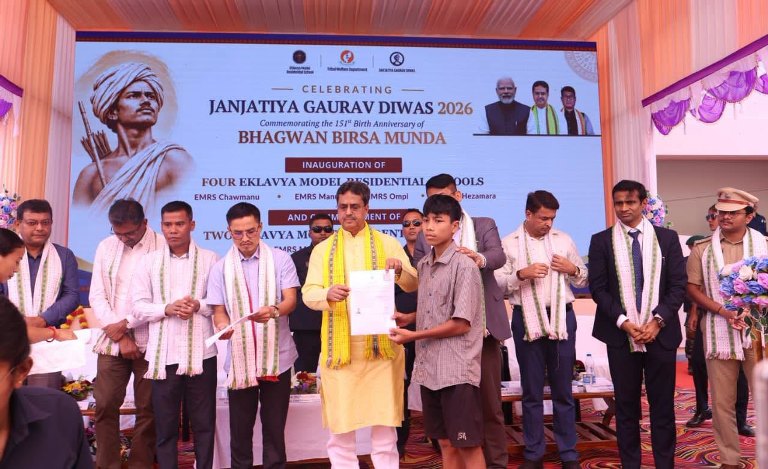
Marking a significant step towards strengthening tribal education in Tripura, Chief Minister Prof. (Dr.) Manik Saha on Sunday virtually inaugurated the 480-seats Eklavya Model Residential School (EMRS) at Manikpur in Dhalai district during the state-level observance of Janjatiya Gaurav Divas, commemorating the 151st birth anniversary of tribal freedom fighter Bhagwan Birsa Munda.
Addressing the gathering, the Chief Minister paid rich tributes to Bhagwan Birsa Munda and highlighted the immense contribution of tribal communities to India's freedom struggle, social reform, education, agriculture, environmental conservation and nation-building. He said the Government of India, under Prime Minister Narendra Modi, had declared November 15 as ‘Janjatiya Gaurav Divas’ in honour of the legendary tribal icon.
Dr Saha said the state government is committed to preserving and promoting the rich history, culture, heritage and socio-economic identity of tribal communities while ensuring that development schemes and welfare programmes reach people living in remote and inaccessible areas. These initiatives, he said, have significantly improved the quality of life in tribal regions.
Highlighting the importance of education, the Chief Minister announced that four Eklavya Model Residential Schools—at Manikpur, Manu, Hezamara and Ompi—were inaugurated simultaneously, marking another milestone in the state's educational infrastructure. Of the 21 EMRSs sanctioned for Tripura, 14 are already operational, and construction of the remaining schools is expected to be completed in the coming years. He also expressed hope that the Centre would sanction 15 more such schools for the state, subject to eligibility norms.
Emphasizing that education is the key to socio-economic transformation, Dr Saha said the government has been implementing several schemes for tribal students, including hostel facilities, stipends, grants, and pre- and post-matric scholarships. He also referred to flagship initiatives such as the PM-JANMAN scheme, Dharti Aaba Janjatiya Gram Utkarsh Abhiyan, Mukhyamantri Janajati Unnayan Mission, and Mukhyamantri Rubber Mission, aimed at improving education, livelihoods, healthcare and infrastructure in tribal areas.
The Chief Minister noted that under the ‘Mukhyamantri Janajati Unnayan Mission’, 50 modern boarding houses equipped with solar power, safe drinking water and other amenities have been constructed. Coaching support is also being provided annually to 40 meritorious tribal students preparing for UPSC examinations. He added that nearly 30,000 hectares have been brought under rubber cultivation over the past five years through the ‘Mukhyamantri Rubber Mission’, enhancing the livelihoods of rubber growers across the state.
He further said that around 30,000 tribal women received yarn in 2025 to promote traditional weaving and livelihood opportunities, with plans to extend the initiative to another 45,000 women. To encourage sports among tribal youth, the government has also developed playgrounds with synthetic surfaces and modern facilities across several RD blocks and subdivisions.
Underscoring the importance of traditional tribal leadership, Dr Saha said community leaders play a crucial role in preserving tribal culture, maintaining peace and strengthening social harmony. He described the establishment of the Manikpur Eklavya Model Residential School in the remote border area of Dhalai district as a landmark achievement that would open new educational opportunities for local students and benefit generations to come.
Speaking on the occasion, Tribal Welfare Minister Bikash Debbarma and MLA Shambhulal Chakma thanked the Chief Minister for his leadership and initiatives to strengthen tribal welfare and educational infrastructure, particularly through the establishment of the Manikpur Eklavya Model Residential School.